Good Fish Guide
Atlantic halibut
(Hippoglossus hippoglossus)
Overview
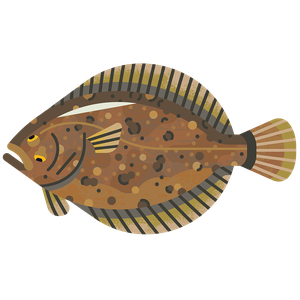
Atlantic halibut, the largest of all flat fishes, is a thick-set, right-eyed (both eyes on the right-hand side of the body) flat fish in the family Pleuronectidae. It is distributed throughout the north Atlantic, particularly Norway, Faroes, Iceland and southern Greenland, but occurs as far south as Maine in north America and the Bay of Biscay in Europe. It can attain a length of 4.7m and more than 300kg, but it is considered slow growing in the wild. Spawning occurs during winter and early spring. Atlantic halibut become sexually mature at 10-14 years, at around 1.4m in length. The oldest recorded halibut has been 55years of age yet models indicate that they could live for nearly 100years! It has been a heavily targeted fishery for more than 100 years and with slow growth rates, high age at maturity and a population doubling time of around 14 years, is highly susceptible to overfishing. IUCN list Atlantic halibut as Endangered (1996) and the species appears on the US National Marine Fisheries Service list of species of concern. Additionally the Project Inshore Phase II Report (2013) noted that under the MSC Risk Based Framework, the species was ranked as the 6th most susceptible species, behind some sharks and rays.
Ratings
Showing 7 results for Atlantic halibut
Best Choice
OK - Needs Improvement
Avoid
Under review
Norway - Wild-caught
Location: All areas
Capture methods: Bottom trawl (otter)
Northeast Atlantic halibut is a data-limited species. Available data indicates increasing catch levels, leading to concern for fishing pressure. There is also concern for biomass. Management of Atlantic halibut in this region remains minimal. Without significant improvements in understanding stock status, effective management cannot be implemented. While a minimum landing size is in place, it is below maturity estimates. Otter trawls are likely to cause some damage to the seabed. Bycatch in otter trawling is moderate and may include some vulnerable species.This rating does not include fisheries in the Northwest Atlantic where some well-managed Marine Stewardship Council certified fisheries are in place.Rating last updated December 2025.
Norway - Wild-caught
Location: All areas
Capture methods: Net (gill or fixed)
Northeast Atlantic halibut is a data-limited species. Available data indicates increasing catch levels, leading to concern for fishing pressure. There is also concern for biomass. Management of Atlantic halibut in this region remains minimal. Without significant improvements in understanding stock status, effective management cannot be implemented. While a minimum landing size is in place, it is below maturity estimates. Gillnets in this area can encounter bycatch of marine mammals, elasmobranchs, and seabirds, including Endangered, Threatened, or Protected (ETP) species. However, impacts to the seafloor are minimal.This rating does not include fisheries in the Northwest Atlantic where some well-managed Marine Stewardship Council certified fisheries are in place.Rating last updated December 2025.
Norway - Wild-caught
Location: All areas
Capture methods: Hook & line (longline)
Northeast Atlantic halibut is a data-limited species. Available data indicates increasing catch levels, leading to concern for fishing pressure. There is also concern for biomass. Management of Atlantic halibut in this region remains minimal. Without significant improvements in understanding stock status, effective management cannot be implemented. While a minimum landing size is in place, it is below maturity estimates. Longlining can have minimal impact on the seabed when set correctly. However, there is risk of non-target fish, seabird, and elasmobranch bycatch.This rating does not include fisheries in the Northwest Atlantic where some well-managed Marine Stewardship Council certified fisheries are in place.Rating last updated December 2025.
Northeast Atlantic - Wild-caught
Location: All areas
Capture methods: Bottom trawl (otter)
Northeast Atlantic halibut is a data limited species, leading to concern for fishing pressure. There is also concern for biomass due to the lack of data, and an indication of recruitment failure within the region. Management of Atlantic halibut in this region remains minimal. Without significant improvements in understanding stock status, effective management cannot be implemented. While no quotas are in place, directed fishing of Atlantic halibut is prohibited in Iceland. Otter trawls are likely to cause some damage to the seabed. Bycatch in otter trawling is moderate and may include some vulnerable species.This rating does not include fisheries in the Northwest Atlantic where some well-managed Marine Stewardship Council certified fisheries are in place.Rating last updated December 2025.
Northeast Atlantic - Wild-caught
Location: All areas
Capture methods: Net (gill or fixed)
Northeast Atlantic halibut is a data limited species, leading to concern for fishing pressure. There is also concern for biomass due to the lack of data, and an indication of recruitment failure within the region. Management of Atlantic halibut in this region remains minimal. Without significant improvements in understanding stock status, effective management cannot be implemented. While no quotas are in place, directed fishing of Atlantic halibut is prohibited in Iceland. Gillnets in this area can encounter bycatch of marine mammals, elasmobranchs, and seabirds, including Endangered, Threatened, or Protected (ETP) species. However, impacts to the seafloor are minimal.This rating does not include fisheries in the Northwest Atlantic where some well-managed Marine Stewardship Council certified fisheries are in place.Rating last updated December 2025.
Farmed
Location: All areas
Production method: Open net pen, marine
Certifications: GLOBALG.A.P.
The GLOBALG.A.P. feed standard requires the majority of feed ingredients to be responsibly sourced. However, Atlantic halibut has a large dependency on wild fish in its diet. Halibut farming in marine pens can have negative environmental impacts, however, these impacts are reduced by the GLOBALG.A.P. standard. GLOBALG.A.P. also has criteria in place to ensure animal welfare and humane slaughter. Norway has a comprehensive range of regulations in place for the aquaculture industry, including a Marine Spatial Planning Programme.This rating is based on full compliance with certification requirements. Commercial buyers should therefore ensure that full compliance has been achieved in order for this rating to be applicable.Rating last updated May 2024.
Farmed
Location: Scotland
Production method: Tanks, flow through
Atlantic halibut is farmed in small quantities in the UK. Unlike salmon and cod, halibut can be farmed in flow through tanks where there is a very low environmental impact. Halibut do depend on fish to form part of their diet and while the feed used in the UK is thought to be responsibly sourced and based on bycatch and trimmings, this has not been verified. Practices are in place to ensure high levels of animal welfare, including humane slaughter. There are regulations and management in place, but no 3rd party certification.Rating last updated June 2022.
Sustainable swaps
Atlantic halibut
Quickly check the sustainability of your fish or seafood with our step-by-step tool.
Find your fish or seafoodLearn more about how we calculate our sustainability ratings.
How our ratings work