

Good Fish Guide
Atlantic salmon
(Salmo salar)
Overview
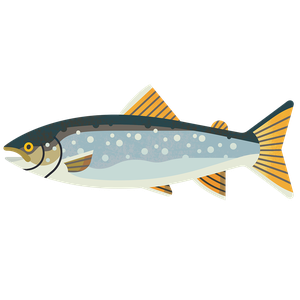
The Atlantic salmon is one of 4 species of salmonids indigenous to European waters. Salmon move between fresh and seawater during their lifecycle. This is referred to as being "anadromous". They spend most of their lives in fresh water and are termed benthopelagic. Atlantic salmon matures at a length of around 73 cm. Maximum length for males is 150 cm, 120 cm for females. Maximum reported age is 13 years, but most individuals only reach 4-6 years. Adult fish return to their birth or natal river from January until November and spawn in late Autumn/early Winter. The eggs, which are laid in nests termed "redds", hatch in April to May and are called alevins. Young fish, which are known firstly as fry and later as parr as they mature, remain in fresh water for 1 to 6 years, then migrate to coastal marine waters, or even the open oceans, between April and May. They have undergone a physiological change to enable them to live at sea and are now termed smolts. Adult salmon return to spawn after spending up to 4 years at sea. Many die after spawning but a number survive to spawn a second or third time. The mechanism by which salmon navigate with such precision back to their birth or natal river to spawn is not fully understood. In the ocean, the earth's magnetic field and the stars may be important. When the salmon reach coastal waters, smell and taste allow precise homing to their river of birth. One of the key biological differences between Atlantic salmon (Salmo) and Pacific salmon (Onchorynchus) is that Atlantic salmon are iteroparous, that is, they do not die after returning to spawn in the rivers in which they hatch. Pacific salmon, and other members of the Onchorynchus genus on the other hand, are referred to as being semelparous, with mature members of the population generally dying within a few days or weeks of spawning.
Ratings
Showing 12 results for Atlantic salmon
Best Choice
OK - Needs Improvement
Avoid
Wild-caught
Location: All rivers not classified as 'Not at risk' by the Environment Agency
Method: Net (drift), Net (gill or fixed)
More infoNE Atlantic (England and Wales) - Wild-caught
Location: All rivers not classified as 'Not at risk' by the Environment Agency
Capture methods: Net (drift), Net (gill or fixed)
Wild Atlantic salmon stocks are depleted over much of their range. The status of individual river stocks in England and Wales is evaluated annually against stock conservation limits (CLs) and management targets (MTs) in line with the requirements of ICES and NASCO. In 2022, just 16% rivers were assessed as meeting their CL, joint lowest in the time series. ICES advises that when the MSY approach is applied, fishing should only take place on salmon from rivers where stocks have been shown to be at full reproductive capacity. Regulatory provisions approved for England in 2018 include the closure of most net fisheries including all driftnet fisheries and mandatory release of salmon caught in net fisheries authorised to operate for sea trout.This rating applies to all rivers not classified as 'Not at risk' by the [Environment Agency](https://www.gov.uk/government/publications/fisheries-annual-report-2021-to-2022).Rating last updated June 2023.
Wild-caught
Location: Rivers listed as Grade 2 or 3 by Marine Scotland
Method: Net (drift), Net (gill or fixed)
More infoNE Atlantic (Scotland) - Wild-caught
Location: Rivers listed as Grade 2 or 3 by Marine Scotland
Capture methods: Net (drift), Net (gill or fixed)
Wild Atlantic salmon stocks are depleted over much of their range. In Scotland, each year, Marine Scotland carry out an assessment of the conservation status of each river. ICES advises that when the MSY approach is applied, fishing should only take place on salmon from rivers where stocks have been shown to be at full reproductive capacity. The Scottish Government has identified 12 high level pressures impacting salmon in Scotland and further afield. Management measures in place to protect declining stocks include prohibiting the retention of salmon caught in coastal waters and the requirement of mandatory catch-and-release of Atlantic salmon in areas which fall below their defined conservation level.This rating applies to rivers listed as Grade 2 or 3 by Marine Scotland.Rating last updated June 2023.
Wild-caught
Location: All areas and all rivers not achieving conservation limits
Method: Net (drift), Net (gill or fixed)
More infoNE Atlantic - Wild-caught
Location: All areas and all rivers not achieving conservation limits
Capture methods: Net (drift), Net (gill or fixed)
Wild Atlantic salmon stocks across the North Atlantic remain at historically low levels. This is despite restrictive management measures and reductions in fisheries and exploitation rates. Due to the Atlantic salmons oceanic migrations, international cooperation is essential to its conservation, restoration and rational management. ICES advises that when the MSY approach is applied, fishing should only take place on salmon from rivers where stocks have been shown to be at full reproductive capacity. High seas and coastal drift netting captures large numbers of fish as they return to rivers to spawn.Rating last updated June 2023.
Under review
Farmed
Location: Scotland
Production method: Open net pen, marine
Atlantic salmon in Scotland are farmed in open net pens in the sea. Producing fish in open systems can cause environmental impacts such as: impacts of chemical and sea lice treatment usage; nutrient and organic waste deposition; outbreaks of disease; impacts on wild salmonids by transmission of sea lice, and escapes from farms. Salmon are carnivorous fish and rely on wild capture fisheries to produce their feed, Marine Conservation Society would like to see all these fish certified as sustainably managed. Due to the lack of data in relation to some of the environmental impacts of salmon farming, MCS is advocating a halt in industry expansion using existing practices until more evidence is available.Rating last updated April 2023.
Farmed
Location: All areas
Production method: Open net pen, marine
Atlantic salmon in Norway are farmed in open net pens in the sea. Producing fish in open systems can cause environmental impacts such as: impacts of chemical and sea lice treatment usage; nutrient and organic waste deposition; outbreaks of disease; impacts on wild salmonids by transmission of sea lice, and escapes from farms. Salmon are carnivorous fish and rely on wild capture fisheries to produce their feed, Marine Conservation Society would like to see all these fish certified as sustainably managed. Due to the lack of data in relation to some of the environmental impacts of salmon farming, MCS is advocating a halt in industry expansion using existing practices until more evidence is available. Rating last updated May 2023.
Farmed
Location: All areas, All areas, Scotland
Method: Open net pen, marine
Certification: GLOBALG.A.P.
More infoFarmed
Location: All areas, All areas, Scotland
Production method: Open net pen, marine
Certifications: GLOBALG.A.P.
Atlantic salmon are farmed in open net pens in the sea. Producing fish in open systems can cause environmental impacts. The GLOBALG.A.P. standard mitigates many areas of environmental concern, including discharge of effluents, use of chemicals, escapes, disease and parasite interactions. However, lethal control of predators is permitted. The GLOBALG.A.P. standard has criteria in place for welfare and humane slaughter. The GLOBALG.A.P. feed standard has criteria that requires reporting on the amount of responsibly sourced ingredients but no requirement for their percentage inclusion. Due to the lack of data in relation to some of the environmental impacts of salmon farming, MCS is advocating a halt in industry expansion using existing practices until more evidence is available.This rating is based on full compliance with certification requirements. Commercial buyers should therefore ensure that full compliance has been achieved in order for this rating to be applicable. Rating last updated April 2023.
Farmed
Location: All areas, Scotland
Production method: Open net pen, marine
Certifications: Organic
Atlantic salmon are farmed in open net pens in the sea. Producing fish in open systems can cause environmental impacts. Organic Certification Standards set comprehensive standards to help mitigate environmental concerns, including discharge of effluents, limited use of chemicals, escapes, disease and parasite interactions. Feed must be preferentially produced from off-cuts and by-products of human consumption fisheries which ensures that organic farmed salmon are a net producer of fish protein. All terrestrial feed ingredients must be organically certified which ensures their responsible sourcing.This rating is based on full compliance with certification requirements. Commercial buyers should therefore ensure that full compliance has been achieved in order for this rating to be applicable.Rating last updated January 2023.
Farmed
Location: All areas, Scotland
Method: Open net pen, marine
Certification: Global Seafood Alliance Best Aquaculture Practices (GAA BAP) 3*, Global Seafood Alliance Best Aquaculture Practices (GAA BAP) 4*
More infoFarmed
Location: All areas, Scotland
Production method: Open net pen, marine
Certifications: Global Seafood Alliance Best Aquaculture Practices (GAA BAP) 3*, Global Seafood Alliance Best Aquaculture Practices (GAA BAP) 4*
Atlantic salmon are farmed in open net pens in the sea. Producing fish in open systems can cause environmental impacts. The Global Seafood Alliance (GSA) Best Aquaculture Practices (BAP) standard addresses many areas of environmental concern including discharge of effluents, use of chemicals, escapes, disease and parasite interactions. However, lethal control of predators is permitted. There are also criteria in place covering welfare and humane slaughter. Criteria on responsible feed sourcing requires it to be traceable, however, sourcing of marine ingredients is not verified via audit and BAP certified salmon can use a high quantity of wild caught fish in their diet. Due to the lack of data in relation to some of the environmental impacts of salmon farming, MCS is advocating a halt in industry expansion using existing practices until more evidence is available. This rating is based on full compliance with certification requirements. Commercial buyers should therefore ensure that full compliance has been achieved in order for this rating to be applicable.Rating last updated February 2023.
Farmed
Location: All areas
Production method: Open net pen, marine
Atlantic salmon is Chile are farmed in open net pens in the sea. Producing fish in open systems can cause environmental impacts such as: impacts of chemical and sea lice treatment usage; nutrient and organic waste deposition; outbreaks of disease; impacts on wild salmonids by transmission of sea lice, and escapes from farms. In Chile, the regulation and management of the aquaculture industry is poor in relation to other salmon producing countries. There is also a lack of evidence of welfare measures in place. Salmon are carnivorous fish and rely on wild capture fisheries to produce their feed, MCS would like to see all these fish certified as sustainably managed. Due to the ongoing nature of as yet unresolved environmental impacts of salmon farming MCS is advocating a halt in industry expansion using existing practices until these can be resolved.Rating last updated May 2023.
Farmed
Location: All areas
Production method: Open net pen, marine
Atlantic salmon in the Faroe Islands are farmed in open net pens in the sea. Producing fish in open systems can cause environmental impacts such as: impacts of chemical and sea lice treatment usage; nutrient and organic waste deposition; outbreaks of disease; impacts on wild salmonids by transmission of sea lice, and escapes from farms. However, in the Faroe Islands, there are low levels of pathogens and sea lice are effectively managed. Salmon are carnivorous fish and rely on wild capture fisheries to produce their feed, MCS would like to see all these fish certified as sustainably managed. Due to the lack of data in relation to some of the environmental impacts of salmon farming, MCS is advocating a halt in industry expansion using existing practices until more evidence is available.Rating last updated May 2023.
Farmed
Location: All areas, All areas, Scotland
Method: Open net pen, marine
Certification: Aquaculture Stewardship Council (ASC)
More infoFarmed
Location: All areas, All areas, Scotland
Production method: Open net pen, marine
Certifications: Aquaculture Stewardship Council (ASC)
Atlantic salmon are farmed in open net pens in the sea. Producing fish in open systems can cause environmental impacts. The ASC standard mitigates many areas of environmental concern, including discharge of effluents, use of chemicals, escapes, disease and parasite interactions. ASC certified salmon is also well managed and management is thought to be fully effective. However, at present, sourcing of marine ingredients is not verified via audit, but the interim feed standard ensures traceability.This rating is based on full compliance with certification requirements. Commercial buyers should therefore ensure that full compliance has been achieved in order for this rating to be applicable.Rating last updated February 2023.
Farmed
Location: All areas
Production method: Closed system, RAS
Atlantic salmon farmed in Recirculating Aquaculture Systems (RAS) have little environmental impact, operating on land and closed off from the natural environment. Salmon are carnivorous fish and rely on wild capture fisheries to produce their feed, MCS would like to see all these fish certified as sustainably managed. Due to the inherent design of RAS facilities and the ability to apply strict bio-security measures, salmon production does not really on chemical use. There is negligible concern about the impact of effluents, disease risks, parasite interaction or escapes. Farmed salmon populations are sourced from hatchery-reared broodstock as opposed to wild-caught individuals, and facilities encompass a nursery.Rating last updated April 2020.
Sustainable swaps
Atlantic salmon
Quickly check the sustainability of your fish or seafood with our step-by-step tool.
Find your fish or seafoodLearn more about how we calculate our sustainability ratings.
How our ratings work
