Good Fish Guide
Blue mussel
(Mytilus edulis)
Overview
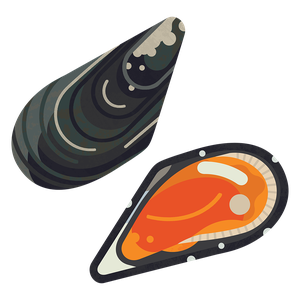
Common mussels are bivalve molluscs found on shores throughout the north Atlantic, Mediterranean, North and Baltic Seas. They normally live in large aggregations, attaching themselves to rocks and each other with sticky threads known as byssus. They can be found from the high intertidal zone to the shallow subtidal zone. Found on the rocky shores of open coasts attached to the rock surface and in crevices, and on rocks and piers in sheltered harbours and estuaries, often occurring as dense masses. The shell roughly triangular in outline. Size and shape vary considerably with environmental conditions, the colour usually purple or blue but sometimes brown. Shell smooth with a sculpturing of concentric lines but no radiating ribs. The ligament is inconspicuous. Length varies, specimens usually ranging from 5 -10 cm although some populations never attain more than 2-3 cm, and the largest specimens may reach 15 -20 cm. Mussels mature when one year old and may live 10-15 years or more. The breeding season is between April and September, with larvae settling after 1-6 months. Distribution: Very common all around the coast of the British Isles, with large commercial beds in the Wash, Morecambe Bay, Conway Bay and the estuaries of south-west England, north Wales, and west Scotland. Typically feeds on bacteria, phytoplankton, detritus, and dissolved organic matter (DOM).
Ratings
Showing 6 results for Blue mussel