Good Fish Guide
Brill
(Scophthalmus rhombus)
Overview
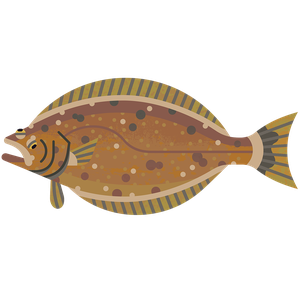
Brill, like turbot, belongs to the family Scophthalmidae, a group of left-eyed flatfish (they lie on their right side and both eyes are on the left). Similarly, brill are distributed from southern Iceland, down the coast of western Europe, including the Baltic, and into the Mediterranean and Black Seas. Brill is a shallow-water fish (between 5 - 70m) mainly found in areas close inshore and even in estuaries. Mature fish tend to inhabit offshore areas and are rarely observed inshore. Brill prefer sandy bottoms, but are also found on gravel and muddy grounds. They can attain a length of 75cm, but usually no more than 55cm, and a weight of around 2.5kg for females (which are larger). Length at first maturity is 33-40cm, with females fully mature at about 4 years and 40cm. Maximum reported age is 6 years. They spawn in spring and summer. Larger brill (> 40cm) are primarily piscivorous. Small brill feed on small benthic fishes, sandeels, gobies, anchovy, and crabs; with increasing length the diet moves to small gadoids. Brill grows relatively fast and generally reaches a certain length faster (at younger ages) than other flatfish, such as sole and plaice, in the same areas.
Ratings
Showing 9 results for Brill
Best Choice
OK - Needs Improvement
Avoid
Under review
North Sea, Skagerrak and Kattegat, English Channel - Wild-caught
Location: All areas
Capture methods: Bottom trawl (beam)
Brill in this area is not in an overfished state and not subject to overfishing. Management of turbot and brill is under a combined species Total Allowable Catch (TAC) which prevents effective control of the single-species exploitation rates. Despite this, catches of brill in recent years have been below the recommended level. Beam trawls have significant impacts on the seabed, including damage to benthic communities and vulnerable marine habitats. They can also have high bycatch, potentially of vulnerable species.Rating last updated July 2023.
North Sea, Skagerrak and Kattegat, English Channel - Wild-caught
Location: All areas
Capture methods: Net (gill or fixed)
Brill in this area is not in an overfished state and not subject to overfishing. Management of turbot and brill is under a combined species Total Allowable Catch (TAC) which prevents effective control of the single-species exploitation rates. Despite this, catches of brill in recent years have been below the recommended level. Whilst gill net fisheries can be very selective with regards to targeted fish species, they can encounter bycatch of vulnerable species including porpoise, sharks and seabirds. Bycatch of harbour porpoise in the North Sea is not considered to be a threat to the population, but localised depletion may be an issue in some areas.Rating last updated July 2023.
North Sea, Skagerrak and Kattegat, English Channel - Wild-caught
Location: All areas
Capture methods: Bottom trawl (otter)
Brill in this area is not in an overfished state and not subject to overfishing. Management of turbot and brill is under a combined species Total Allowable Catch (TAC) which prevents effective control of the single-species exploitation rates. Despite this, catches of brill in recent years have been below the recommended level. Otter trawling is likely to cause some damage to the seabed. Bycatch is moderate and may include vulnerable species such as blue and flapper skate.Rating last updated July 2023.
North Sea, Skagerrak and Kattegat, English Channel - Wild-caught
Location: Cornwall IFCA District (0-6nm)
Capture methods: Bottom trawl (beam)
For more information about this rating please visit: https://www.cornwallgoodseafoodguide.org.uk/fish-guide/brill.php
North Sea, Skagerrak and Kattegat, English Channel - Wild-caught
Location: Cornwall IFCA District (0-6nm)
Capture methods: Net (gill or fixed)
For more information about this rating please visit: https://www.cornwallgoodseafoodguide.org.uk/fish-guide/brill.php
North Sea, Skagerrak and Kattegat, English Channel - Wild-caught
Location: Cornwall IFCA District (0-6nm)
Capture methods: Bottom trawl (otter)
For more information about this rating please visit: https://www.cornwallgoodseafoodguide.org.uk/fish-guide/brill.php
Celtic Sea, Bristol Channel - Wild-caught
Location: Cornwall
Capture methods: Bottom trawl (beam)
For more information about this rating please visit: https://www.cornwallgoodseafoodguide.org.uk/fish-guide/brill.php
Celtic Sea, Bristol Channel - Wild-caught
Location: Cornwall
Capture methods: Bottom trawl (otter)
For more information about this rating please visit: https://www.cornwallgoodseafoodguide.org.uk/fish-guide/brill.php
Celtic Sea, Bristol Channel - Wild-caught
Location: Cornwall
Capture methods: Net (gill or fixed)
For more information about this rating please visit: https://www.cornwallgoodseafoodguide.org.uk/fish-guide/brill.php
Sustainable swaps
Brill
Quickly check the sustainability of your fish or seafood with our step-by-step tool.
Find your fish or seafoodLearn more about how we calculate our sustainability ratings.
How our ratings work