

Good Fish Guide
King prawn
(Litopenaeus vannamei)
Also known as: Whiteleg shrimp, Whiteleg prawn
Overview
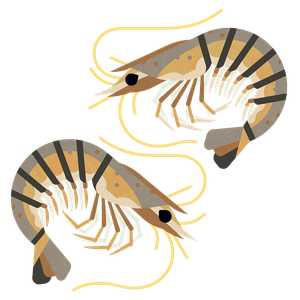
The king prawn (or whiteleg prawn, white shrimp) belongs to the largest of the prawn and shrimp family, the Penaeidae. It is a native species of the Eastern Pacific coast. Its lifecycle may be divided into 6 stages or phases, from embryo to adult, which it completes in one year. The age of sexual maturity varies from 5 to 7 months. They can live up to 2 years in the wild although farmed prawns are usually harvested at 6 months.
Ratings
Showing 8 results for King prawn
Best Choice
OK - Needs Improvement
Avoid
Under review
Farmed
Location: All Areas, All Areas
Production method: Pond, semi-intensive
Production of King prawns (L. vannamei) in Ecuador and Honduras relies upon both marine and terrestrial feed ingredients in commercial feeds produced by well-established, global feed companies. The environmental impacts are well managed and mangrove destruction for the construction of prawn ponds is no longer taking place in Ecuador and Honduras. Chemical usage is also minimal, as are effluent outputs, and surrounding prawn populations are not impacted by disease or escapes. However, there is a lack of data on welfare and humane slaughter practices. Management and regulation of the sector also needs to be better resourced to ensure effectiveness and environmental impact assessments should be required for small farms, as well as large, to account for cumulative impacts.Rating last updated January 2025.
Farmed
Location: All areas
Production method: Pond, freshwater
Certifications: GLOBALG.A.P.
GLOBALG.A.P. farmed prawns are well managed and management is thought to be fully effective. The Aquaculture standard has criteria in place for welfare and humane slaughter. It also mitigates many areas of environmental concern in prawn farming, including freshwater depletion, habitat alteration, discharge of effluents, chemical usage, escapes and disease and parasite interactions.This rating is based on full compliance with certification requirements. Commercial buyers should therefore ensure that full compliance has been achieved in order for this rating to be applicable.Rating last updated: October 2024
Farmed
Location: All areas
Method: Pond, freshwater
Certification: Global Seafood Alliance Best Aquaculture Practices (GAA BAP) 2*, Global Seafood Alliance Best Aquaculture Practices (GAA BAP) 3*
More infoFarmed
Location: All areas
Production method: Pond, freshwater
Certifications: Global Seafood Alliance Best Aquaculture Practices (GAA BAP) 2*, Global Seafood Alliance Best Aquaculture Practices (GAA BAP) 3*
King prawns certified by the Global Seafood Alliance (GSA), formerly Global Aquaculture Alliance (GAA), Best Aquaculture Practices (BAP) are managed well and the Farm Standard mitigates many areas of environmental concern in prawn farming, including freshwater depletion, habitat alteration, discharge of effluents, chemical usage, escapes and disease and parasite interactions. The Farm Standard also has criteria in place to ensure animal welfare and humane slaughter. A 4* rating ensures compliance with the BAP Feed Mill Standard. However, there are still improvements that could be made, including the addition of a mandatory Environmental Impact Assessment, and increasing the percentage inclusion of responsible feed ingredients. This rating is based on full compliance with certification requirements. Commercial buyers should therefore ensure that full compliance has been achieved in order for this rating to be applicable.Rating last updated December 2024.
Farmed
Location: All Areas, All Areas
Method: Pond, semi-intensive
Certification: EU Organic, Soil Association
More infoFarmed
Location: All Areas, All Areas
Production method: Pond, semi-intensive
Certifications: EU Organic, Soil Association
Organic King prawns (L. vannamei) from Ecuador and Honduras rely on traceable, responsible terrestrial feed ingredients, and the marine component of the feed includes trimmings, although whole fish can also be used. Organic certification ensures best practices and guidelines are in place for animal welfare and humane slaughter and also mitigates many areas of environmental concern. The production of Organic King prawn does not allow the destruction of mangroves for pond construction, pond discharges are low and only minimal chemical treatments are used, if at all and all juveniles are hatchery based. Surrounding wild shrimp populations are also not impacted by disease or escapes from farms. However, there are still improvements that could be made. Lethal control of predators may still be used and Environmental Impact Assessments are not in place for smaller farms. Management and regulation of the aquaculture sector, while comprehensive, still needs to be better resourced to ensure effectiveness.This rating is based on full compliance with certification requirements. Commercial buyers should therefore ensure that full compliance has been achieved in order for this rating to be applicable.Rating last updated: October 2021
Farmed
Location: All Areas, All Areas, All areas
Method: Pond, intensive, Pond, semi-intensive
More infoFarmed
Location: All Areas, All Areas, All areas
Production method: Pond, intensive, Pond, semi-intensive
There are many areas of environmental concern in King prawn aquaculture in India, Vietnam and Indonesia. This includes the use of illegal chemicals, including antibiotics, salinisation of soil and freshwater, and discharges into the environment. Supplementary feed is used in intensive and semi-intensive systems, however, there is little transparency of the ingredients used and no requirements for responsible feed sourcing. It’s also not known if there are any welfare regulations in place and management for the aquaculture sector in India, Vietnam and Indonesia is thought to be only partially effective in mitigating negative environmental impacts.Rating last updated January 2025.
Farmed
Location: All areas
Method: Pond, freshwater
Certification: Aquaculture Stewardship Council (ASC)
More infoFarmed
Location: All areas
Production method: Pond, freshwater
Certifications: Aquaculture Stewardship Council (ASC)
ASC farmed King prawns are well managed and management is thought to be fully effective. The standard mitigates many areas of environmental concern in prawn farming, including freshwater depletion, habitat alteration, discharge of effluents, chemical usage, escapes and disease and parasite interactions. However, there are still improvements that could be made. Criteria on sustainable feed still refers to the interim solution, with requirements for responsible ingredient sourcing lacking, these will be introduced with the new feed mill standard. Criteria on animal welfare is also lacking, with no requirements for humane slaughter.This rating is based on full compliance with certification requirements. Commercial buyers should therefore ensure that full compliance has been achieved in order for this rating to be applicable.Rating last updated December 2024.
Farmed
Location: All areas
Method: Pond, freshwater
Certification: Global Seafood Alliance Best Aquaculture Practices (GAA BAP) 4*
More infoFarmed
Location: All areas
Production method: Pond, freshwater
Certifications: Global Seafood Alliance Best Aquaculture Practices (GAA BAP) 4*
King prawns certified by the Global Seafood Alliance (GSA), formerly Global Aquaculture Alliance (GAA), Best Aquaculture Practices (BAP) are managed well and the Farm Standard mitigates many areas of environmental concern in prawn farming, including freshwater depletion, habitat alteration, discharge of effluents, chemical usage, escapes and disease and parasite interactions. The Farm Standard also has criteria in place to ensure animal welfare and humane slaughter. A 4* rating ensures compliance with the BAP Feed Mill Standard. However, there are still improvements that could be made, including the addition of a mandatory Environmental Impact Assessment, and increasing the percentage inclusion of responsible feed ingredients. This rating is based on full compliance with certification requirements. Commercial buyers should therefore ensure that full compliance has been achieved in order for this rating to be applicable.Rating last updated December 2024.
Farmed
Location: All areas, Scotland
Production method: Closed system, RAS
King prawns farmed in UK recirculating aquaculture systems are a good choice. They have relatively low requirements for fishmeal and fish oil. Being that RAS is a closed-loop system, there is minimal environmental impact, or risk of escapes, disease, and predator interactions. Although currently at low production volumes, this method is well regulated and managed, but remains uncertified.Rating last updated November 2025.
Sustainable swaps
Whiteleg shrimp
Whiteleg prawn
Quickly check the sustainability of your fish or seafood with our step-by-step tool.
Find your fish or seafoodLearn more about how we calculate our sustainability ratings.
How our ratings work
