Good Fish Guide
Native oyster
(Ostrea edulis)
Also known as: European oyster, Flat oyster
Overview
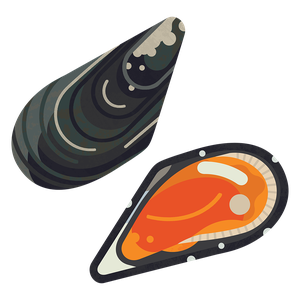
The native or flat oyster is a filter feeding, bivalve mollusc. They live on the seabed in relatively shallow coastal waters and estuaries (from the lower shore to 80m). They prefer habitats sheltered from strong wave action which tend to be muddy but require something hard for larval settlement - usually shells or stones. All native oysters start out as males, and throughout their lives change back and forth from male to female. In Britain, breeding normally takes place in the summer. It reaches maturity at about 3 years old. The average reproductive size for the oyster is about 5 cm. Oysters can reach a shell length of up to 11cm, and occur in variable shapes. Native oysters have a rough shell that is yellow, pale green or brown in colour, sometimes with bluish, pink or purple markings. The two halves of a native oyster' s shell are different shapes. The left shell is deeply concave and fixed to the substratum, the right being flat with rougher edges and sitting inside the left acting as a lid. Inner surfaces of both valves or shells are smooth and usually pearly, white or bluish-grey, often with darker blue areas. The shell shape is a good way to distinguish native oysters from Pacific oysters, which were introduced to the UK in 1926, and which compete with the native oyster for space and food. Native oysters have rounder shells with smoother edges, while their Pacific relatives have a more elongated shell with deeply grooved edges. A single female oyster can produce 2 million eggs. Although usually up to about 11cm long, native oysters can grow to more than 20cm and can live as long as 20 years.
Ratings
Showing 4 results for Native oyster