Good Fish Guide
Spider crab
(Maja squinado)
Also known as: Maja brachydactyla
Overview
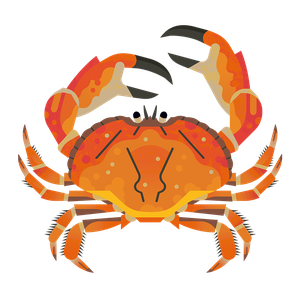
Spider crabs are generally only to be found on southern and western coasts of the UK, although there are increasing reports of commercial quantities of spider crabs occurring in Wales, Ireland and the Isle of Man. It is the largest crab found in British waters, with a carapace width of up to 20 cm and a leg span of 50 cm or more. Spider crabs inhabit coarse sand mixed grounds and open bedrock from the shallow sublittoral zone to a depth of 120 m, although highest densities occur between 0 and 70 m. Large migrations of spider crabs occur during the early spring when they move into shallower water to spawn. Female crabs become berried (egg-bearing) from April onwards, and by June all mature females are berried. Hatching occurs from July until November, following which the crabs migrate back to deeper water. It has a juvenile phase of up to three years, which is spent in shallow water close to the coast, with a predominance of small male spider crabs on rockier areas. A number of moults take place resulting in increases in size of up to 33% per moult, with males generally having the greatest increases in size. Males have an additional moult to the females, during which their chelipeds (claw bearing legs) reach their final size relative to the body. After the final, or terminal, moult occurs, M. squinado becomes fully mature and enters the adult phase of its life cycle when it starts breeding. After this terminal moult, the spider crab will not grow any larger, unlike edible crabs which will continue to grow throughout most of their life. This makes ageing of spider crabs very problematic, as individuals of the same age may be of different sizes. Carapace widths for mature adults are from 8.5 -20 cm for males and 7-17.5 cm for females. Spider crabs are known to congregate in large numbers and form mounds.
Ratings
Showing 6 results for Spider crab