Good Fish Guide
Thornback ray
(Raja clavata)
Also known as: Roker
Overview
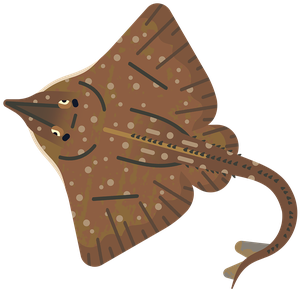
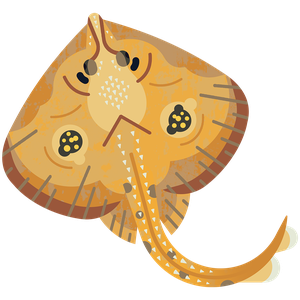
Thornback rays or roker are an inshore to slope species, belonging to the Rajidae family of skates and rays. Thornback rays have been described as showing philopatric behaviour (tendency of a migrating animal to return to a specific location in order to breed or feed). Females can grow to 118cm in length and 18kg in weight, while males can reach 98cm in length. Females mature between 60 and 85cm while males mature between 60 and 77cm (in both cases corresponding to an age of 5 to 10 years). The species has a maximum recorded age of 16 years. There are 13 species of ray and skate Rajidae and 7 to 8 demersal shark species in the North Sea ecoregion.
Ratings
Showing 14 results for Thornback ray
Best Choice
OK - Needs Improvement
Avoid
Under review
North Sea, Skagerrak, Kattegat and Eastern English Channel - Wild-caught
Location: All areas
Capture methods: Bottom trawl (otter)
The population of thornback ray in the North Sea, Skagerrak, Kattegat, and Eastern English Channel is above target levels, and fishing is within sustainable limits. Thornback ray is a vulnerable species and management needs to be more precautionary. There is currently no specific management plan in place for skates and rays in these waters, although it is a prohibited species in Skagerrak and Kattegat. Thornback are managed under a joint TAC for skates and rays which is not considered to be a suitable management method and better protection is needed. Demersal otter trawling is likely to cause some damage to the seabed and bycatch may include vulnerable species.Rating last updated October 2023.
North Sea, Skagerrak, Kattegat and Eastern English Channel - Wild-caught
Location: All areas
Capture methods: Bottom trawl (beam)
The population of thornback ray in the North Sea, Skagerrak, Kattegat, and Eastern English Channel is above target levels, and fishing is within sustainable limits. Thornback ray is a vulnerable species and management needs to be more precautionary. There is currently no specific management plan in place for skates and rays in these waters, although it is a prohibited species in Skagerrak and Kattegat. Thornback are managed under a joint TAC for skates and rays which is not considered to be a suitable management method and better protection is needed. Beam trawls have significant impact on the seabed, including damage to benthic communities and vulnerable marine habitats. Bycatch can be high and may include vulnerable species.Rating last updated October 2023.
North Sea, Skagerrak, Kattegat and Eastern English Channel - Wild-caught
Location: All areas
Capture methods: Net (gill or fixed)
The population of thornback ray in the North Sea, Skagerrak, Kattegat, and Eastern English Channel is above target levels, and fishing is within sustainable limits. Thornback ray is a vulnerable species and management needs to be more precautionary. There is currently no specific management plan in place for skates and rays in these waters, although it is a prohibited species in Skagerrak and Kattegat. Thornback are managed under a joint TAC for skates and rays which is not considered to be a suitable management method and better protection is needed. Gillnets can be very size selective for the target fish but can be unselective at the species level for both non-target fish and for mammals, birds and turtles.Rating last updated October 2023.
Western English Channel - Wild-caught
Location: All areas
Capture methods: Bottom trawl (otter)
There is concern for the biomass of thornback ray the Western English Channel and concern for fishing pressure. There is no management plan for skates and rays and the joint TAC has been deemed an unsuitable method for protecting individual species. Otter trawling is likely to cause some damage to the seabed. Bycatch is moderate and may include vulnerable species.Rating last updated January 2023.
Western English Channel - Wild-caught
Location: All areas
Capture methods: Bottom trawl (beam)
There is concern for the biomass of thornback ray the Western English Channel and concern for fishing pressure. There is no management plan for skates and rays and the joint TAC has been deemed an unsuitable method for protecting individual species. Beam trawls have significant impacts on the seabed, including damage to benthic communities and vulnerable marine habitats. They can also have high bycatch, potentially of vulnerable species.Rating last updated January 2023.
West of Scotland - Wild-caught
Location: All areas
Capture methods: Bottom trawl (otter)
This stock is data limited. There is concern for fishing pressure, but no concern for biomass. There is currently no specific management plan in place for skates and rays in these waters. They are managed under a joint total allowable catch (TAC) for skates and rays which is not considered to be a suitable management method and better protection is needed. Demersal otter trawling is likely to cause some damage to the seabed and bycatch may include vulnerable species.Rating last updated October 2023.
Irish Sea, Bristol Channel, Celtic Sea North - Wild-caught
Location: All areas
Capture methods: Bottom trawl (beam)
Thornback ray in the Irish Sea, Bristol Channel, and Celtic Sea North is not overfished, or subject to overfishing. There is no management plan for skates and rays and the joint TAC has been deemed an unsuitable method for protecting individual species. Beam trawls have significant impacts on the seabed, including damage to benthic communities and vulnerable marine habitats. They can also have high bycatch, potentially of vulnerable species.Rating last updated January 2023.
Irish Sea, Bristol Channel, Celtic Sea North - Wild-caught
Location: All areas
Capture methods: Bottom trawl (otter)
Thornback ray in the Irish Sea, Bristol Channel, and Celtic Sea North is not overfished, or subject to overfishing. There is no management plan for skates and rays and the joint TAC has been deemed an unsuitable method for protecting individual species. Otter trawling is likely to cause some damage to the seabed. Bycatch is moderate and may include vulnerable species.Rating last updated January 2023.
Wild-caught
Location: Bristol Channel: The North Devon Fishermen's Association (NDFA)
Method: Bottom trawl (beam)
More infoIrish Sea, Bristol Channel, Celtic Sea North - Wild-caught
Location: Bristol Channel: The North Devon Fishermen's Association (NDFA)
Capture methods: Bottom trawl (beam)
Thornback ray in the Irish Sea, Bristol Channel, and Celtic Sea North is not overfished, or subject to overfishing. There is no management plan for skates and rays and the joint TAC has been deemed an unsuitable method for protecting individual species. However, in this area, the North Devon Fishermen's Association have implemented some management measures to help conserve stocks. Beam trawls have significant impacts on the seabed, including damage to benthic communities and vulnerable marine habitats. They can also have high bycatch, potentially of vulnerable species.Rating last updated January 2023.
Wild-caught
Location: Bristol Channel: The North Devon Fishermen's Association (NDFA)
Method: Bottom trawl (otter)
More infoIrish Sea, Bristol Channel, Celtic Sea North - Wild-caught
Location: Bristol Channel: The North Devon Fishermen's Association (NDFA)
Capture methods: Bottom trawl (otter)
Thornback ray in the Irish Sea, Bristol Channel, and Celtic Sea North is not overfished, or subject to overfishing. There is no management plan for skates and rays and the joint TAC has been deemed an unsuitable method for protecting individual species. However, in this area, the North Devon Fishermen's Association have implemented some management measures to help conserve stocks. Otter trawling is likely to cause some damage to the seabed. Bycatch is moderate and may include vulnerable species.Rating last updated January 2023.
Irish Sea, Bristol Channel, Celtic Sea North - Wild-caught
Location: Cornwall
Capture methods: Bottom trawl (otter)
For more information about this rating please visit: http://www.cornwallgoodseafoodguide.org.uk/fish-guide/thornback-ray.php
Irish Sea, Bristol Channel, Celtic Sea North - Wild-caught
Location: Cornwall
Capture methods: Net (gill or fixed)
For more information about this rating please visit: http://www.cornwallgoodseafoodguide.org.uk/fish-guide/thornback-ray.php
Western English Channel - Wild-caught
Location: Cornwall
Capture methods: Bottom trawl (otter)
For more information about this rating please visit: http://www.cornwallgoodseafoodguide.org.uk/fish-guide/thornback-ray.php
Western English Channel - Wild-caught
Location: Cornwall
Capture methods: Net (gill or fixed)
For more information about this rating please visit: http://www.cornwallgoodseafoodguide.org.uk/fish-guide/thornback-ray.php
Sustainable swaps
Roker
Quickly check the sustainability of your fish or seafood with our step-by-step tool.
Find your fish or seafoodLearn more about how we calculate our sustainability ratings.
How our ratings work