Good Fish Guide
Undulate ray
(Raja undulata)
Overview
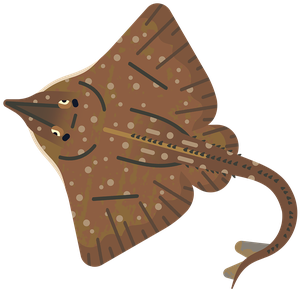
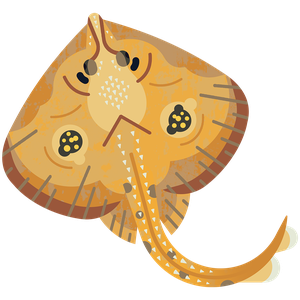
Undulate rays belong to the Rajidae family, which includes most of the skates and rays commonly found in British waters, and sold at fishmongers. The undulate ray is a medium sized shelf species growing to a maximum length of 100 cm and weight of 10 kg. The species has a maximum age of 20 years with size and age at maturity estimated at 75 cm and 9 years for females and 73 cm and 7.5 years for males. Eggs are laid from March to September. Undulate rays are at the northern edge of their range in UK waters. They form discrete populations isolated from other stocks, for example, on the southwest coast of Ireland, with occasional records in the English Channel. They are also present along the south coast of England.
Ratings
Showing 6 results for Undulate ray
Best Choice
OK - Needs Improvement
Avoid
Celtic Sea and west of Scotland - Wild-caught
Location: All areas
Capture methods: Bottom trawl (beam)
Updated: November 2020.This stock is data limited, there is a lack of survey data and a lack of landings data. There is concern for both fishing pressure and biomass. ICES advises that when the precautionary approach is applied, there should be zero catches in each of the years 2021 and 2022. Since 2015, no directed fishery has been allowed to take place under EU regulations and there is no Total Allowable Catch (TAC) for this stock. However, some undulate rays may be caught as bycatch in this are and therefore, it is a critical fail. Undulate ray has also been listed as an endangered species globally and as near threatened in Europe. Beam trawling is one of the least selective and high impact methods of fishing.
Celtic Sea and west of Scotland - Wild-caught
Location: All areas
Capture methods: Bottom trawl (otter)
Updated: November 2020.This stock is data limited, there is a lack of survey data and a lack of landings data. There is concern for both fishing pressure and biomass. ICES advises that when the precautionary approach is applied, there should be zero catches in each of the years 2021 and 2022. Since 2015, no directed fishery has been allowed to take place under EU regulations and there is no Total Allowable Catch (TAC) for this stock. However, some undulate rays may be caught as bycatch in this are and therefore, it is a critical fail. Undulate ray has also been listed as an endangered species globally and as near threatened in Europe. Demersal otter trawls can impact the seabed through abrasion of habitats and can catch endangered, threatened and protected (ETP) species.
Under review
English Channel - Wild-caught
Location: All areas
Capture methods: Bottom trawl (beam)
Undulate ray in the English channel has recovered to a healthy state and is currently being harvested sustainably. The undulate ray fishery in the English Channel has only recently reopened. Multiple management measures are in place, however, it is too soon to know if these measures will be effective. Beam trawls have significant impact on the seabed, including damage to benthic communities and vulnerable marine habitats. Bycatch can be high and may include vulnerable species.Rating last updated October 2023.
English Channel - Wild-caught
Location: All areas
Capture methods: Bottom trawl (otter)
Undulate ray in the English channel has recovered to a healthy state and is currently being harvested sustainably. The undulate ray fishery in the English Channel has only recently reopened. Multiple management measures are in place, however, it is too soon to know if these measures will be effective. Otter trawling is likely to cause some damage to the seabed. Bycatch is moderate and may include vulnerable species.Rating last updated October 2023.For more information about this fishery in Cornwall, see: http://www.cornwallgoodseafoodguide.org.uk/fish-guide/undulate-ray.php
English Channel - Wild-caught
Location: All areas
Capture methods: Net (gill or fixed)
Undulate ray in the English channel has recovered to a healthy state and is currently being harvested sustainably. The undulate ray fishery in the English Channel has only recently reopened. Multiple management measures are in place, however, it is too soon to know if these measures will be effective. Gillnets can be very size selective for the target fish but can be unselective at the species level for both non-target fish and for mammals, birds and turtles.Rating last updated October 2023.
English Channel - Wild-caught
Location: Cornwall
Capture methods: Net (gill or fixed)
For more information about this rating please visit: https://www.cornwallgoodseafoodguide.org.uk/fish-guide/undulate-ray.php
Sustainable swaps
Undulate ray
Quickly check the sustainability of your fish or seafood with our step-by-step tool.
Find your fish or seafoodLearn more about how we calculate our sustainability ratings.
How our ratings work