Atlantic (common) puffin
Fratercula arctica
IUCN Status:Vulnerable
Where can they be found?
Orkney and Shetland, Farnes and Pembrokeshire Islands are great places to see.
Please note: this map is intended as a guide for general locations rather than detailed localised populations.
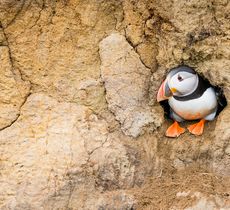
Did you know... Atlantic puffins often return to the exact same burrow year after year. Since they form long-term bonds with one another they may reuse the same nesting tunnel for decades.
Key facts about Atlantic (common) puffins
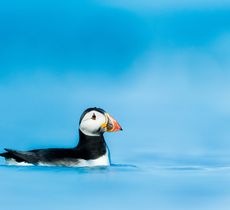
The Atlantic puffin is one of Britain’s most beloved and recognisable seabirds, often called the “clown of the sea” for its comical, upright stance and bright bill.
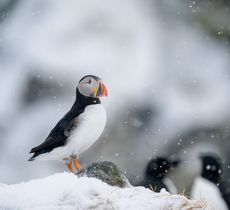
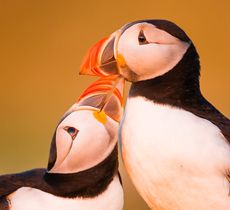
It’s a small bird with a squat black-and-white body, bright orange legs, and a spectacular tri-coloured bill; blue-grey at the base, yellow in the middle, and orange at the tip. However, this bill becomes most vibrant during the breeding season, then will fade in colour during the winter after the breeding season has ended.
Puffins breed in colonies on remote coastal cliffs and islands around the UK, such as the Farne Islands, Skomer, Lundy, and Shetland. They nest in burrows, often digging their own or reusing those abandoned by rabbits, which will provide shelter from their predators and the harsh British weather. Here, they lay just one egg in Spring and where they will look after their puffling; the name for a baby puffin. Too cute! After 6 weeks of feeding their chick, the parents will return back to the sea spending months out in the North Atlantic by themselves.
As a seabird, Atlantic puffins are expert divers, using their wings to “fly” underwater and their feet for steering up to depths of 60m. However, they aren’t the greatest fliers as they have to beat their wings 300-400 times a minute just to stay in the air! They also have a tendency to ‘crash’ into the water or tumble onto grass.
| Also known as | Clown of the sea |
|---|---|
| IUCN status | Vulnerable |
| Age | Atlantic puffins are surprisingly long-lived for such small birds and can live between 20-30 years. |
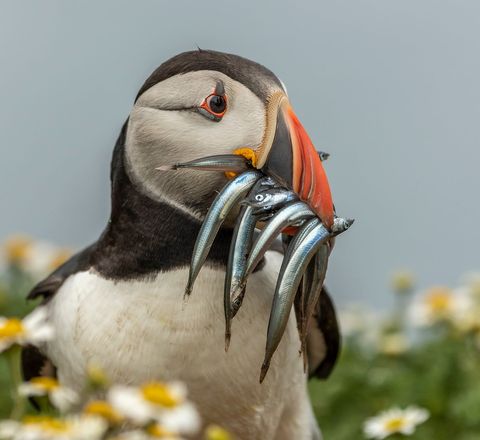
| Diet | Atlantic puffins eat a variety of small schooling fish. However in the UK, they are mostly known for eating sand eels. However they will also eat herring and sprat. They may also eat small crustaceans and worms. They’re famous for carrying multiple fish crosswise in their bill which other birds are unable to do, this is thanks to a unique hinge mechanism and rough tongue that can grip prey. |
| Habitat | Cliffs, Open ocean |
| Length | 26–29cm / 47–63cm wingspan |
| Speed and distance | Atlantic puffins are surprisingly fast for their size! They can reach up to 80 km/h (about 50 mph) in the air and around 7–11 km/h in the sea when chasing prey |
| Weight | 20-500g |
A big thank you to those helping us support Atlantic (common) puffins