

Blue jellyfish
Cyanea lamarckii
IUCN Status:Not Evaluated
Where can they be found?
Found all around the UK, especially in summer
Please note: this map is intended as a guide for general locations rather than detailed localised populations.
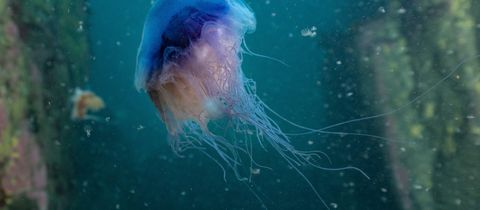
Did you know... A blue jellyfish’s age can be identified by the colour of their bell. When young, they are pale, but as they age, the bell becomes bright purple-blue.
Key facts about Blue jellyfishs
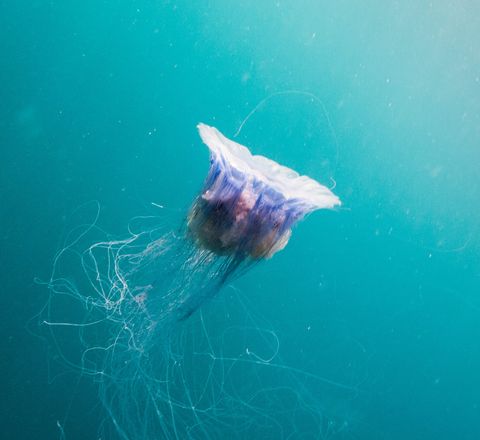
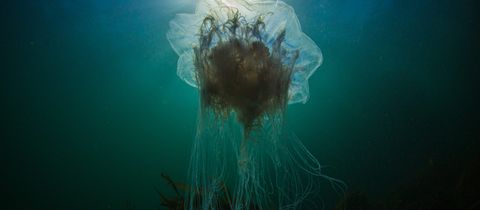
They're called blue jellyfish for a reason - purplish-blue lines radiate visibly through their bell-shaped body. Similar in shape to a lion’s mane, but much smaller, and with a relatively mild sting - though this can still be painful.
While it appears quite similar to the lion’s mane, it has only recently been classed as a different species, though still related.
| IUCN status | Not Evaluated |
|---|---|
| Age | Like most jellyfish, they do not have long lifespans, usually less than one year |
| Diet | They live off a diet of phytoplankton or zooplankton, as well as the eggs and larvae of other aquatic animals, such as fish if they're caught in their tentacles. Like most jellyfish, they use tiny "harpoon-like" stinging cells (Nematocysts) in their tentacles, that shoot out when touched to grab hold of prey and inject them with venom. |
| Habitat | Open ocean |
| Length | Up to 30cm (across the bell) |
| Speed and distance | Like many species of jellyfish, they're not strong swimmers and move slowly through the water with a pulsating movement. This also means they're susceptible to being moved by tides and currents. |
| Weight | Lacking data |

