

Common (European) lobster
Homarus gammarus
IUCN Status:Least Concern
Where can they be found?
Can be a lucky spot at a very low tide, more active in darkness than daylight. Hides out in crevices during the day.
Please note: this map is intended as a guide for general locations rather than detailed localised populations.
Did you know... Lobsters actually have four antennae. A larger, longer pair used for touch and navigation, as well as a short pair (Antennules) covered in fine hairs, crucial for smelling (detecting chemical signals).
Key facts about Common (European) lobsters
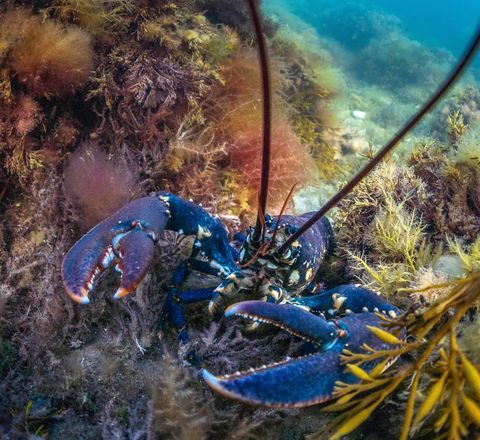
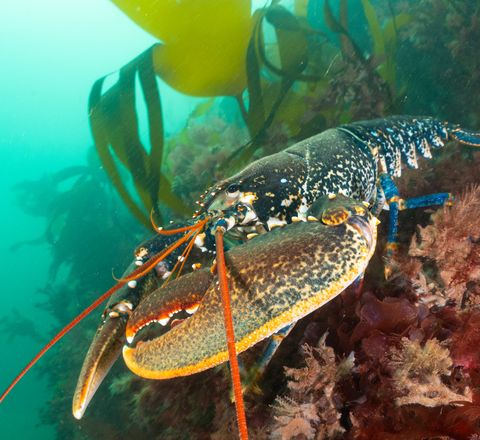
The common lobster is actually a beautiful blue colour - never pink! They have long red antennae and pale yellow markings.
Their two powerful claws are very different in shape and size. A "crusher" claw for breaking shells, and a "pincer" for cutting and holding their food. Interestingly, they can be right or left “handed”.
Female lobsters carry between 5,000 - 40,000 fertilised eggs on their legs for around 12 months, to protect them from predators before they hatch.
Common lobsters also have a very special ability - they can regrow missing limbs!
| IUCN status | Least Concern |
|---|---|
| Age | Small but mighty, the common lobster is slow growing, and can live a suprisingly long time of 45 to 50 years. Amazingly, the oldest Common Lobster on record was over 1m long and predicted to be around 80 years old! |
| Diet | Common lobsters are scavengers, meaning they’re not fussy and feed on whatever they can find on the ocean floor. This includes dead fish, crabs, and other small animals. |
| Habitat | Rocky shore, lower shore, subtidal, seabed, rock pools |
| Length | 25-35cm |
| Speed and distance | European lobsters primarily move by crawling along the seafloor as they slowly forage, but they can also perform a rapid backward jet by powerfully flexing their muscular tails (abdomen) to escape predators. They can also use their swimmerets for finer underwater control, such as when females are carrying eggs. |
| Weight | 1-2kg |

