

Moon jellyfish
Aurelia aurita
IUCN Status:Not Evaluated
Where can they be found?
All around the UK, especially sheltered waters in the west of Scotland.
Please note: this map is intended as a guide for general locations rather than detailed localised populations.
Did you know... Due to their simple anatomy, resilience and passive nature, scientists have begun researching how to equip moon jellyfish with sensors that monitor temperature, acidity, oxygen and pollution in deep waters.
Key facts about Moon jellyfishs
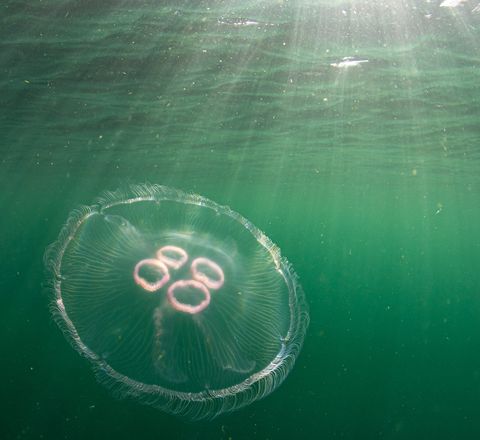
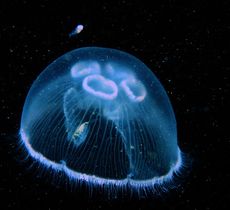
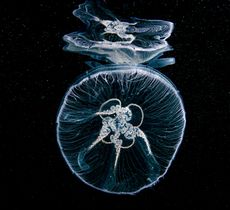
Moon jellyfish are transparent with an umbrella-shaped bell that's edged with short hair-like tentacles. They have four, usually purple rings towards its centre, which are its reproductive organs. They can glow in the dark, making them a beautiful sight if seen at night.
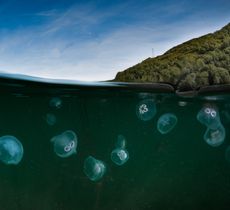
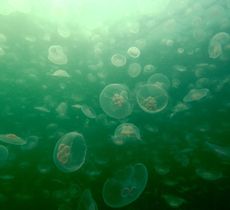
Moon jellies are mostly harmless, though they can sting any sensitive skin. If you see one, there are likely many more as they're very common and can bloom in large numbers when our chilly seas begin to warm up, or cool down.
They form mating aggregations in late summer using the sun as a compass. Having no brain, they detect light and touch and respond to them.
| IUCN status | Not Evaluated |
|---|---|
| Age | As with other types of jellyfish, their lifespan is increidbly short at around 6 months. |
| Diet | These jellyfish use use specialised "harpoon-like" stinging cells (nematocysts) that shoot out and inject venom when touched, to hold and immobalise their prey. They like to eat small animals like fish eggs and larvae, and zooplankton, alongside small crustaceans and water fleas…yum! |
| Habitat | Open ocean, strandline |
| Length | 5-40 cm |
| Speed and distance | Moon jellyfish don't really "swim" - they rely on the ocean currents to move through the water, and are therefore technically (large) plankton! |
| Weight | 2-20g |

