

Orca
Orcinus orca
IUCN Status:Data Deficient
Where can they be found?
Global, with a small resident pod around the west coast of the UK and Ireland (the ‘West Coast Community’). Another pod also seasonally visit northern Scotland to hunt in the summer.
Please note: this map is intended as a guide for general locations rather than detailed localised populations.
Did you know... Believe it or not, orcas can have trends too – including 80’s revivals! In the 1980s, a female orca was observed wearing a dead ‘salmon hat’, with two other members of her pod appearing to copy the trend. The trend soon fizzled out, but then in 2024, scientists in Washington State witnessed another orca in Puget Sound doing the same! Scientists are baffled, but believe it may be the orca version of a ‘packed lunch’!
Key facts about Orcas
Despite also being known as ‘killer whales’, orcas are actually the largest species in the dolphin family. They live up to their formidable name however, and are well known for their highly coordinated and often ingenious hunting tactics – sometimes preying on much bigger whales.
They can live for up to 90 years and are one of the most widespread animals on the planet – they can be found everywhere from the Arctic to Antarctic, but you’d need to be very lucky to see them in UK waters!
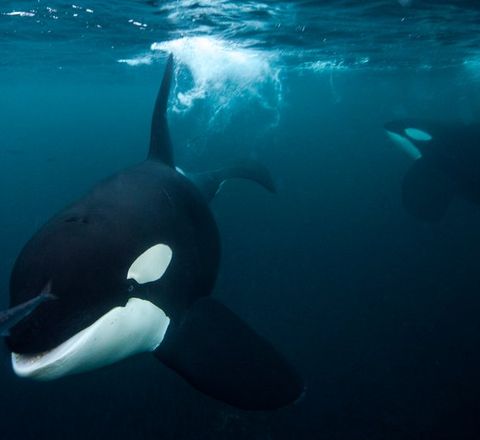
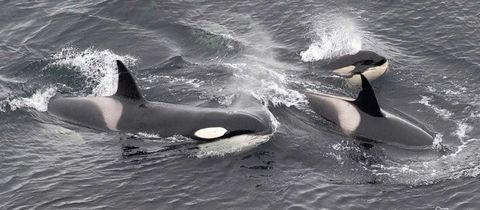
Perhaps one of the most recognisable marine animals, orcas are mostly black on top which extends to their pectoral fins. With distinct white patches above their eye, a saddle patch behind their dorsal fin and a flank patch extending to their underbelly, their beautiful markings can be used to distinguish individuals.
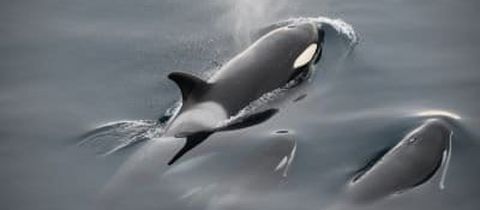
Orcas live in pods led by a strong matriarch (a single female) with her sons, daughters and the descendants of her daughters. Within the pod the bonds are very strong and the whole group takes responsibility for diligently caring for calves. To prevent inbreeding, males will mate with females from other pods but will return to their own.
The females are pregnant for an incredible 17 months and reproduce every 3-4 years.
Orcas communicate through a range of whistles, squeals, clicks, squeaks and screams and they have distinct ‘languages’ within their family groups.
Orcas face threats from boat disturbance and noise, which can affect their feeding and echolocation, while overfishing threatens their food source and can risk net entanglement.
PFAS (forever chemicals) are also an ever-present risk, with toxic contamination building up in their bodies and affecting their reproductive and immune systems.
| Also known as | Killer Whale |
|---|---|
| IUCN status | Data Deficient |
| Age | Similar to us, orcas can live to up to 90 years old, with females often outliving males. Sadly, this has been recorded as much lower in captivity at under 30 years. |
| Diet | While orcas aren’t fussy eaters, with a diet ranging from fish to seals, sharks to dolphins, turtles, squid and even birds, it is now recognised that different families often have specialities, with the matriarch of the group often knowing how and where to find food when it is scarce. The seasonal northern Scotland orcas focus on fish and seals for example. As recorded on popular nature documentaries, orcas have incredible hunting techniques, such as swimming together to create swells and push seals of ice floes, to working in coordination to take down large whales. |
| Habitat | Open ocean |
| Length | Up to 9.8 metres, with the females being slightly smaller than males. The male’s dorsal fins can also be up to 2 metres tall, typically twice the height of the females. |
| Speed and distance | Orcas can travel over 100 miles a day and one tracked orca showed a migration round trip of nearly 6,000 miles! |
| Weight | Up to 10 tons (10,000 kg) |

