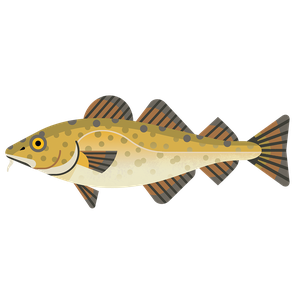
Alaska pollock
Theragra chalcogramma
What to check for
Location
Bering Sea (West)
Technical location
Pacific, Northwest, All areas
Caught by
Net (pelagic trawl)
Rating summary
Western Bering Sea pollock is abundant and fishing pressure is within sustainable limits. Some appropriate management measures are in place. However, catch limits have been exceeded in recent years, which could be a threat to the population. Most Alaska pollock in this area is caught by mid-water trawling, which does not have habitat impacts. Impacts on vulnerable species are thought to be minimal.Rating last updated September 2022.
How we worked out this Rating
Western Bering Sea pollock is in a healthy state: the population is above target levels, and fishing pressure is within sustainable limits.There are two pollock stocks in the Western Bering Sea (WBS):East of 174 degrees E, known as Navarinsky stock, which includes the Chukotka subzone.West of 174 degrees E, known as the WBS stock, which includes the Karaginsky subzone.This rating relates to the WBS stock. Fisheries research and stock assessments are coordinated by the Russian Federal Fishery Agency (FFA) through KamchatNIRO. The most recent stock assessment was carried out in 2021 using data up to 2020, although owing to Covid disruption, 2020 data are incomplete. In 2020, there was no targeted pollock fishery, and it was caught only as bycatch.KamchatNIRO define this this stock as data rich, or Level 1, indicating that there is enough data for a stock assessment.This stock was at a low level in the 1990s and the fishery was closed at this time. It briefly improved until 2007, when a small fishery was reopened. However, it then declined again. Between 2016 and 2019, reproduction by the pollock population was low, contributing to the declines. Since 2015, targeted fishing for pollock in the WBS zone outside of the Karaginsky area has been banned, and pollock here is caught as bycatch in fisheries for cod and squid. Most pollock catches are therefore from the Karaginsky subzone.In 2018, spawning stock biomass (SSB) was estimated to be 198,800 tonnes, increasing to approximately 240,000t in 2020. This was well below the average from the 1980s, which was 764,000t. Because the stock for the past 25 years has been in a low productivity state compared to the 1970s, the management targets were revised in 2021. The target stock size (Btr) has been reduced from 362,900t to 225,000t. The point of reproductive impairment (Blim) is reduced from 145,900t to 131,000t. As a result, the biomass is now above target levels, and the stock is not in an overfished state.Between 2007 and 2015, there was systematic overfishing of the stock and catches averaged 40,000t. Fishing mortality (F) was several times higher than the targets at that time. After 2016, WBS pollock catches decreased and fishing mortality fell below the target. This contributed to a slight increase in stock. As with biomass, the management targets for F were revised in 2021. The target fishing mortality (Ftr) has increased from 0.126 to 0.208. The upper limit (Flim) has decreased slightly, from 0.344 to 0.341. F is not recorded for the most recent year. In 2019, the stock assessment reports that catches exceeded the limit by 58%, but were 12% below the limit in 2020. In 2021, it was recommended to keep F at 0.079, equating to a catch of 23,600t. Actual catch is unknown, but if it matches the recommendation, it is projected to result in an increase in SSB to 468,900t.For 2022, catch recommendations have increased to 62,100t (F 0.208), which will prevent the stock from exceeding biologically safe limits with 95% probability. As recent catches have been some way below this level (even when they exceeded specified limits), and the 2021 TAC is equivalent to an F of 0.079, it appears that F is below Ftr and the stock is not subject to overfishing.

Some appropriate and relevant management measures are in place for this pollock stock. However, catch limits have been exceeded in recent years, which could be a threat to the population.Pollock in the Bering Sea lives in the economic zone of two states: Russia and the United States. During years of very high abundance, it spreads to the central part of the Bering Sea, outside the zones of Russia and the United States, where its commercial use is regulated by the six-party (Russia, USA, Japan, China, Republic of Korea, Poland) Convention (1993) on the preservation and management of pollock resources in the central part of the Bering Sea.Pollock in Russian waters is managed by the Russian Federal Fishery Agency (FFA) using a range of measures under the Fishing Rules for the Far Eastern Fishing Basin. These include: Total allowance Catch (TACs), gear and area restrictions, bycatch and juvenile limits, and move-on rules. The FFA sets TACs for each management sub-area based on the recommendations given by the TINRO (Pacific Fisheries and Oceanography Institute, Vladivostok).There are a number of different pollock stocks in Russian waters, including two stocks in the Western Bering Sea:East of 174 degrees E, known as Navarinsky stock, which includes the Chukotka subzone.West of 174 degrees E, known as the WBS stock, which includes the Karaginsky subzone.Prior to 2016, the Total Allowable Catch (TAC) for the WBS stock was not divided from the Navarinsky stock and therefore, TACs were not set in line with scientific advice. Systematic overfishing took place, leading to stock declines. In 2015, targeted fishing for pollock in the WBS zone outside of the Karaginsky area was banned, although bycatch of pollock is allowed. Targeted fishing for pollock in the Karaginsky zone continues, except in the spawning season (March-May). In 2016, WBS pollock catches decreased and fishing mortality fell below target levels. This contributed to a slight increase in stock.Under current regulations, the TAC is determined by the Harvest Control Rule (HCR) and is based on the status of fishing mortality and spawning biomass in relation to limit and target reference points. The TAC has been exceeded several times in recent years (2007–2015 and again in 2019), putting the stock at risk. Therefore, while management appears to be following scientific advice, there appear to be issues with compliance.Because the stock for the past 25 years has been in a low productivity state compared to the 1970s, the management targets were revised in 2021. The target stock size was reduced, and target fishing pressure increased. It remains to be seen whether this will hinder the recovery of the stock. However, scientific advice is that if the recommended TACs in recent years are followed, the stock of West Bering Sea walleye pollock will gradually recover with a 95% probability and not go beyond the biologically safe limits after 2020.The minimum landings size for pollock is 35cm. Pelagic trawls use inserts that are designed to allow smaller pollock to escape. However, up to 20% of the total catch can be juveniles, which is high.There is a National Action Plan and a series of bilateral agreements with other countries to deter Illegal, Unreported and Unregulated (IUU) fishing. Monitoring is by the FSB Coastguard and scientific observers. Enforcement inspectors from the Border Control Department (FSB) are tasked with enforcing the fishing rules and combating unlawful fishing at sea.
Most Alaska pollock in this area is caught by mid-water trawling, which does not have habitat impacts. Impacts on vulnerable species are thought to be minimal.Around 60% of pollock catches are by mid-water trawling, and the remainder by demersal seining. Mid-water trawl does not make contact with the bottom and therefore, has minimal negative impact on the benthic ecosystem. Spatial restrictions have been set and trawling may not be conducted less than 30 miles offshore and 5-12 miles from islands.Pelagic trawls target big shoals of slow-moving pollock and are designed to allow small pollock and other fish to escape. All bycatch must be recorded and reported. There are regulations in place to reduce bycatch, including temporal and spatial closures. For example, if bycatch exceeds 2% of the pollock catch, the excess catch must be discarded and the vessel must relocate at least 5 miles from the area. The main bycatch species in this fishery include herring, cod, Pacific and Greenland halibut, Chinook and coho salmon, and commander squid. Pacific herring accounted for 8.4% of the WBS trawl catch in 2019, but this stock is in a healthy state and is not thought to be threatened by the pollock fishery.Russian Far East seas are important areas for feeding, seasonal concentrations and breeding aggregations for 19 rare species of marine mammals and 22 endangered, threatened or protected (ETP) seabird species. Alaskan pollock are important prey for Steller sea lions, making up 23% of their diet, but there is not thought to be any impact on Steller sea lion populations from this fishery.Closed areas have been declared around rookeries of otters, Steller sea-lions and seals to protect these species. Although some populations of Stellar sea-lions have recovered in the WBS, it seems that in the eastern coast of Kamchatka and in proximity with this fishery, recovery has been limited.Interaction with Laysan albatross, Northern fulmar, Short-tailed shearwater, Black-legged kittiwake and Red-legged kittiwake have been reported for the WBS fishery. Its impact on the population of those species, which range in abundance from 280,000 to 23,000,000 individuals, appears to be minimal.Scientific observers increased in the WBS trawl fishery in 2019. Interaction with Steller sea lions or ETP seabirds were not reported.
References
Akulenko, V.S., 2020. History of bilateral cooperation in the field of fisheries between the Russian Federation and the Republic of Korea. Вестник СПбГУ. Международные отношения. 2020. Т. 13. Вып. 2Federal Security Service (FSB), 2020. WBS Mid-Water Trawl Pollock Fishery. 2018–2020 Compliance Statistics in West Bering Sea Zone. FSB Coastguard East Arctic Department. 2 pp. (Cited in Lloyd’s Register 2021 MSC Public certification report).Federal Fisheries Agency, 2021. Summary Materials for Public Discussion-Hearing. 115 pp. Petropavlovsk-Kamchatsky. Available at: https://s3.amazonaws.com/assets.fishsource.org/Federal+Fisheries+Agency+-+2021+-+Preliminary+Short-Form+Materials+for+Public+Hearin.pdfFederal Fisheries Agency, 2020. Summary Materials for Public Discussion-Hearing. 133 pp. Petropavlovsk-Kamchatsky. Available at: https://s3.amazonaws.com/assets.fishsource.org/FAR+Kamchatka+branch+2020.pdf.Japp, D., Sharov, A., Payne. A., 2021. Western Bering Sea Pollock. Pollock Catchers Association. Initial Lloyd’s Register. July 2021. 301 pp.Ministry of Agriculture of the Russian Federation, 2019. On the Approval of Fishing Rules for the Far Eastern Fisheries Basin (with amendments on 23 May 2019). Available at http://docs.cntd.ru/document/554767016.Pollock Catcher’s Association, 2020. PCA note on scientific observer status. 2 pp. Available at http://russianpollock.com/information/publications/Pollock Catcher’s Association, 2020. Overview of the Fisheries Management System in Russia: Walleye Pollock fisheries case study. Available at http://russianpollock.com/information/publications/Pollock Catcher's Association, 2020c. Supplementary information and statistics relating to FSB Coastguard operations in the West Bering Sea. PCA, Vladivostok. 5 pp. (Cited in Lloyd’s Register 2021 MSC Public certification report).Pramod, G., 2020. Russia – Country Report, 9 pages, In: Policing the Open Seas: Global Assessment of Fisheries Monitoring Control and Surveillance in 84 countries, IUU Risk Intelligence - Policy Report No. 1, Canada, 840 pages. Available at https://iuuriskintelligence.com/wp-content/uploads/2020/04/Russia-Country-Report-Global-Fisheries-MCS-Report-2020.pdf [Accessed 22/6/22].Radchenko, V.I., 2017. Russian Fisheries Management System performance (the Sea of Okhotsk walleye pollock fishery case study). PCA, Vladivostok. 37 pp.RussianPollock, 2022. Stock status: West Bering Sea Zone (west of 174° E), Karaginskaya Subzone. Available at: http://www.russianpollock.com/stock/stock-status/.Saltykov, M.A., & Krasova, E.V., 2021. Trends in development of Russian Far East’s fishing industry in context of strategic regional growth. Revista Amazonia Investiga, 10(47), 93-106. https://dialnet.unirioja.es/descarga/articulo/8320608.pdfSamy-Kamal, M., 2020. Overview of fisheries governance and policy system in the Russian Federation: An analysis against the Marine Stewardship Council (MSC) standard. Ocean & Coastal Management, 197, 105312.TINRO, 2020. TAC Materials for Fisheries Located in Inner Sea Waters of Russia, Territorial Seas of Russia, the Continental Shelf of Russia, in the EEZ of Russia and in the Caspian Sea (including assessment of environmental impact) for 2021. Part 2: Fish of the Far Eastern Seas. Available at: https://s3.amazonaws.com/assets.fishsource.org/TINRO+2020.doc.Vasilets, P., Scarcella, G., Samy-Kamal, M., 2022. Fishery Shipowners Association (FSA) Western Bering Sea Walleye pollock. Initial assessment. 31 May 2022. UCSL. 240 pp.
Sustainable swaps
Learn more about how we calculate our sustainability ratings.
How our ratings work