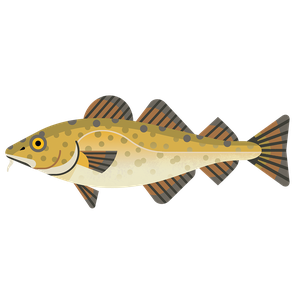
Alaska pollock
Theragra chalcogramma
What to check for
Location
Gulf of Alaska
Technical location
Pacific, Northeast, All areas
Caught by
Net (pelagic trawl)
Rating summary
Updated: June 2020.
The stock of Alaskan pollock in the Gulf of Alaska is in a good state and fishing pressure is within sustainable limits. The Fishery Management Plan for groundfish in the Gulf of Alaska includes a total allowable catch, spatial and temporal closures and monitoring through high observer coverage and vessel monitoring systems. The majority of the targeted pollock fishery in this area is taken by pelagic trawls and as the fishery is pelagic, there is little impact with the seabed. Alaskan fisheries are thought to have low relative bycatch while landing more target catch than all other US regions as they target a highly productive, yet less biodiverse assemblage. There are defined limits for most bycatch species, and catches are well below these limits, therefore, bycatch are levels unlikely to be causing populations to decline.
How we worked out this Rating
The stock of Alaska pollock in the Gulf of Alaska is above target levels and fishing pressure is within sustainable limits.Pollock in the Gulf of Alaska (GOA) is treated as two separate stock units for assessment and management purposes: Southeast Outside and Central / Western / West Yakutat. The latter makes up the largest proportion of the stock and is the main focus of this rating.The fishery for Alaska pollock in the GOA began in the 1960s. Catches grew rapidly to peak at over 300,000 tonnes in the 1980s. After a low of 45,000t in the 2000s, recent catches have increased to around 150,000t.The most recent stock assessment was published by NOAA in 2024 using data up to 2024. The approach to setting targets and reference points for stocks varies depending on which tier the stock is listed as. They also vary from one year to the next, depending on the most recent stock assessment data.The Central / Western / West Yakutat GOA stock is Tier 3, indicating there are some data limitations.The biomass of the female spawning stock (Spawning Stock Biomass, SSB) peaked in the 1980s at 120% of unfished levels (B120%). It subsequently declined, reaching a low of B35% in 2003. There have been some fluctuations since then. The level associated with Maximum Sustainable Yield for a Tier 3 stock is B35%, which in 2024 is 177,000 tonnes. SSB in 2024 is projected to be 274,141 t, which is B54%. Therefore, the stock is not in an overfished state.Fishing mortality (F) was above levels associated with Maximum Sustainable Yield (MSY) in the 1970s and 1980s. Since then, F has been below FMSY. In 2024, FMSY (defined as the Overfishing Limit, OFL) was set at 0.307, which equates to 269,916t. The precautionary management target (Acceptable Biological Catch, ABC) was set at 0.26, or 190,740t. Estimated catch in 2023 was 135,103t, below these thresholds. Therefore, the stock is not subject to overfishing.Recruitment of young fish into the Gulf of Alaska fishery is more variable than in the East Bering Sea stock. There was a very strong year in 2012, followed by poor recruitment until 2017. Spawning biomass has not been consistent over the last decade. It is projected to increase slightly in the coming year.The Southeast Outside GOA stock is Tier 5, indicating there are a number of data limitations.In 2024, biomass is estimated to be 43,328 tons. There are no biomass reference points available for this stock, and no estimate of whether it is in an overfished state.In 2024, the overfishing level in this area was estimated to be 0.3 or 12,998 tonnes (OFL) and the ABC/TAC set below that level at 9,749 t. The same ABC and OFL is recommended for 2025. As this component of the stock is small and the TAC is set well below the overfishing limit (and not surpassed), fishing pressure is thought to be within sustainable limits
The Fishery Management Plan (FMP) for groundfish in the Gulf of Alaska is prepared by the North Pacific Fishery Management Council and managed by the National Marine Fisheries Service (NMFS). The FMP encompasses a range of species, which are managed using a suite of management measures to protect the stock and ecosystem. This includes a Total Allowable Catch (TAC), spatial and temporal closures and monitoring through high observer coverage and Vessel Monitoring Systems. The stock status is assessed regularly, with a variety of fishery-dependent and independent survey methods. All vessels in the groundfish fisheries must also have a Federal groundfish license. In 2018, vessels using pelagic trawl gear in the Gulf of Alaska had 23% observer coverage and accounted for about 99% of the pollock catch. This fishery has Marine Stewardship Council (MSC) certified since 2005.
Since 1992, the Gulf of Alaska pollock TAC has been apportioned spatially and temporally to reduce potential impacts on Stellar sea lions. Stellar Sea Lion Protection Measures implemented in 2001 established four seasons in the Central and Western Gulf of Alaska with 25% of the total TAC allocated to each season. In addition, a harvest control rule was implemented that requires suspension of directed pollock fishing when spawning biomass declines below 20% of the reference unfished level. There are also measures in place to protect Chinook salmon bycatch in the pollock fishery. A sharp spike in Chinook salmon bycatch in 2010 led the Council to adopt management measures to reduce bycatch, including a cap of 25,000 Chinook salmon bycatch in the directed pollock fishery.
The majority (90%) of the targeted pollock fishery in the Gulf of Alaska is taken by pelagic trawls. As the fishery is pelagic, there is little impact with the seabed and bycatch of non-target species is small relative to the magnitude of the fishery. For tows classified as pollock targets in the Gulf of Alaska between 2012 and 2016, on average 96% of the catch by weight consisted of pollock. However, the fishery is unlikely to be over-exploiting other species. Species of incidental catch recorded were arrowtooth flounder, Pacific ocean perch, flathead sole, shallow-water flatfish, and squid. There is concern about catches of Pacific cod in the pollock fishery, however bycatch is reported to be very low and is accounted for in the TAC allowed for indirect fisheries in the Gulf of Alaska. Chinook salmon are also of particular concern as they represent the largest proportion of bycatch in the Gulf of Alaska fishery.
Marine mammals such as species of seal, dolphin and whale are at risk of interaction with the pollock fishery, however are rarely taken as bycatch and the fishery continues to be listed as a Category III (remote likelihood or no known interaction with marine mammals) fishery. No seabirds were recorded as bycatch in the pollock fishery in 2017, however, sharks can sometimes be taken as bycatch have averaged at 171 tonnes per year since 1997.
References
Muto, M. M., Helker, V. T., Angliss, R. P., Boveng, P. L., Breiwick, J. M., Cameron, M. F., Clapham, P. J. et al. 2018. Alaska Marine Mammal Stock Assessments. U. S. Department of Commerce. NOAA Technical Memorandum NMFS-AFSC-393. Available at https://repository.library.noaa.gov/view/noaa/20606 [Accessed on 12.06.2020].
North Pacific Fishery Management Council. 2019. Meeting Summary. 247th Plenary Session of the North Pacific Fishery Management Council. December 2019 Council Summary. Available at https://meetings.npfmc.org/CommentReview/DownloadFile?p=653a6082-5f01-471e-b412-bab6bce03d9c.pdf&fileName=Council%20Summary%20December%202019.pdf [Accessed on 12.06.2020].
Savoca, M. S. and Brodie, S., Welch, H., Hoover, A., Benaka, L. R., Bograd, S. J. and Elliott, L. H. 2020. Comprehensive bycatch assessment in US fisheries for prioritizing management. Nature Sustainability. Available at https://cpb-us-e1.wpmucdn.com/sites.ucsc.edu/dist/e/692/files/2020/03/Savoca-et-al.-2020-NBR-NatureSust.pdf [Accessed on 12.06.2020].
Wilson, E., Bowen, D., Rice, J. and Knapman, P. 2019. Gulf of Alaska Pollock Fishery 4th Surveillance Report. Certificate No: MRAG-F-0033 (MSC-F-31222). MRAG Americas Inc. Available at https://fisheries.msc.org/en/fisheries/alaska-pollock-gulf-of-alaska/@@view [Accessed on 12.06.2020].
Seafish RASS. 2019. Alaska Pollock, Gulf of Alaska, Mid-water otter trawl. Available at https://www.seafish.org/risk-assessment-for-sourcing-seafood/profile/alaska-pollock-gulf-of-alaska-mid-water-otter-trawl [Accessed on 12.06.2020].
National Oceanic and Atmospheric Administration. 2019. Fisheries of the Exclusive Economic Zone Off Alaska; Gulf of Alaska; Final 2019 and 2020 Harvest Specifications for Groundfish; Correction. Available at https://www.federalregister.gov/documents/2019/04/12/2019-07276/fisheries-of-the-exclusive-economic-zone-off-alaska-gulf-of-alaska-final-2019-and-2020-harvest#p-11 [Accessed on 12.06.2020].
Dorn, M., Aydin, K., Fissel, B., Jones, D., McCarthy, A., Palsson and Spalinger, K. 2017. Chapter 1: Assessment of the Walleye Pollock Stock in the Gulf of Alaska. Available at https://repository.library.noaa.gov/view/noaa/17517 [Accessed on 12.06.2020].

Sustainable swaps
Learn more about how we calculate our sustainability ratings.
How our ratings work