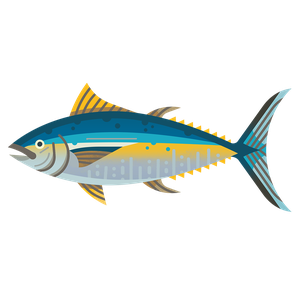
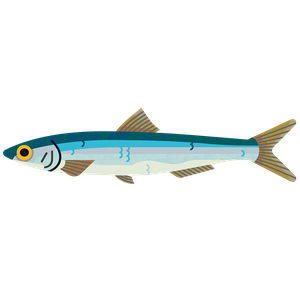
Albacore tuna
Thunnus alalunga
What to check for
Location
South Pacific
Technical location
Pacific, Eastern Central, Pacific, Southeast, Pacific, Southwest, Pacific, Western Central, All areas, All areas, All areas, All areas
Caught by
Hook & line (longline)
Rating summary
The population of albacore tuna in the south Pacific Ocean is at a healthy size. However, there are no catch limits and it is projected to decline if recent catch levels continue. Almost all catches are by longlining, which can have a bycatch of highly vulnerable and endangered species, including sharks, turtles, and seabirds.Rating last updated January 2022.
Technical consultation summary
The most recent stock assessment for albacore tuna in the south Pacific Ocean is from 2021 and indicated that the stock is not overfished and not subject to overfishing. Spawning biomass is approximately 3 times SBMSY, and F is 24% of FMSY. However, the stock is thought to be declining, and is projected to continue to decline under current catch rates. Few appropriate management measures are in place. There are no catch limits, and effort controls only cover part of the fishery - excluding the area of highest depletion rates. Observer coverage is too low and needs to be improved, both for catch and bycatch data. Almost all of the albacore catches in the south Pacific Ocean are by longlining, which can have a bycatch of highly vulnerable and endangered species, including sharks, turtles, and seabirds.
How we worked out this Rating
Albacore tuna in the south Pacific Ocean is not overfished and not subject to overfishing.There are two stocks of albacore tuna in the Pacific Ocean: North and South. This rating covers South Pacific albacore.South Pacific albacore is assessed by the Secretariat of the Pacific Community and jointly managed by the Western and Central Pacific Fishery Commission (WCPFC) and the Inter-American Tropical Tuna Commission (IATTC). The last stock assessment was carried out in 2021, using data up to 2019. The next assessment is expected in 2024.Recent assessments of south Pacific albacore had covered the western Pacific Ocean only, leaving the eastern part of the stock effectively un-assessed. However, the 2021 assessment was expanded to include the entire south Pacific. This has not significantly affected the conclusions or trajectories of the stock status.Catches of this stock increased from around 25,000 tonnes in 1960 to peak at over 90,000t in 2017. They averaged 80,500t in 2018-2020.Spawning biomass (SB) declined from around 90% of unfished levels in 1960 to 60% in 2015, then sharply dropped. The 2016-2019 value is 52%. This is above the limit reference point (LRP) of 20%, but below the interim target level of 56%. However, this target is based on achieving a certain catch per unit of fishing effort, rather than achieving a certain biomass level. The stock is around 3 times the level associated with Maximum Sustainable Yield (SB MSY = 109,710 tonnes). As the stock is above the LRP, the assessment has concluded that it is not in an overfished state.Fishing mortality (F) has continuously increased, with a steep increase from 5% of FMSY in 2000 to 24% for 2015-2018. As F is below the MSY level, the stock is not subject to overfishing.The figures used in the stock assessment are the median values from the most recent years (2016-2019 for biomass and 2015-2018 for fishing mortality). When looking just at 2019, SB is much lower, at 40%, and F appears to be much higher, at 27%. This indicates that the stock has substantially declined in the last three years.Projections indicated that the South Pacific albacore stock has a greater than 20% risk of falling below the LRP by 2049 if 2017-2019 average catches (88,000t) are maintained. There is a 19% risk of fishing mortality exceeding FMSY. These probabilities are relatively high. The projections also indicated that the stock will not reach the target of 52% of unfished levels if recent catches are maintained.
Few appropriate management measures are in place. The management measures that do exist only cover part of the fishery. The stock is projected to decline if recent catch levels are maintained. Observer coverage in fisheries targeting albacore is too low and needs to be improved.Tuna, marlin, and swordfish are highly migratory species, found on the high seas and in numerous countries' waters. This makes harmonised and effective management challenging. Regional Fisheries Management Organisations (RFMOs) are responsible for monitoring and managing these stocks on behalf of the countries that access them. However, the degree to which management is implemented, monitored and enforced by each country varies significantly.South Pacific albacore is assessed by the Secretariat of the Pacific Community and jointly managed by the Western and Central Pacific Fishery Commission (WCPFC) and the Inter-American Tropical Tuna Commission (IATTC). The impact of fisheries in the WCPFC area (85% of catches) on south Pacific albacore tuna are far greater than that of fisheries in the IATTC area, and so management measures by WCPFC are considered to be of greater importance. However, management must be comparable and properly implemented across the entire range of the stock in order for it to be effective. The IATTC and WCPFC endeavour to work together to promote compatibility between their respective conservation and management measures across the Pacific. However, this is not always achieved.Recent assessments of south Pacific albacore had covered the western Pacific Ocean only, leaving the eastern part of the stock effectively un-assessed. However, the 2021 assessment was expanded to include the entire south Pacific. This is a significant improvement in providing an accurate evidence base for management decisions.There are no catch limits for this stock. The IATTC has no specific management measures for south Pacific albacore, leaving the eastern part of the fishery (15% of catches) unregulated. The WCPFC has frozen fishing effort to 2000-2004 levels in the area south of 20 degrees S. However, the albacore stock is experiencing the highest depletion rates north of this area, where no management applies.The WCPFC is reviewing management and developing catch limits and harvest strategies in 2022, and has noted the urgency of completing this work. Until a new measure is in place it has 'encouraged' countries to limit catch or effort to recent years. However, projections indicate that the stock will decline if recent catches or effort are maintained. Therefore, management is not protecting the stock from overexploitation.Monitoring of the fisheries is not high enough for some fleets. Both RFMOs have 100% observer coverage on large purse seiners (for WCPFC this is on the high seas, or on vessels fishing in multiple countries' waters, or all vessels fishing between 20N and 20S). Only 5% observer coverage is required on large longliners, considered too low for accurate data: a minimum of 20% coverage is recommended. In addition, data recorded by longliners in the IATTC area is considered inadequate for scientific purposes and minimum data standards must be identified and introduced.To help address illegal, unregulated and unreported fishing, WCPFC and IATTC maintain an IUU Vessel List; a register of authorised large longliners; and prohibit transhipments at sea for large purse seiners, and most other transhipments must be documented and observed as part of the regional observer programme. Countries are required to report annually on monitoring, control and compliance of management measures.
Almost all albacore catches in the south Pacific Ocean are by longlining. While longlining is unlikely to have habitat impacts, it can have a bycatch of highly vulnerable and endangered species, including sharks, turtles, and seabirds.Longlining is responsible for the majority (96%) of albacore catches in the south Pacific Ocean (SPO). Longlining for swordfish and albacore tuna usually happens in shallower waters than other tuna species, making it more accessible to some species such as seabirds.Data on bycatch in longline fisheries is very poor, partly because there are not enough scientific observers on vessels. Observer coverage is only required to be 5%, and recommendations are for at least 20%. The 5% target is often not achieved. Some mitigation measures are in place, but they often don't follow scientific recommendations for best practice, and their effectiveness has not been evaluated.Sharks are both bycaught and targeted in longline fisheries in the Pacific. In the western Pacific in 2020, an estimated 1.6 million sharks were caught as bycatch. Some were released alive, and observer data indicates that there were 3,150 longline mortalities. As just 5% of the longline fleet is observed, this is a significant underestimate of total mortality. In the eastern Pacific in 2020, over 14,000 tonnes of sharks were caught by longlining, including targeted blue shark. In both areas, bycatch species include bigeye thresher, shortfin mako, and silky shark. There are also some catches of the critically endangered oceanic whitetip and scalloped hammerhead, and the endangered pelagic thresher and mako species.There are some mitigation measures, including restrictions on finning, a ban on landing silkies and oceanic whitetips; and restrictions on the use of shark lines (which increase bycatch in longlining). The effectiveness of these measures are difficult to evaluate owing to lack of data. Mobulid rays are also bycaught, but there is very little data on these species.Seabird bycatch is also a concern. Albatrosses and petrels are attracted to the baited hooks on longlines. There were at least 126 seabird deaths from EPO longlining in 2020, which is a minimum estimate given the significant data gaps. In previous years, interactions have been recorded with the waved albatross, which it is endemic to the EPO and nests only in the Galapagos Islands. Modelling has estimated that between 13,000 and 19,000 seabirds were killed in western Pacific longline and purse seine fisheries from 2015 to 2018. On quarter of the mortalities were by longline fisheries south of 30 degrees S. A small area east of Tasmania and south of 40 degrees S is estimated to account for around 60% of the longline seabird bycatch south of 30 degrees S and 15% of the total. Of critical concern is Antipodean wandering albatross, which is expanding its foraging range into tuna fishery areas and has experienced a high and sustained rate of decline - it is now in New Zealand's "Nationally Critical" conservation status category.The required mitigation measures do not follow recommended best practice by ACAP (the Agreement on the Conservation of Albatrosses and Petrels). IATTC and WCPFC require one or more measures (depending on location) from a set list of options, including weighted branch lines, bird scaring lines and night setting. ACAP recommends the simultaneous use of all three, or hook-shielding or underwater bait setting devices.The five marine turtle species in the western Pacific (green, hawksbill, leatherback, loggerhead and olive ridley) are vulnerable, endangered, or critically endangered. There is not enough data to assess the threat posed by longline fisheries. The Eastern Pacific sub-population of leatherbacks is classified as Critically Endangered and at risk of extinction in the area. Bycatch and fishery interactions are the primary cause of the decline, mainly by gillnets and longlines in the southern and central Eastern Pacific (from Chile to Mexico). Urgent measures are needed to reduce impacts on this species, including better observer coverage, and improved handling and release practices to improve post-capture survival.There are some mitigation measures, including requirements for safe handling and release. In the west, shallow-set swordfish longliners, used for swordfish and albacore, must use circle hooks and whole finfish bait (with some exemptions), but this covers less than 1% of WCPO longline effort, even though approximately 20% of the WCPO longline effort consists of shallow sets. The remaining 80% of longlining, which is deeper-set, has not mitigation requirements. In the east, shallow longliners must use circle hooks or finfish bait. Turtle interaction rates are thought to be higher in shallow-set longlines, but mortality rates are higher in deeper sets because sea turtles have a higher probability of asphyxiation.Interactions between cetaceans and longliners have been recorded. They can be attracted by the fish caught on the line. In the west Pacific, species included false killer whales, toothed whales and oceanic dolphins. Most interactions resulted in the animal being released alive. In the east, there were 17 reported interactions in 2020, which is a minimum estimate, given the data gaps. These interactions are not well recorded and the scale of impact by longlining is unclear.
References
ACAP, 2021. ACAP Review of mitigation measures and Best Practice Advice for Reducing the Impact of Pelagic Longline Fisheries on Seabirds. Reviewed at the Twelfth Meeting of the Advisory Committee Virtual meeting, 31 August – 2 September 2021. Available at https://www.acap.aq/resources/bycatch-mitigation/mitigation-advice/3956-acap-2021-pelagic-longlines-mitigation-review-bpa/file [Accessed on 09.12.2021].Hare S.R., Williams P.G., Castillo Jordan, C., Hamer P.A., Hampton W.J., Scott R.D. and Pilling G.M., 2021.The western and central Pacific tuna fishery: 2020 overview and status of stocks. Tuna Fisheries Assessment Report no.21. Noumea, NewCaledonia: Pacific Community. 53p. Available at https://purl.org/spc/digilib/doc/qkpa2 [Accessed on 25.01.2022].IATTC, 2021. Inter-American Tropical Tuna Commission: Active IATTC and AIDCP Resolutions and Recommendations. Available at https://www.iattc.org/ResolutionsActiveENG.htm [Accessed on 09.12.2021].IATTC, 2021. Report on the tuna fishery, stocks, and ecosystem in the Eastern Pacific Ocean in 2020. IATTC-98-01 presented to the 98th meeting of the Inter-American Tropical Tuna Commission. Online, 23-27 August 2021. Available at https://www.iattc.org/Meetings/Meetings2021/IATTC-98a/Docs/_English/IATTC-98a-01_The%20fishery%20and%20status%20of%20the%20stocks%202020.pdf [Accessed on 09.12.2021].Peatman, T., Abraham, E., Ochi, D., Webber, D. and Smith, N., 2019. Project 68: Estimation of seabird mortality across the WCPFC Convention Area. WCPFC-SC15-2019/EB-WP-03. 15th Regular Session of the Scientific Committee, Pohnpei, Federated States of Micronesia, 12-20 August 2019. Available at https://meetings.wcpfc.int/file/7140/download [Accessed on 25.01.2022].Pilling, G. and Hamer, P., 2021. Stock assessment of South Pacific Albacore Tuna (Results of Weighted Stochastic Projections). WCPFC-SC17-2021/SA-WP-02a (Rev.02-17Aug21). Seventeenth Regular Session of the Scientific Committee. Online, 11-19 August 2021. Available at https://meetings.wcpfc.int/file/9461/download [Accessed on 28.01.2022].Rigby, C.L., Barreto, R., Carlson, J., Fernando, D., Fordham, S., Francis, M.P., Herman, K., Jabado, R.W., Liu, K.M., Marshall, A., Pacoureau, N., Romanov, E., Sherley, R.B. & Winker, H. 2019. Carcharhinus longimanus. The IUCN Red List of Threatened Species 2019: e.T39374A2911619. Available at https://dx.doi.org/10.2305/IUCN.UK.2019-3.RLTS.T39374A2911619.en [Accessed on 26.01.2022].The Laúd OPO Network, 2020. Enhanced, coordinated conservation efforts required to avoid extinction of critically endangered Eastern Pacific leatherback turtles. Sci Rep. 10: 4772. https://doi.org/10.1038/s41598-020-60581-7.WCPFC, 2021. Conservation and Management Measures of the Western and Central Pacific Fisheries Commission. Compiled 15 Dec 2021 - 20:45. Available at https://www.wcpfc.int/system/files/booklets/31/CMM%20and%20Resolutions.pdf [Accessed on 24.01.2022].WCPFC, 2021. Provisional Outcomes Document. WCPFC18-2021-Outcomes. 18th Regular Session of the Commission, Online, 29 November - 7 December 2021. Available at https://meetings.wcpfc.int/file/10370/download [Accessed on 24.01.2022].WCPFC, 2021. Public domain Bycatch data (Bycatch Data Exchange Protocol – BDEP), Regional Observer Programme (ROP) Database. 27 July 2021. Available at https://www.wcpfc.int/node/29966 [Accessed on 25.01.2022].WCPFC, 2021. Summary Report of the Seventeenth Regular Session of the Scientific Committee. Online, 11-19 August 2021. Available at https://meetings.wcpfc.int/file/10079/download [Accessed on 24.01.2022].WCPFC, 2021. WCPO Ecosystem and Climate Indicators from 2000 to 2020. WCPFC-SC17-2021/EB-IP-09. 17th Regular Session of the Scientific Committee, Online, 11-19 August 2021. Available at https://meetings.wcpfc.int/file/9004/download [Accessed on 25.01.2022].Williams, P., Pilling G. and S. Nicol, S., 2021. An update on available data on cetacean interactions in the WCPFC longline and purse seine fisheries. WCPFC-SC17-2021/ST IP-10. 17th Regular Session of the Scientific Committee, Online, 11-19 August 2021. Available at https://meetings.wcpfc.int/file/8983/download [Accessed on 25.01.2022].

Sustainable swaps
Learn more about how we calculate our sustainability ratings.
How our ratings work