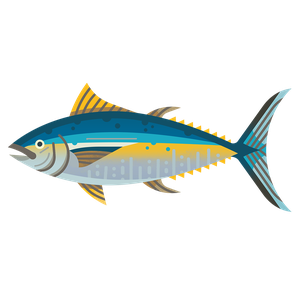
Albacore tuna
Thunnus alalunga
What to check for
Location
South Atlantic
Technical location
Atlantic, Southeast, Atlantic, Southwest, All areas, All areas
Caught by
Hook & line (pole & line)
Rating summary
Albacore tuna in the south Atlantic Ocean is not overfished and not subject to overfishing. Management of the southern Atlantic albacore stock appears to be keeping it in a healthy state. However, observer coverage in most fisheries targeting albacore is too low and needs to be improved. Some albacore tuna in the south Atlantic are caught by pole & line fishing. This is a generally low-impact method.Rating last updated January 2021.
How we worked out this Rating
Albacore tuna in the south Atlantic Ocean is not overfished and not subject to overfishing.This stock is managed and assessed by the International Commission for the Conservation of Atlantic Tunas (ICCAT). Atlantic albacore have been caught in targeted fisheries since the 1950s. In the south, catches peaked at 40,000 tonnes in 1987 and again in 2001. They have since declined to around 15,000t. The last stock assessment was carried out in 2020, using data up to 2018. The next assessment is expected in 2023.Biomass (B) of the stock steadily declined from the 1960s to drop just below target levels (Maximum Sustainable Yield, MSY) in the mid-2000s. It has since improved and has been above BMSY since 2009. In the 2020 assessment it is estimated to be 158% of BMSY. Therefore, the stock is not in an overfished state.Fishing Mortality (F) increased to above sustainable levels in the 1980s, peaked in 2001 and then declined. It has been below the target level (FMSY) since 2003 and in the 2020 assessment was estimated to be 40% of FMSY. Therefore, the stock is not subject to overfishing.Both biomass and fishing pressure are at levels last seen in the 1980s. The probability of the stock not being overfished and not undergoing overfishing is 99.4%. Catches around the MSY level of 27,000t will keep the stock from being overfished or subject to overfishing through to 2033 with 90% probability. The catch limit is set to 24,000t. Provisional catch in 2020 was around 18,000t, and the 2016-2020 average is around 15,700t.Much about the reproductive biology of Atlantic albacore is still poorly known, which undermines the advice of the scientific committee as this is critical for the stock assessment currently being used. A research program is underway to increase biological knowledge to improve the quality of scientific advice and reduce the uncertainty associated with it.
Management of the southern Atlantic albacore stock appears to be keeping it in a healthy state. However, observer coverage in most fisheries targeting albacore is too low and needs to be improved.Tuna, marlin, and swordfish are highly migratory species, found on the high seas and in numerous countries' waters. This makes harmonised and effective management challenging. Regional Fisheries Management Organisations (RFMOs) are responsible for monitoring and managing these stocks on behalf of the countries that access them. However, the degree to which management is implemented, monitored and enforced by each country varies significantly.This stock is managed and assessed by the International Commission for the Conservation of Atlantic Tunas (ICCAT). There is no Harvest Control Rule for this fishery. The main management measure is a catch limit (Total Allowable Catch, TAC).The south Atlantic albacore TAC for 2017-2022 is 24,000t, with individual catch limits assigned to each country. This increases to 28,000t for 2023-2026. Catches of up to 28,000t are expected to keep the stock from being overfished or subject to overfishing through to 2033 with 83% probability. Since the late 1990s, catch limits have been set for this stock in line with the best estimates for Maximum Sustainable Yield. Management therefore appears to be following scientific advice.Catches have generally stayed within the limits. Provisional catch in 2020 was around 18,000t, and the 2016-2020 average is around 15,700t. In 2016, countries were required to immediately improve their catch reporting systems to ensure accurate and validated catch and effort data for southern albacore. Most albacore is caught by longline. The mandatory level of observer coverage in Atlantic longline fisheries is low, at just 5%, rising to 10% in 2022. Many countries are not achieving this level. This is below the recommended minimum of 20%. Monitoring and enforcement therefore requires improvement.In terms of enforcement and compliance with management measures: in 2016 ICCAT passed measures to strengthen and streamline its compliance assessment process and to develop a scheme of responses to non-compliance. There is also a list of vessels authorised to fish for tuna and tuna-like species in the ICCAT area, and a list of vessels caught carrying out Illegal, Unreported or Unregulated activities. At-sea transhipment is prohibited unless pre-authorised and the vessel has an observer on board. Vessel Monitoring Systems are required for all vessels over 24m, but smaller vessels are less well monitored.

Some albacore tuna in the south Atlantic are caught by pole & line fishing. This is a generally low-impact method.Pole & line fishing accounts for about 19% of the albacore catch in the south Atlantic (around 4,300 tonnes in 2020). This method of fishing, also known as bait boat, targets fish near the surface, and so rarely touches the seabed and doesn't have habitat impacts. It is labour-intensive and very selective.Most southern albacore pole and line fishing is by Namibian and South African fleets. It involves fishing with rods, using live bait to attract the albacore. The baitfish, usually small pelagic species such as sardines or anchovy, are caught and stored alive nearby or on the boats. Estimates for the quantity of bait used for pole and line tuna fisheries varies depending on the specific characteristics of the fishery. It could range from 2-8%, i.e. 2-8kg of bait is needed to catch 100kg of tuna. In 2020, baitboats caught 4,300t of southern albacore. If a ratio of 5% was assumed, this would equate to 215 tonnes of baitfish being used. This is unlikely to have a significant impact on baitfish stocks. However, better monitoring and recording is needed of the use of baitfish species in order to ensure that these impacts are kept low and are appropriately managed.
References
ICCAT, 2020. 5.1 ALB - Atlantic albacore. From 2020 SCRS Advice to the Commission, September 2020, Madrid, Spain. 362pp. Available at https://www.iccat.int/Documents/SCRS/ExecSum/ALB_ENG.pdf [Accessed on 04.01.2021].ICCAT, 2021. 2021 SCRS Report: Panel 3 - South Atlantic Albacore and Southern Bluefin Tuna. Presented to the 27th Regular Meeting of the Commission. 15-23 November 2021, Online. Available at https://www.iccat.int/com2021/presentations/SCRS_Chair_2021_PA3_Presentation.pdf [Accessed on 04.01.2021].ICCAT, 2021. 2021 Secretariat Report on Research and Statistics. PLE-105 presented to the 27th Regular Meeting of the Commission. 15-23 November 2021, Online. Available at https://www.iccat.int/com2021/ENG/PLE_105_ENG.pdf [Accessed on 15.12.2021].ICCAT, 2021. Report of the Standing Committee on Research and Statistics (SCRS), 27 September - 2 October 2021, Online. Available at https://www.iccat.int/Documents/Meetings/Docs/2021/REPORTS/2021_SCRS_ENG.pdf [Accessed on 14.12.2021].ICCAT, 2022. Resolutions, Recommendations and other Decisions. Available at https://www.iccat.int/en/RecRes.asp [Accessed on 04.01.2023].IPNLF, 2012. Ensuring sustainability of livebait fish, International Pole and Line Foundation, London, 57 pp. Available at https://ipnlf.org/wp-content/uploads/2021/02/ensuring-sustainability-of-livebait-fish-reportipnlfrocliffe-printable-04-12-12-.pdf.ISSF, IPNLF, 2019. Skippers' Guidebook to Pole-and-Line Fishing Best Practices. First Edition, 2019. A Joint Publication by the International Seafood Sustainability Foundation and International Pole & Line Foundation. Available at https://www.iss-foundation.org/issf-downloads/download-info/issf-ipnlf-skippers-guidebook-to-pole-and-line-fishing-best-practices/ [Accessed on 16.12.2021].
Sustainable swaps
Learn more about how we calculate our sustainability ratings.
How our ratings work