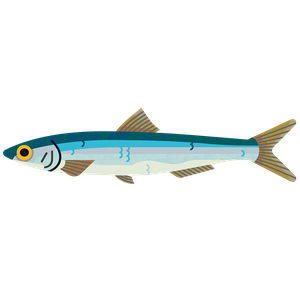
Albacore tuna
Thunnus alalunga
What to check for
Location
North Atlantic
Technical location
Atlantic, Eastern Central, Atlantic, Northeast, Atlantic, Northwest, Atlantic, Western Central, All areas, All areas, All areas, All areas
Caught by
Hook & line (longline)
Rating summary
Albacore tuna in the north Atlantic Ocean is abundant and not subject to overfishing. Some but not all appropriate relevant management measures are in place including catch limits. However, there are no limits on catches of immature albacore, which could have implications for the stock in future. Observer coverage in most fisheries targeting albacore is too low and needs to be improved. Some albacore catches from the north Atlantic are by longline. While longlining is unlikely to have habitat impacts, it can have a bycatch of highly vulnerable species such as sharks, turtles, and seabirds.Commercial buyers should establish what measures the flag state and fleet relating to their source is taking to reduce impacts to and improve reporting of interactions with vulnerable species. Large buyers should consider supporting such improvements.Rating last updated January 2024.
Technical consultation summary
The albacore stock in the north Atlantic Ocean is abundant and not subject to overfishing. A new stock assessment was carried out in 2023, using data up to 2021. It showed that in 2021, biomass was 219% of BMSY and fishing mortality was 45% of FMSY. Some but not all appropriate relevant management measures are in place. The management plan includes catch limits (Total Allowable Catches, TACs), which are based on the HCR. The TAC was 33,600t for 2018-2020, increasing to 37,801t for 2022-2023. The TAC is now above the MSY estimate (36,816t), however the current biomass is well above BMSY, so the level of catch can be sustained in the short term. There are no limits on catches of immature albacore, which could have implications for the stock in future. Observer coverage in most fisheries targeting albacore is too low and needs to be improved. Some albacore catches from the north Atlantic are by longline. While longlining is unlikely to have habitat impacts, it can have a bycatch of highly vulnerable species such as sharks, turtles, and seabirds.
How we worked out this Rating
Albacore tuna in the north Atlantic Ocean is abundant and not subject to overfishing.This stock is managed and assessed by the International Commission for the Conservation of Atlantic Tunas (ICCAT). Atlantic albacore have been caught in targeted fisheries since the 1950s. In the north, catches increased from the 1930s to peak at over 60,000 tonnes in the early 1960s. They then declined to a low of around 15,000 tonnes in 2009 and have since increased to around 32,000 tonnes. The last stock assessment was carried out in 2023, using data up to 2021.Biomass (B) of the stock steadily declined from the 1930s to below target levels (Maximum Sustainable Yield, MSY) in the 1980s and 1990s. It has since improved and has been above BMSY since 2010. In the 2023 assessment it is estimated to be 219% of BMSY. Therefore, the stock is not in an overfished state.Fishing Mortality (F) increased to above MSY levels in the 1960s, peaked in the 1980s and then declined. It has been below FMSY since the early 2000s and in the 2020 assessment was estimated to be 45% of FMSY. Therefore, the stock is not subject to overfishing.Both biomass and fishing pressure are at levels last seen in the 1960s. The probability of the stock not being overfished and not undergoing overfishing is 99.6%.The Harvest Control Rule (HCR) adopted in 2018 is expected to maintain the stock in a good state with at least 60% probability. The current management procedure results in a TAC of 47,251 tonnes for 2024-2026. This represents a 25% increase with respect to the previous one and is in line with the positive stock status estimated in the 2023 assessment. It is noted that this TAC for 2024-2026 is above the MSY estimate for this stock (41,995 tonnes); this is because the current biomass is well above BMSY (B2021/BMSY = 2.19), and therefore this level of catch can be sustained in the near term. Since the establishment of the TAC in 2001, catch has remained substantially below the limit in all but four years, which might have accelerated rebuilding over the last decade.Studies in the North Atlantic, North Pacific and the Mediterranean, suggest that environmental variability may have a serious impact on albacore stocks, affecting fisheries by changing fishing grounds, productivity levels and potential MSY of the stocks. This could explain the apparent decline in the estimated recruitment of young fish into the stocks, and needs more research. Northern albacore are targeted by fisheries which take a large number of immature and sub-adult fish, which could have implications for the stock.Much about the reproductive biology of Atlantic albacore is still poorly known, which undermines the advice of the scientific committee as this is critical for the stock assessment currently being used. A research program is underway to increase biological knowledge to improve the quality of scientific advice and reduce the uncertainty associated with it.
Management of north Atlantic albacore follows scientific advice, and appears to be well enforced. However, there are no limits on catches of immature albacore, which could have implications for the stock in future. Observer coverage in most fisheries targeting albacore is too low and needs to be improved.Tuna, marlin, and swordfish are highly migratory species, found on the high seas and in numerous countries' waters. This makes harmonised and effective management challenging. Regional Fisheries Management Organisations (RFMOs) are responsible for monitoring and managing these stocks on behalf of the countries that access them. However, the degree to which management is implemented, monitored and enforced by each country varies significantly.North Atlantic albacore is managed and assessed by the International Commission for the Conservation of Atlantic Tunas (ICCAT). It is managed through a multi-annual plan, which is supported by a Harvest Control Rule. The HCR has targets for keeping the stock at certain levels: fishing pressure should be kept at 80% of Maximum Sustainable Yield (MSY) to maintain biomass at MSY levels or higher. If biomass falls below MSY, fishing pressure will gradually be reduced in line with the level of depletion of the biomass. If the stock was to be at risk of reduced reproductive capacity (Blim), catch would be reduced to the lowest levels that can sustain adequate scientific monitoring. The HCR is expected to maintain the stock in a good state with at least 60% probability. A peer-review in 2018 concluded that the HCR was scientifically robust. Management is therefore in line with scientific recommendations. It is following what is considered to be best practice.The management plan includes catch limits (Total Allowable Catches, TACs), which are based on the HCR. Individual catch limits are assigned to each country. The TAC was 37,801t for 2022-2023, increasing to 47,251t for 2024-2026. This is a 25% increase and is in line with the positive stock status estimated in 2023. The TAC for 2024-2026 is above the MSY estimate for this stock (41,995 tonnes), this is because the biomass is well above BMSY (B2021/BMSY = 2.19), and therefore this level of catch can be sustained in the near term. Since the establishment of the TAC in 2001, catch has remained substantially below the limit in all but four years, which might have accelerated rebuilding over the last decade.Most catches of northern albacore are by traditional surface fisheries in the Bay of Biscay. These fisheries mainly catch immature and sub-adult fish. As there are no limits to control the catch of immature fish, there could be implications for the stock. There are important data gaps in these fisheries which could make the stock assessment less certain.Since 1999, capacity has been limited to the average number of vessels from 1993-1995. The effect of this has not been evaluated but a general decrease of fishing mortality has been observed since its implementation.The mandatory level of observer coverage in the Atlantic is low, at just 5% for most gears targeting albacore, so these fisheries are not well monitored. Scientific recommendations are for a minimum of 20% for accurate reporting of catch and bycatch. Requirements for longline coverage increased from 5% to 10% in 2022, but many fleets have not reached this yet (some have not reached 5%). There is no minimum requirement for observer coverage for the troll fleet, responsible for 15% of catches. Coverage for this fleet is at less than 5%. However, work is underway to develop and roll out electronic monitoring. Purse seine and longline vessels over 20m long are encouraged to increase their observer coverage from the required minimum, and some have.In terms of enforcement and compliance with management measures: in 2016 ICCAT passed measures to strengthen and streamline its compliance assessment process and to develop a scheme of responses to non-compliance. There is also a list of vessels authorised to fish for tuna and tuna-like species in the ICCAT area, and a list of vessels caught carrying out Illegal, Unreported or Unregulated activities. At-sea transhipment is prohibited unless pre-authorised and the vessel has an observer on board. Vessel Monitoring Systems are required for all vessels over 24m, but smaller vessels are less well monitored.
Some albacore catches from the north Atlantic are by longline. While longlining is unlikely to have habitat impacts, it can have a bycatch of highly vulnerable species such as sharks, turtles, and seabirds.Monitoring and reporting of bycatch in fisheries managed by ICCAT is poor. Most data come from scientific observers on vessels. Scientific recommendations are that 20% of a fishery should be observed for accurate data. ICCAT only requires coverage of 5%, increasing to 10% in 2022. Many fleets are not reaching this level. This makes it difficult to assess the impact of these fisheries on vulnerable species.Around 17% of the albacore catch from the North Atlantic is from pelagic longline fisheries. Longlining for swordfish and albacore tuna takes place closer to the surface than in other fisheries. This increases the bycatch risk, as animals such as seabirds are more easily attracted to the bait.There is a bycatch of loggerhead, leatherback and olive ridley turtles in longline fisheries. According to the IUCN Red List, loggerhead turtles are endangered in the north east Atlantic and leatherbacks are endangered in the north west Atlantic. Observer data for 2020 indicates 20 dead discards of turtles, 1,308 live discards and 20 discards of unknown status. Given the poor observer coverage, this is likely to be an underestimate of the total catch. Post-release mortality is 1-4%. Longliners are required to safely unhook and release alive turtles. Other scientifically recommended mitigation measures, such as using finfish bait and large circle hooks, are not mandated.Seabirds are known to be vulnerable to bycatch in longline fisheries. Bycatch of seabirds is understood to be most problematic in the southern Atlantic. However, increasing evidence indicates that northern species are also at risk in some longline fisheries. For example, up to 1% of the global population of northern fulmars is killed annually in gillnet and longline fishing in the North Atlantic. A study comparing multiple gears in the Atlantic Iberian coast indicated that longlines had the highest seabird bycatch. Reliable bycatch data is needed to assess whether pelagic longlines in the North Atlantic are a concern for seabirds. The required mitigation measures do not follow recommended best practice by ACAP (the Agreement on the Conservation of Albatrosses and Petrels). ICCAT requires one or more measures from a set list of options, including weighted hooks, bird scaring lines and night setting, depending on location and target species. ACAP recommends the simultaneous use of all three, or hook-shielding or underwater bait setting devices. In the Mediterranean, all these mitigation measures are voluntary.Sharks are both bycaught and targeted in longline fisheries in the Atlantic. Bycatch species include the critically endangered scalloped hammerhead, silky shark, and the bigeye thresher, which is endangered in Europe and the Mediterranean. Observer data for 2020 indicates 1,098 dead discards of sharks and 1,109 live discards. Given the poor observer coverage, this is likely to be an underestimate of the total catch. There are some mitigation measures, such as restrictions on finning, but no gear-specific measures. This is in spite of repeated recommendations from the scientific committee to use circle hooks, which have been shown to increase survival of shortfin mako, blue marlin and swordfish if accidentally caught. Catching silky sharks, hammerheads, oceanic whitetips, and bigeye threshers is prohibited, and catching other thresher species is discouraged. Shortfin mako, which is heavily overfished, can be caught and retained. However, measures came into force in 2022 aimed at ending overfishing of this species.There are no specific management measures to protect marine mammals, including cetaceans. ICCAT has not prioritised collecting data on mammal bycatch to date. More needs to be done to understand and reduce the impact of ICCAT fisheries on marine mammals.
References
ACAP, 2021. ACAP Review of mitigation measures and Best Practice Advice for Reducing the Impact of Pelagic Longline Fisheries on Seabirds. Reviewed at the Twelfth Meeting of the Advisory Committee Virtual meeting, 31 August – 2 September 2021. Available at https://www.acap.aq/resources/bycatch-mitigation/mitigation-advice/3956-acap-2021-pelagic-longlines-mitigation-review-bpa/file [Accessed on 10.01.2024].Anon., 2021. Advances on the collaborative work to assess sea turtle bycatch in pelagic longline and purse seine fleets (Atlantic and Indian oceans and Mediterranean Sea). SCRS/2021/076. Collect. Vol. Sci. Pap. ICCAT, 78(4): 155-166. Available at https://www.iccat.int/Documents/CVSP/CV078_2021/n_4/CV078040156.pdf [Accessed on 10.01.2024].Calado, J.G., Ramos, J.A., Almeida, A., Oliveira, N., Paiva, V.H., 2021. Seabird-fishery interactions and bycatch at multiple gears in the Atlantic Iberian coast, Ocean & Coastal Management, Volume 200, 105306. https://doi.org/10.1016/j.ocecoaman.2020.105306.Clarke, S., Sato, M., Small, C., Sullivan, B., Inoue, Y. & Ochi, D. 2014. Bycatch in longline fisheries for tuna and tuna-like species: a global review of status and mitigation measures. FAO Fisheries and Aquaculture Technical Paper No. 588. Rome, FAO. 199 pp. Available at https://www.fao.org/3/i4017e/i4017e.pdf.Colston-Nepali, L., Provencher, J.F., Mallory, M.L., Franckowiak, R.P., Sun, Z., Robertson G.J. & Friesen , V.L., 2020. Using genomic tools to inform management of the Atlantic northern fulmar. Conserv. Genet. 21, 1037–1050. https://doi.org/10.1007/s10592-020-01309-y.ICCAT, 2020. The development of the seabird component of the ICCAT ecosystem report card. SCRS/2020/045. Collect. Vol. Sci. Pap. ICCAT, 77(4): 144-156. Available at https://www.iccat.int/Documents/CVSP/CV077_2020/n_4/CV077040144.pdf [Accessed on 10.01.2024].ICCAT, 2024. Report of the Standing Committee on Research and Statistics (SCRS) (Hybrid / Madrid (Spain) – 25-29 September 2023). Available at https://www.iccat.int/Documents/BienRep/REP_EN_22-23-II-2.pdf [Accessed on 10.01.2024].ICCAT, 2021. Resolutions, Recommendations and other Decisions. Available at https://www.iccat.int/en/RecRes.asp [Accessed on 10.01.2024].ICCAT, 2020. 5.1 ALB - Atlantic albacore. From 2020 SCRS Advice to the Commission, September 2020, Madrid, Spain. 362pp. Available at https://www.iccat.int/Documents/SCRS/ExecSum/ALB_ENG.pdf [Accessed on 10.01.2024].ICCAT, 2020. Report of the 2020 ICCAT Atlantic Albacore Stock Assessment Meeting, 29 June - 8 July 2020, Online. 93pp. Available at https://www.iccat.int/Documents/Meetings/Docs/2020/REPORTS/2020_ALB_ENG.pdf [Accessed on 10.01.2024].ICCAT, 2020. Report of the 2020 ICCAT Atlantic Albacore Stock Assessment Meeting, 29 June - 8 July 2020, Online. 93pp. Available at https://www.iccat.int/Documents/Meetings/Docs/2020/REPORTS/2020_ALB_ENG.pdf [Accessed on 10.01.2024].ISSF, 2024. Mixed Results at ICCAT Annual Session: Compliance Reforms and Electronic Monitoring Standards Among Positive Meeting Outcomes. Available athttps://www.iss-foundation.org/about-issf/what-we-publish/2023/11/21/mixed-results-at-iccat-annual-session-compliance-reforms-and-electronic-monitoring-standards-among-positive-meeting-outcomes [Accessed on 10.01.2024].Okamoto, K., Ochi, D., and Oshima, K., 2017. Review of sea turtle by-catch data in the ICCAT convention area obtained through Japanese scientific observer program. SCRS/2017/155. Collect. Vol. Sci. Pap. ICCAT, 74(7): 3698-3713 (2018). Available at https://www.bmis-bycatch.org/system/files/zotero_attachments/library_1/BYJUU4PR%20-%20CV074073698.pdf [Accessed on 10.01.2024].
Sustainable swaps
Learn more about how we calculate our sustainability ratings.
How our ratings work