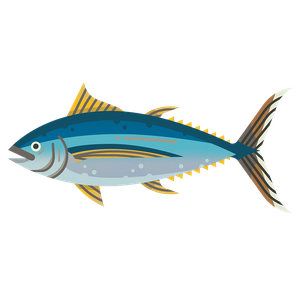
Atlantic bluefin tuna
Thunnus thynnus
What to check for
Location
East Atlantic & Mediterranean
Technical location
Atlantic, Northeast, Mediterranean and Black Sea, All areas, All areas
Caught by
Hook & line (longline)
Rating summary
Atlantic bluefin tuna in the east Atlantic and Mediterranean is recovering from historically low levels. Management has been effective at supporting stock recovery. However, there remains a lot of uncertainty about whether the stock has reached sustainable levels yet. Additionally, some illegal fishing is taking place. Some east Atlantic bluefin tuna are caught by longlining. While longlining is unlikely to have habitat impacts, it can have a bycatch of highly vulnerable species such as sharks, turtles, and seabirds.Rating last updated January 2023
Technical consultation summary
Atlantic bluefin tuna in the east Atlantic and Mediterranean is recovering from historically low levels. There remains concern for abundance, but not for fishing pressure. A new stock assessment was carried out in 2022, using data up to 2020, but it has not changed the perception of the stock. Route 2 (data limited) scoring has been applied to this rating owing to the lack of reference points. Assessments confirm a recent stock biomass increase, although the magnitude of the increase remains difficult to quantify. Given the levels of uncertainty, and that the stock is recovering from very low levels, MCS considers that there is still concern for the biomass. F in 2020 is estimated to be 81% of F0.1, the proxy for FMSY. This is an increase from the estimate of average F from 2015-2017, which was 42.6% of the target level. However, F remains below the target and therefore, there is no concern for fishing pressure. Management has been effective at supporting stock recovery. There is a harvest control rule and a series of measures to control fleet capacity, catches, and size limits. However, there remains a lot of uncertainty about whether the stock has reached sustainable levels yet. Additionally, some illegal fishing is taking place. Most of the catch is by purse seiners, mostly on juveniles, which are taken alive to tuna farms for fattening. While there is no data in the latest stock assessment relating to ages and sizes of tuna caught, a high catch of juveniles would be very concerning for the long-term growth of the stock. Some east Atlantic bluefin tuna are caught by longlining. While longlining is unlikely to have habitat impacts, it can have a bycatch of highly vulnerable species such as sharks, turtles, and seabirds. Monitoring and reporting of bycatch in fisheries managed by ICCAT is generally poor. This makes it difficult to assess the impact of these fisheries on vulnerable species.
How we worked out this Rating
Atlantic bluefin tuna in the east Atlantic and Mediterranean is recovering from historically low levels. There remains concern for abundance, but not for fishing pressure.Atlantic bluefin tuna is managed and assessed by the International Commission for the Conservation of Atlantic Tunas (ICCAT). The eastern stock was heavily fished from the 1950s until 1996, when management measures caused catches to drop from a peak of 60,000 tonnes to 10,00 tonnes. Recent catches have been around 30,000 tonnes. The last stock assessment was carried out in 2022, using data up to 2020. It is unclear when the next assessment will be carried out.Route 2 (data limited) scoring has been applied to this rating owing to the lack of reference points in stock assessments. Atlantic bluefin tuna is considered to have medium resilience to fishing pressure.The stock declined from the 1970s until 1991, coming close to stock collapse. It began to increase in the mid-2000s when a recovery plan was implemented. Assessments confirm a recent stock biomass increase, although the magnitude of the increase remains difficult to quantify. The assessment depends on recruitment estimates, which are highly unstable. It is also closely related to assumptions made about stock structure and migratory behaviour, which are poorly known. Given the levels of uncertainty, and that the stock is recovering from very low levels, MCS considers that there is still concern for the biomass.Fishing mortality (F) increased from the 1970s until the recovery plan was introduced, and then declined sharply. It has recently been increasing again, but remains below the target level. F in 2020 is estimated to be 81% of F0.1, which is a proxy for FMSY and has been set with the aim of maintaining the biomass at B0.1. This is an increase from the estimate of average F from 2015-2017, which was 42.6% of the target level. However, F remains below the target and therefore, there is no concern for fishing pressure.The outlook for this stock is highly uncertain because of the uncertainties in the data. However, it is projected that the spawning biomass will increase under the current TAC of 36,000t.The fattening and farming activities in the Mediterranean since 1997 have resulted in increasing but unknown catches of juveniles going into farms. There have been considerable improvements in data quality and quantity over the past few years but important gaps remain.It is unclear how much of the Eastern Atlantic stock mixes with and supports the Western Atlantic stock.Atlantic bluefin was listed as Endangered on the IUCN Red List until 2021, when it was moved to Least Concern. It is still listed as Endangered in the Mediterranean and Gulf of Mexico.
Management has been effective at supporting stock recovery. However, there remains a lot of uncertainty about whether the stock has reached sustainable levels yet. Additionally, some illegal fishing is taking place.Tuna, marlin, and swordfish are highly migratory species, found on the high seas and in numerous countries' waters. This makes harmonised and effective management challenging. Regional Fisheries Management Organisations (RFMOs) are responsible for monitoring and managing these stocks on behalf of the countries that access them. However, the degree to which management is implemented, monitored and enforced by each country varies significantly.Atlantic bluefin tuna is managed and assessed by the International Commission for the Conservation of Atlantic Tunas (ICCAT). After the eastern stock came close to collapse in the early 2000s, a rebuilding plan was introduced. It ran from 2007-2017, and included catch reductions and increases in minimum landing size. Although it is not known if the stock has reached target levels (Biomass at levels associated with Maximum Sustainable Yield), fishing pressure (F) was brought below FMSY. These measures are thought to have contributed to the subsequent rapid stock increase.During 2022, a number of management options were tested. Based on this, a new management procedure was introduced in 2023 that covers both east and west Atlantic bluefin tuna. It will be reviewed every 6 years. It includes harvest control rules that form the basis for setting catch limits (Total Allowable Catches, TACs) on a 3-yearly basis. Stocks must have a 60% or greater probability of not being overfished or subject to overfishing, and a less than 15% probability of being below Blim. Annual changes in TAC can be up to 20% increase or 35% decrease.TAC for 2023-2025 is 40,570t, split between the various catching countries. This is an increase from the 2020-2022 TAC of 36,000t. The stock assessment projected that catches of 36,000 tonnes would allow the stock to increase, but it is unclear what the expected impact of 40,000t would be. It is also unclear how management will ensure that biomass is above target thresholds with 60% probability when assessments have been unable to indicate the biomass. However, it appears that management is following the available scientific advice and has been effective at recovering the stock to date.Average catch from 2017-2021 was 30,500 tonnes - below the TAC. However, the Scientific Committee has been informed of unquantified illegal catches of unknown magnitude. Given the high levels of uncertainty around the status of the stock, this is of concern.Most of the catch is by purse seiners, mostly on juveniles, which are taken alive to tuna farms for fattening. While there is no data in the latest stock assessment relating to ages and sizes of tuna caught, a high catch of juveniles would be very concerning for the long-term growth of the stock.Management measures also include:To protect spawning grounds (the precise location of which are still being identified), there are open seasons, varying depending on gear and location.Annual fishing and farming plans must be submitted by each country, to include quotas and fishing seasons for each gear type.Countries must calculate the fishing capacity needed to deliver their set quotas, and reduce current capacity, e.g. by reducing licenses or vessel sizes, if it is too high. The allowed number of baitboats and trolls is frozen to 2006 levelsThere is a minimum size of 30kg or 115cm, although there are some exceptions, e.g. baitboats and trolls.Aerial vehicles cannot be used to help vessels find bluefin tuna.As of 2006, catch of Atlantic bluefin by longliners from the central Atlantic is frozen to levels caught in 1999/2000 as mixing of eastern and western stocks in this area is not well understood.Minimum observer coverage is higher than for other stocks and varies by gear: 20% for longliners, pelagic trawlers, and bait boats over 15m; 100% for purse seiners, towing vessels, and harvesting operations from traps.Countries must keep a list of vessels and traps authorised to fish for, and facilities authorised to farm, this species. Transhipment at sea is prohibited, and may only take place in designated ports with prior authorisation. Vessels over 15m must have Vessel Monitoring Systems. There is a catch documentation scheme, which since 2018 is fully electronic to improve tracking of bluefin from catch to farm to export.A small amount of bluefin tuna (less than 500 tonnes) is caught in Marine Stewardship Council-certified fisheries. Certifications are conditional improving the understanding of the stock and the fishery, and better monitoring of impacts on other species. This rating covers these certified fleets as well as uncertified fleets.
Some east Atlantic bluefin tuna are caught by longlining. While longlining is unlikely to have habitat impacts, it can have a bycatch of highly vulnerable species such as sharks, turtles, and seabirds.Longline catches of east Atlantic bluefin account for about 15% of the total catch.Monitoring and reporting of bycatch in fisheries managed by ICCAT is generally poor. Most data come from scientific observers on vessels. Recommendations are that 20% of a fishery should be observed for accurate data. ICCAT only requires coverage of 10% for most longliners, and many fleets are not reaching this level. While coverage on large longliners (over 15m) targeting bluefin is 20%, the data provided is for all gears combined so this does little to improve understanding of bycatch. This makes it difficult to assess the impact of these fisheries on vulnerable species.There is a bycatch of loggerhead, leatherback and olive ridley turtles in longline and purse seine fisheries. According to the IUCN Red List, loggerhead turtles are endangered in the north east Atlantic and leatherbacks are endangered in the north west Atlantic. Observer data for all gears for the whole Atlantic for October 2021 - October 2022 indicates: 190 dead discards of turtles, 3,752 live discards and 69 discards of unknown status. Given the poor observer coverage, this is likely to be an underestimate of the total catch. Data on the impact of individual fisheries is not publicly available. Post-release mortality is 1-4%. Longliners are required to safely unhook and release alive turtles, and purse seiners must avoid encircling them. In 2023, ICCAT brought in additional measures that had been scientifically recommended and proven to be effective, which is to use either circle hooks or finfish bait, or other recommended measures. However, countries achieving 10% observer coverage can request an exemption from this.Seabirds are known to be vulnerable to bycatch in longline fisheries. Observer data for all gears for the whole Atlantic for October 2021 - October 2022 indicates: 1,376 dead discards of seabirds, 55 live discards and 64 discards of unknown status. Given the poor observer coverage, this is likely to be an underestimate of the total catch. Data on the impact of individual fisheries is not publicly available. Bycatch of seabirds is understood to be most problematic in the southern Atlantic. However, increasing evidence indicates that northern species are also at risk in some longline fisheries. For example, up to 1% of the global population of northern fulmars is killed annually in gillnet and longline fishing in the North Atlantic. A study comparing multiple gears in the Atlantic Iberian coast indicated that longlines had the highest seabird bycatch. Reliable bycatch data is needed to assess whether pelagic longlines in the North Atlantic are a concern for seabirds. The required mitigation measures do not follow recommended best practice by ACAP (the Agreement on the Conservation of Albatrosses and Petrels). ICCAT requires one or more measures from a set list of options, including weighted hooks, bird scaring lines and night setting, depending on location and target species. ACAP recommends the simultaneous use of all three, or hook-shielding or underwater bait setting devices. In the Mediterranean, all these mitigation measures are voluntary.Sharks are both bycaught and targeted in longline fisheries in the Atlantic. Bycatch species include the critically endangered scalloped hammerhead, silky shark, and the bigeye thresher, which is endangered in Europe and the Mediterranean. Observer data for all gears for the whole Atlantic for October 2021 - October 2022 indicates: 804 dead discards of sharks and 1,082 live discards. Data on the impact of individual fisheries is not publicly available. Given the poor observer coverage, this is likely to be an underestimate of the total catch. There are some mitigation measures, such as restrictions on finning, but no gear-specific measures. This is in spite of repeated recommendations from the scientific committee to use circle hooks, which have been shown to increase survival of shortfin mako, blue marlin and swordfish if accidentally caught. Circle hooks to prevent turtle bycatch are only required between 55 degrees N and 35 degrees S, which will not cover the full range of these species. Catching silky sharks, hammerheads, oceanic whitetips, and bigeye threshers is prohibited, and catching other thresher species is discouraged. Shortfin mako, which is heavily overfished, can be caught and retained. However, measures came into force in 2022 and 2023, aimed at ending overfishing of this species.Mediterranean swordfish is also targeted by longliners, and caught as bycatch in albacore and bluefin longline fisheries. While there are restrictions on when albacore fishing can take place to reduce swordfish bycatch, there are no measures to control bluefin longlining.There are no specific management measures to protect marine mammals, including cetaceans. ICCAT has not prioritised collecting data on mammal bycatch to date. More needs to be done to understand and reduce the impact of ICCAT fisheries on marine mammals.To a lesser extent, bluefin is also captured in illegal gill net fisheries. For EU Member States, driftnet fishing for tuna has been banned since January 2002, yet remains a problem in some Italian fisheries and is still officially permitted in Morocco. Gill netting, especially offshore drift netting, encounters a very high proportion of bycatch and would receive a default red rating from MCS.
References
ACAP, 2021. ACAP Review of mitigation measures and Best Practice Advice for Reducing the Impact of Pelagic Longline Fisheries on Seabirds. Reviewed at the Twelfth Meeting of the Advisory Committee Virtual meeting, 31 August – 2 September 2021. Available at https://www.acap.aq/resources/bycatch-mitigation/mitigation-advice/3956-acap-2021-pelagic-longlines-mitigation-review-bpa/file [Accessed on 09.12.2021].Anon., 2021. Advances on the collaborative work to assess sea turtle bycatch in pelagic longline and purse seine fleets (Atlantic and Indian oceans and Mediterranean Sea). SCRS/2021/076. Collect. Vol. Sci. Pap. ICCAT, 78(4): 155-166. Available at https://www.iccat.int/Documents/CVSP/CV078_2021/n_4/CV078040156.pdf [Accessed on 16.12.2021].Calado, J.G., Ramos, J.A., Almeida, A., Oliveira, N., Paiva, V.H., 2021. Seabird-fishery interactions and bycatch at multiple gears in the Atlantic Iberian coast, Ocean & Coastal Management, Volume 200, 105306. https://doi.org/10.1016/j.ocecoaman.2020.105306.Clarke, S., Sato, M., Small, C., Sullivan, B., Inoue, Y. & Ochi, D. 2014. Bycatch in longline fisheries for tuna and tuna-like species: a global review of status and mitigation measures. FAO Fisheries and Aquaculture Technical Paper No. 588. Rome, FAO. 199 pp. Available at https://www.fao.org/3/i4017e/i4017e.pdf.Collette, B.B., Boustany, A., Fox, W., Graves, J., Juan Jorda, M. & Restrepo, V. 2021. Thunnus thynnus. The IUCN Red List of Threatened Species 2021: e.T21860A46913402. Available at https://dx.doi.org/10.2305/IUCN.UK.2021-2.RLTS.T21860A46913402.en [accessed on 17.12.2021].Colston-Nepali, L., Provencher, J.F., Mallory, M.L., Franckowiak, R.P., Sun, Z., Robertson G.J. & Friesen , V.L., 2020. Using genomic tools to inform management of the Atlantic northern fulmar. Conserv. Genet. 21, 1037–1050. https://doi.org/10.1007/s10592-020-01309-y.Froese, R. and Pauly, D. (Editors), 2023. Thunnus thynnus, Atlantic bluefin tuna. Available at https://www.fishbase.de/summary/Thunnus-thynnus.html [Accessed on 11.01.2023].ICCAT, 2020. The development of the seabird component of the ICCAT ecosystem report card. SCRS/2020/045. Collect. Vol. Sci. Pap. ICCAT, 77(4): 144-156. Available at https://www.iccat.int/Documents/CVSP/CV077_2020/n_4/CV077040144.pdf [Accessed on 16.12.2021].ICCAT, 2022. Report of the Standing Committee on Research and Statistics (SCRS). Revision, 6 October 2022. 26-30 September 2022. Madrid, Spain and Online. Available at https://www.iccat.int/com2022/ENG/PLE_104_ENG.pdf [Accessed on 04.01.2023].ICCAT, 2022. Resolutions, Recommendations and other Decisions. Available at https://www.iccat.int/en/RecRes.asp [Accessed on 04.01.2023].ICCAT, 2022. 2022 Secretariat Report on Research and Statistics. PLE-105/2022 presented to the 23rd Special Meeting of the Commission. 13-21 November 2022, Vale do Lobo, Portugal. Available at https://www.iccat.int/com2022/ENG/PLE_105_ENG.pdf [Accessed on 10.01.2023].Mucientes, G., Vedor, M., Sims, D. and Queiroz, N., 2022. Unreported discards of internationally protected pelagic sharks in a global fishing hotspot are potentially large. Biological Conservation: 269. https://doi.org/10.1016/j.biocon.2022.109534.Okamoto, K., Ochi, D., and Oshima, K., 2017. Review of sea turtle by-catch data in the ICCAT convention area obtained through Japanese scientific observer program. SCRS/2017/155. Collect. Vol. Sci. Pap. ICCAT, 74(7): 3698-3713 (2018). Available at https://www.bmis-bycatch.org/system/files/zotero_attachments/library_1/BYJUU4PR%20-%20CV074073698.pdf [Accessed on 16.12.2021].Sieben, C., Gascoigne, J. and des Clers, S., 2020. Marine Stewardship Council (MSC) Public Certification Report: SATHOAN French Mediterranean Bluefin tuna artisanal longline and handline fishery, October 2020. Prepared by Control Union UK Ltd on behalf of CM des pêcheurs de Sète Môle – OP SATHOAN. 387pp. Available at https://fisheries.msc.org/en/fisheries/sathoan-french-mediterranean-bluefin-tuna-artisanal-longline-and-handline-fishery/@@view [Accessed on 11.01.2023].
Sustainable swaps
Learn more about how we calculate our sustainability ratings.
How our ratings work