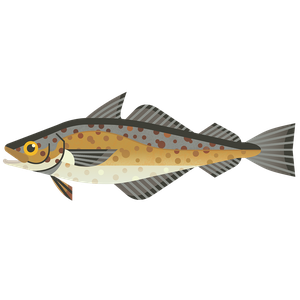
Atlantic cod
Gadus morhua
What to check for
Location
Northeast Arctic (Barents and Norwegian Sea)
Technical location
Atlantic, Northeast, Barents Sea, Norwegian Sea, Spitzbergen, and Bear Island
Caught by
Hook & line (longline)
Certification
Marine Stewardship Council (MSC)
Rating summary
The population of cod in the northeast Arctic is subject to overfishing and is being overfished. There is a management plan, which is responsive to stock status to an extent, but it has not protected the stock from overexploitation. Some Arctic cod is caught by longlining. This method is thought oto have low levels of bycatch, but the impacts of the fishery are not fully understood. This rating covers MSC-certified longline Arctic cod fisheries only.Rating last updated August 2025.
Technical consultation summary
The population of cod in the northeast Arctic is declining but remains above target levels. However, it is being overfished. The most recent stock assessment was carried out by the Joint Russian-Norwegian Arctic Fisheries Working Group (JRN-AFWG) in 2025 using data up to 2025. In 2025 the biomass was 330,486t, this is below MSY BTrigger (460,000t) and the halfway point between Btrigger and Blim (340,000t), but is above Blim (220,000t). The stock considered in an overfished state and there is concern for the biomass levels. Fishing mortality (F) decreased from a peak of 0.94 in the 1990s to a low of 0.29 in 2012. It has since increased to 0.627 in 2024. The F associated with Maximum Sustainable Yield (FMSY) is now between 0.4 and 0.6, depending on stock size, according to a Harvest Control Rule. For 2024, FMSY was set at 0.4. The current F is below Flim (0.74), which is the point at which fishing pressure would result in the stock falling to Blim. However, it is above the halfway point between FMSY and Flim (0.57), suggesting a concerning level of overfishing. There is a management plan, which is responsive to stock status to an extent. It is supported by a series of technical measures and appears to be well monitored. However, fishing pressure is above sustainable limits because the TAC is constrained to a 20% reduction and scientific advice is for more than this. Management has not protected the stock from overexploitation. Some Arctic cod is caught by longlining. This method can have a bycatch of endangered seabird species, but the impacts of this are not fully understood. This rating covers certified longline Arctic cod fisheries only. They are thought to have low levels of bycatch, but there are records of interactions with ivory gulls and northern fulmar. There is a small bycatch of the endangered and declining Arctic golden redfish. It does not seem likely that this fishery is contributing to the decline of this species.
How we worked out this Rating
The population of cod in the northeast Arctic is subject to overfishing and is being overfished.NE Arctic cod catches have fluctuated since the 1950s, exceeding 1 million tonnes in the mid-1950s, late 1960s, and mid 1970s. Recent catches have been around 500,000 tonnes.The most recent stock assessment was carried out by the Joint Russian-Norwegian Arctic Fisheries Working Group (JRN-AFWG) in 2025 using data up to 2025. JRN-AFWG consists of scientists from VNIRO (Russia) and IMR (Norway).The stock assessment defines reference points for fishing pressure (F) and biomass (B). For fishing pressure, there is a target to keep F at or below Maximum Sustainable Yield (MSY). For biomass, there is no target. However, there is a trigger point (MSY BTrigger). Below this level, F should be reduced to allow the stock to increase. Because BMSY is not defined, the Good Fish Guide applies its own definition of 1.4 x MSY BTrigger.Spawning-stock biomass (SSB) declined from around 1 million tonnes in the 1950s to fluctuate around the point of reproductive impairment (Blim) throughout the 1960s-1980s. SSB subsequently peaked at over 2.2 million tonnes in 2013 and has been declining since following poor recruitment of young fish into the population. In 2025 the biomass was 330,486t, this is below MSY BTrigger (460,000t) and the halfway point between Btrigger and Blim (340,000t), but is above Blim (220,000t). Therefore, the stock is considered in an overfished state and there is concern for the biomass levels.Fishing mortality (F) decreased from a peak of 0.94 in the 1990s to a low of 0.29 in 2012. It has since increased to 0.627 in 2024. The F associated with Maximum Sustainable Yield (FMSY) is now between 0.4 and 0.6, depending on stock size, according to a Harvest Control Rule. For 2024, FMSY was set at 0.4. The current F is below Flim (0.74), which is the point at which fishing pressure would result in the stock falling to Blim. However, it is above the halfway point between FMSY and Flim (0.57), suggesting a concerning level of overfishing.JRN-AFWG advises that when the Joint Norwegian–Russian Fisheries Commission management plan is applied, catches in 2026 should be no more than 269,440 tonnes. This is 14% lower than the previous year's advice owing to the declining stock trend. It is expected to result in a 10% increase in SSB.Because SSB is below Bpa in 2026 there is no 20% limit on the annual change in TAC.It is noted that this assessment would normally have been carried out by the International Council for the Exploration of the Sea (ICES). However, in 2022-2024 the advice was conducted outside ICES, by JRN-AFWG, and should not be considered as ICES advice. However, the assessment and advice was produced following the methodology agreed at the ICES benchmark in 2021. This is due to Russian scientists being temporarily suspended from that body in 2022 and the Russian decision to withdraw from ICES in 2024.
Some appropriate management measures are in place. There is a management plan, but fishing pressure is above sustainable limits.There are numerous Marine Stewardship Council certified fisheries for northeast Arctic and Barents Sea cod. The largest are the Norway North East Arctic cod, which covers the entire Norwegian fleet; FIUN Barents & Norwegian Seas cod and haddock; and Barents Sea cod, haddock and saithe. In 2023, they appear to have caught around 550,000t of NE Arctic cod combined, accounting for 95% of total catches. There is also a small certified UK fleet, which fishes in Norwegian waters and caught around 5,000t in 2024. Certified fisheries are subject to regular audits and must meet certain requirements for traceability. Further information about management measures is below. There appears to be little difference between the certified and uncertified components of this fishery, as most measures are from national and international legislation rather than than voluntary measures by certified fleets. Russia and Norway are the main countries catching cod in the northeast Arctic, accounting for about 90% of the total catch. The European Union, Greenland, Iceland, the Faroe Islands, and the United Kingdom also catch smaller amounts of cod in this region.This stock is managed through the Joint Russian-Norwegian Fisheries Commission (JRNFC) management plan. ICES considers it to be precautionary. The goal is to maintain the cod stock at a level that allows for sustainable fishing, known as Maximum Sustainable Yield (MSY). To determine the amount that can be caught, the plan has used a Harvest Control Rule since 2016. It calculates catch limits, called Total Allowable Catches (TACs), based on the size (spawning biomass) of the stock. These catch limits are then divided among the countries involved in fishing. The TACs can change by a maximum of 20% from one year to the next, unless the stock falls below a certain threshold. This stability helps to ensure the sustainability of the fishery even if the cod stock size fluctuates. 10% of the TAC can also be transferred between years.Currently, stock assessments are carried out by the Joint Russian-Norwegian Arctic Fisheries Working Group (JRN-AFWG) this is due to Russian scientists being temporarily suspended from the usual assessment body, the International Council for the Exploration of the Sea (ICES), in 2022 and the Russian decision to withdraw from ICES in 2024. Despite this change, the assessments still follow the agreed format and methodology of ICES, so this situation does not appear to be of concern for stock management.Between 2002 and 2008 there were high levels of unreported (IUU) catches, but since 2009 there has been close alignment between total catches and officially reported landings. From 2016 - 2020, TACs were set above scientific advice, but from 2021 to 2024 they have matched it. However, in 2025 TAC (340,000t) has been set 9% above advice. Overall, catches have been slightly below or equal to TACs, but were slightly above TAC in 2022 and 2023. Average catch from 2020-2024 was 642,998t - 88% of the advised limit.Therefore, management seems to be responsive to the status of the stock, has recently been following scientific advice, and catches have been overall compliant. However, reports note that the stock size has been decreasing in recent years due to low incoming recruitment and increasing fishing mortality (F). The reasons for low recruitment are unclear. The increase in F is partly due to the limit on TAC reductions and the transferring of quotas between years. The original advised reduction in TAC from 2023 to 2024 based on stock size was 37%, but was constrained to only a 20% decrease by the HCR. F is currently above MSY. Spawning stock size is approaching Bpa, below which recruitment may be impaired. If it falls below this level, the 20% constraint will be removed. Therefore, management has not fully protected the stock from overexploitation.In addition to the Harvest Control Rule described above, there are various other regulations. There is a minimum landing size to protect juveniles (44cm for cod and 40cm for haddock) and limits on how many undersize fish can be caught (15% for cod, haddock and saithe combined of the total catch). Bottom trawlers targeting cod and haddock in the northeast Arctic must use at least 130mm mesh size and have a sorting grid in the net, which help small fish and other species to escape. Some areas are closed to fishing to protect juveniles, and vessels that catch too many juveniles must move 5nm away from the location. Discarding of unwanted or below-minimum-size fish is considered to be negligible in recent years.Vessel monitoring systems are required on all Norwegian vessels, regardless of size, allowing real-time tracking of fishing locations and compliance with closed areas. Catches are reported electronically, which helps to monitor compliance with catch limits. The Russian fleet has 100% scientific observer coverage, which ensures catch data is accurate.Increased surveillance and monitoring at sea and in the air by Russian and Norwegian authorities, including greater participation by regulation-compliant fishing vessels, and greater cooperation from receiving port authorities, is reported to have practically eradicated Illegal, Unreported and Unregulated fishing in the Barents Sea.A small part of the centre of the Barents Sea is beyond national jurisdiction and is therefore an area of high seas. It is known as “the Loophole”. Fishing here is managed through the Northeast Atlantic Fisheries Commission (NEAFC) and by coastal states.
Some Arctic cod is caught by longlining. This method can have a bycatch of endangered seabird species, but the impacts of this are not fully understood.Most Arctic cod (around 70%) is caught by trawling, with the remainder by longline, jig, gillnet and Danish seine. Most catches are by Russia and Norway. The fishery takes place in the Barents and Norwegian Seas.The longline fishery is thought to have low levels of bycatch, but there are records of bycatch of endangered, threatened and protected species. This includes ivory gulls and northern fulmar. Ivory gulls are endangered, while northern fulmars are abundant in some areas but endangered in others. A better understanding is needed of the impacts of this fishery on these species. Norwegian regulations require bird scarers on longliners, which reduces interactions. However, this does not meet best practice recommendations. For example, the Agreement on the Conservation of Albatrosses and Petrels (ACAP) states that the most effective measures are line weighting to sink baited hooks and reduce their availability to seabirds, bird scaring lines, and setting longlines at night.There may be bycatch of elasmobranchs. Greenland shark has been reported, but at very low levels - 4 records between 2015 and 2022.There is a small bycatch of the endangered and declining Arctic golden redfish. ICES recommends zero catch of this species, but around 10,000t were caught in 2021. Most catches were by trawling, with only 6% by longline. Catches by the main certified longline fleets averaged 100 tonnes from 2017-2019 - 0.01% of the total golden redfish catch. Therefore, while all sources of bycatch should be avoided, it does not seem likely that this fishery is contributing to the decline of this species.Longlining uses bait to attract the target species. Bait use is understood in some fisheries but not others. Better monitoring is needed to ensure that the fishery is not having a negative impact on bait species such as squid, herring and mackerel.Longline fisheries have much lower impact on habitats than bottom-towed gear such as trawls. However, if they are bottom longlines using anchoring systems, or are dragged across the seabed during fishing and hauling, they can snag on or otherwise affect vulnerable species such as corals and sponges, which can be slow to recover. There are designated MPAs in Norwegian and Russian waters, within which all fishing is prohibited. It is an offence for any fishing vessel to fish on or in close proximity to known areas of coral reef or coral garden. Norwegian vessels report the presence of cold-water corals or sponges in a catch and then move 2-5 miles away to continue fishing - this is monitored through Vessel Monitoring Systems.Cod is the most important predator among fish species in the Barents Sea. The impact of removals of this species by fishing is unclear.
References
ACAP, 2024. ACAP Review of Mitigation Measures and Best Practice Advice for Reducing the Impact of Demersal Longline Fisheries on Seabirds. Reviewed at the Fourteenth Meeting of the Advisory Committee. 12 - 16 August 2024, Lima, Peru. Available at https://acap.aq/resources/bycatch-mitigation/mitigation-advice/4839-acap-2024-demersal-longline-review-bpa/file [Accessed on 06.08.2025].Aravind, V., Stashkevich, N. and Shulezhko T., 2025. Marine Stewardship Council Reassessment. Public Certification Report: FIUN Barents & Norwegian Seas cod and haddock. Carried out by UCSL United Certification Systems Limited Assessment on behalf of The Fishing Industry Union of the North (FIUN). 08 April 2025. Available at https://fisheries.msc.org/en/fisheries/fiun-barents-norwegian-seas-cod-and-haddock/@@assessments [Accessed on 06.08.2025].Clark, M., Althaus, F., Schlacher, T., Williams, A., Bowden, D., Rowden, A., 2016. The impacts of deep-sea fisheries on benthic communities: a review. ICES Journal of Marine Science 73: suppl_1. P. i51–i69. https://doi.org/10.1093/icesjms/fsv123.Dierschke, V., Christensen-Dalsgaard, S., Koschinski, S. 2022. Pilot Assessment of Marine bird bycatch. In: OSPAR, 2023: The 2023 Quality Status Report for the North-East Atlantic. OSPAR Commission, London. Available at https://oap.ospar.org/en/ospar-assessments/quality-status-reports/qsr-2023/indicator-assessments/marine-bird-bycatch-pilot/ [Accessed on 10.07.2023].Honneland, G., Scarcella, G., & Hoare, D., 2023. Marine Stewardship Council Public Certification Report: Barents Sea cod, haddock and saithe. Carried out by LRQA on behalf of Norebo Group. April 2022. Available at https://fisheries.msc.org/en/fisheries/barents-sea-cod-haddock-and-saithe/@@assessments [Accessed on 06.08.2025].ICES. 2025. Arctic Fisheries Working Group (AFWG). ICES Scientific Reports. 7:66. 339 pp. Available at: https://doi.org/10.17895/ices.pub.29234186 [Accessed on 06.08.2025].CES. 2024. Norwegian Sea ecoregion – fisheries overview. In Report of the ICES Advisory Committee, 2024. ICES Advice 2024, section 12.2, Available at: https://doi.org/10.17895/ices.advice.27879897 [Accessed on 06.08.2025].ICES, 2021. Barents Sea Ecoregion – Ecosystem overview. In Report of the ICES Advisory Committee, 2021. ICES Advice 2021, Section 5.1, Available at: https://doi.org/10.17895/ices.advice.9438 [Accessed on 06.08.2025].ICES, 2021. Benchmark Workshop for Barents Sea and Faroese Stocks ( WKBARFAR 2021).ICES Scientific Reports. 3: 21. 205 pp. https://doi.org/10.17895/ices.pub.7920. [Accessed on 06.08.2025].ICES, 2022. Barents Sea ecosystem - fisheries overview. In Report of the ICES Advisory Committee, 2022. ICES Advice 2022, section 5.2. https://doi.org/10.17895/ices.advice.21640814. [Accessed on 06.08.2025].ICES, 2022. Norwegian Sea ecoregion –Ecosystem overview. In Report of the ICES Advisory Committee, 2022. ICES Advice 2022, Section 12.1, https://doi.org/10.17895/ices.advice.21731726. [Accessed on 06.08.2025].Japp, D.,& Sharov, A., 2025. Marine Stewardship Council: Third Surveillance Audit. Barents Sea cod, haddock and saithe. Carried out by United Certification Systems Limited (UCSL) on behalf of Norebo Group. 3 July 2025. Available at https://fisheries.msc.org/en/fisheries/barents-sea-cod-haddock-and-saithe/@@assessments [Accessed on 06.08.2025].JRN-AFWG, 2025. Advice on fishing opportunities for Northeast Arctic cod in 2026 in ICEAS subareas 1 and 2. Report series IMR-PINRO 2025-4 Published: 01.07.2025 Available at: https://www.hi.no/en/hi/nettrapporter/imr-pinro-2025-4 [Accessed on 07.07.2025].Pham, C., Diogo, H., Menezes, G., Porteiro, F., Braga-Henriques, A., Vandeperre F. and Morato, T., 2014. Deep-water longline fishing has reduced impact on Vulnerable Marine Ecosystems. Sci Rep 4, 4837. https://doi.org/10.1038/srep04837.
Sustainable swaps
Learn more about how we calculate our sustainability ratings.
How our ratings work