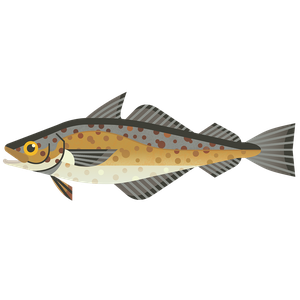
Atlantic cod
Gadus morhua
What to check for
Location
East Greenland
Technical location
Atlantic, Northeast, Atlantic, Northwest, East Greenland, NAFO 1
Caught by
Fish trap
Rating summary
Cod in East Greenland is very data limited. For this reason, we consider there to be concern for the biomass and fishing pressure. Few appropriate management measures are in place. There is a management plan but, historically, catch limits have substantially exceeded scientific advice. Most East Greenland cod is caught by traps known as poundnets. This is a generally low impact method of fishing.Rating last updated May 2024.
Technical consultation summary
Cod in East Greenland is very data limited. For this reason, we consider there to be concern for the biomass and fishing pressure. There is no assessment of the stock biomass. In the absence of this data, and noting that the stock is recovering from a collapsed state, we consider there to be concern for the biomass. There is no assessment of fishing pressure. Landings have steadily increased since 2001. ICES notes that, to date, the fishery has never been limited by a TAC because the TAC has always been set well above the fleet capacity or raised when reached. Based on the historic lack of fishing controls and the current absence of information, we consider there to be concern for the fishing pressure.Few appropriate management measures are in place. There is a management plan but, historically, catch limits have substantially exceeded scientific advice. The current management plan dates from 2021 and includes a spawning closure and two management area TACs. While stock assessments prior to 2023 are not comparable to current catch advice, they provide an indication of how closely management has been following scientific advice. ICES noted in its 2022 assessment that TACs have never followed advice. In 2021, when the latest management plan was implemented, ICES advised catches of up to 6,091t. The TAC was set at 26,091t. This suggests that, to date, scientific advice has not been followed and is not adequately protecting the stock from overexploitation. Total advice for the three Greenlandic stocks combined for 2024 is 29,021t. The combined TACs in 2023 were 51,445t. This implies a substantial reduction in TAC to meet the new advice and prevent overexploitation. It is too early to tell whether management will follow the new advice.Most East Greenland cod (60-80%) is caught by traps known as poundnets. There are records of humpback whale entanglement in poundnets in Greenland. Gillnets and poundnets are listed as high risk for marine mammals but no data is available after 2016. Whale hunting is permitted in Greenland, and is a larger source of documented removals than entanglements. The North Atlantic Marine Mammal Commission has concluded that 25 removals per year are safe for the period 2019-2024. There is some uncertainty, given the lack of recent entanglement data. However, it appears that, in general, total removals from hunting and entanglement are within the suggested sustainable limits. Humpback whale populations are increasing. Therefore, we consider that entanglement rates are unlikely causing populations to decline. Any indications of a declining population could affect this score in future.
How we worked out this Rating
Cod in East Greenland is very data limited. For this reason, we consider there to be concern for the biomass and fishing pressure.The cod caught around Greenland is from four separate stocks, which are defined based on where they spawn:Offshore Western Greenland (WOSC)Inshore West Greenland (aka West Greenland fiords) (WISC)Eastern Greenland-Iceland offshore (EGIOSC)Inshore Icelandic waters.The first three stocks mix outside spawning season. This rating is for Eastern Greenland-Iceland offshore spawning cod, which will be referred to as East Greenland cod.The fishery for cod in east Greenland began in 1954. Landings were around 20,000-35,000 tonnes in the 1970s, declining to 10,000-30,000t in the 1990s. It completely collapsed in 1991, and cod was only caught as bycatch until the mid-2000s. Recent catches have been around 25,000t.Stock assessments are carried out annually by the International Council for the Exploration of the Sea (ICES). The most recent assessment was published in 2023 and is a Category 5 assessment, indicating substantial data limitations. Route 2 (data limited) scoring has been applied to this rating owing to the lack of reference points for biomass and fishing pressure. Cod is considered to have medium resilience to fishing pressure.Cod stocks around Greenland were benchmarked in 2023, resulting in a number of changes to the understanding of the various stocks. Therefore, 2023 is the first year of advice based on the new approach and is not comparable to previous years. ICES advises that when the precautionary approach is applied, catches in 2024 should be no more than 23,518t. This is based on applying a precautionary 20% decrease from the 2022 catch because of the lack of stock information.There is no assessment of the stock biomass. In the absence of this data, and noting that the stock is recovering from a collapsed state, we consider there to be concern for the biomass.There is no assessment of fishing pressure. Landings have steadily increased since 2001. Catches increased to 28,000t in 2021 and 29,000t in 2022. As the three Greenlandic stocks mix, there is the potential for the fishery for one stock to overexploit others. ICES notes that, to date, the fishery has never been limited by a TAC because the TAC has always been set well above the fleet capacity or raised when reached. Based on the historic lack of fishing controls and the current absence of information, we consider there to be concern for the fishing pressure.
Few appropriate management measures are in place. There is a management plan but, historically, catch limits have substantially exceeded scientific advice.Fisheries in Greenland are managed by the Ministry of Fisheries, Hunting and Agriculture. Inshore fleets are mainly from Greenland, while offshore fishing is also conducted by EU, Iceland and Norway. There are four main stocks, defined by where they spawn: Offshore west Greenland, Inshore west Greenland, Offshore east and south Greenland, and Inshore Iceland. The first three stocks mix in the waters around west Greenland.Cod in east Greenland has been covered by several management plans over the years. The current plan dates from 2021 and has two management areas: South (NAFO 1F) and East (ICES 14b). The plan accounts for scientific advice and cod migration. The Kleine Bank spawning ground is closed from March to May. Most catches (around 70%) come from the Dohrn Bank area. This area has a yearly Total Allowable Catch (TAC) of 20,000t. There is also a defined management area for southwest and southeast Greenland. The TAC here is based on scientific advice.While stock assessments prior to 2023 are not comparable to current catch advice, they provide an indication of how closely management has been following scientific advice. ICES noted in its 2022 assessment that TACs have never followed advice. In 2021, when the latest management plan was implemented, ICES advised catches of up to 6,091t. The TAC was set at 26,091t, suggesting that the Dohrn Bank TAC describe above is added directly on top of the advised limits from ICES. In the 2023 North Western Working Group report, ICES notes that this fishery has never been limited by a TAC because the TAC has always been set well above the fleet capacity or raised when reached. This suggests that, to date, scientific advice has not been followed and is not adequately protecting the stock from overexploitation.In 2023, ICES reviewed and improved its stock assessments using genetic and tagging data, to account for the mixing of the three stocks. Advice is not therefore comparable to previous years. The three stocks mix outside of the spawning season, which should be taken into account when setting TACs and other management measures. Total advice for the three stocks combined for 2024 is 29,021t. The combined TACs in 2023 were 51,445t. This implies a substantial reduction in TAC to meet the new advice and prevent overexploitation. It is too early to tell whether management will follow the new advice.Some other management measures are in place. Licences have been required since 2009. Vessels above a certain size, and trawling, are banned within 3nm of the coast. Discarding is banned in Greenlandic waters. Given that the fishery has been unlimited, there is no incentive to discard fish or misreport catches under the current management system. Most fish (over 60%) are caught by poundnet, which allows release of small cod.
Most East Greenland cod is caught by traps known as poundnets. This could entangle humpback whales, although entanglement rates are generally low.Most East Greenland cod is caught by pound net, accounting for 60-80% of catches. Other catches are by longlines and bottom trawl.A poundnet is a fish trap used in coastal areas. In consists of a leader, which is a long straight vertical net that diverts fish towards a trap, or pound, where the fish are held. The trap is usually perpendicular to the shore, with the pound being furthest away from the shore.The nets are anchored to the seabed, so depending on where the traps are set, there could be seabed impacts. Traps tend to be set on soft sediments, which are more robust than sensitive habitats like rocky or biogenic reefs.The leader can be up to 400m long, and may act like a gillnet. There are records of humpback whale entanglement in poundnets in Greenland. Entanglements must be reported using the hunting reporting scheme. From 1998-2016, annual entanglements from poundnets, crab pots and gillnets were between 1 and 3 individuals, with the exception of 2005, when 5 were reported, and 2015, when 10 were reported. Gear specific data is not available except for 2015, when 3 of the entanglements were attributed to poundnet. Gillnets and poundnets are listed as high risk for marine mammals. No data is available after 2016.Whale hunting is permitted in Greenland, and is a larger source of documented removals than entanglements. The quota is 10 individuals per year, but the average catch was 7 individuals from 2010-2017. The quota of 10 per year is considered sustainable by the International Whaling Commission. The North Atlantic Marine Mammal Commission has concluded that 25 removals per year are safe for the period 2019-2024. There is some uncertainty, given the lack of recent entanglement data. However, it appears that, in general, total removals from hunting and entanglement are within the suggested sustainable limits.No earnings are permitted from an entangled whale, although if damage to fisheries equipment can be documented, the owner can sell products to cover the loss. This removes some incentive to allow entanglements to continue. The northeast Atlantic population of humpback whale is at least 35,000 individuals and increasing. The west Greenland population is around 993 (434-2,272) and is also listed as increasing by the Greenland government, albeit with some fluctuations owing to migration to east Greenland. Therefore, we consider that entanglement rates are unlikely causing populations to decline. Any indications of a declining population could affect this score in future.
References
Froese R. and Pauly D. (Editors), 2024. Gadus morhua, Atlantic Cod. Available at: https://www.fishbase.se/summary/Gadus-morhua.html. [Accessed on 08.08.2024].Government of Greenland, 2018. White paper on management and utilization of large whales in Greenland. The Government of Greenland Ministry of Fisheries, Hunting & Agriculture. June 2018. IWC/67/ASW/05 ASW Agenda item 6. Available at https://iwc.int/management-and-conservation/whaling/aboriginal/greenland [Accessed on 28.07.2023].ICES, 2022. Cod (Gadus morhua) in ICES Subarea 14 and NAFO Division 1.F (East Greenland, South Greenland). In Report of the ICES Advisory Committee, 2022. ICES Advice 2022, cod.2127.1f14. Available at https://doi.org/10.17895/ices.advice.19447838 [Accessed on 08.05.2024].ICES, 2023. Cod (Gadus morhua) in NAFO Subarea 1 and ICES Subarea 14 (East Greenland- Iceland offshore spawning cod). In Report of the ICES Advisory Committee, 2023. ICES Advice 2023, cod.2127.1.14.osc. Available at https://doi.org/10.17895/ices.advice.21828291 [Accessed on 08.05.2024].ICES, 2023. Stock Annex: Cod (Gadus morhua) in ICES Subarea 14 and NAFO Division 1.F (East Greenland, South Greenland). ICES Stock Annexes. 31 pp. Available at 10.17895/ices.pub.23742135 [Accessed on 08.05.2024].ICES. 2023. Northwestern Working Group (NWWG). ICES Scientific Reports. 5:64. 843 pp. Available at https://doi.org/10.17895/ices.pub.23267153 [Accessed on 08.5.2024].Levermann, N., 2016. Greenland case study. Ministry of Fisheries, Hunting and Agriculture. Available at https://www.bycatch.org/sites/default/files/N.%20Levermann%20-%20Greenland%20case%20study.pdf [Accessed on 12.09.2023].Government of Greenland, 2017. Review of Existing Knowledge on Marine Mammal By-Catch in Greenland. Ministry of Fisheries, Hunting and Agriculture. SC/24/BYC/14. Available at https://nammco.no/wp-content/uploads/2018/11/fi-01-review-of-existing-knowledge-on-marine-mammal-by-catch-in-greenland-2017-draft.pdf [Accessed on 28.07.2023].NAMMCO, 2023. Humpback whale. Available at https://nammco.no/humpback-whale/ [Accessed on 28.07.2023]NOAA, 2019. Fishing Gear: Pound Nets. Last updated by Office of Protected Resources on 02/12/2019. Available at https://www.fisheries.noaa.gov/national/bycatch/fishing-gear-pound-nets [Accessed on 28.07.2023].
Sustainable swaps
Learn more about how we calculate our sustainability ratings.
How our ratings work