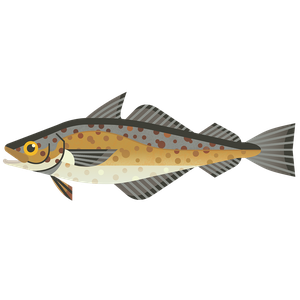
Atlantic cod
Gadus morhua
What to check for
Location
Iceland
Technical location
Atlantic, Northeast, Iceland Grounds
Caught by
Net (gill or fixed)
Certification
Marine Stewardship Council (MSC)
Rating summary
Icelandic cod is abundant and not subject to overfishing. There is a management plan in place, which has successfully reduced fishing pressure. Some cod is caught by gillnetting, which can have a bycatch of marine mammals and seabirds. All Icelandic cod landed by the Icelandic fleet is MSC certified. Certification is conditional on having a strategy to avoid bycatch, and better data to prove that it is not having a detrimental impact on Endangered, Threatened or Protected species.Rating last updated July 2023
Technical consultation summary
Icelandic cod is abundant and not subject to overfishing. The spawning-stock biomass (SSB) was 368,345t in 2023. It remains 39% above target levels (MSY BTrigger, 265,000t). The Harvest Rate (HR) in 2023 was 0.20. This is 91% of HR MSY. There is a management plan in place, which has successfully reduced fishing pressure. Catch limits are set in line with scientific advice and are expected to keep the stock at target levels. All Icelandic cod landed by the Icelandic fleet is MSC certified. There are no requirements or recommendations to make any improvements to management. Some cod is caught by gillnetting. Gillnetting can have a bycatch of vulnerable species such as cetaceans and seabirds. 100% of Icelandic cod landed by the Icelandic fleet is MSC certified. The MSC certification is conditional on having a strategy to avoid bycatch, and better data to prove that it is not having a detrimental impact on Endangered, Threatened or Protected species. Gillnet effort has been reducing over the last couple of decades, which is likely to have reduced bycatch. Gillnets and fixed nets can be very size selective, with low levels of fish bycatch. There is a bycatch of marine mammals and seabirds, but the fishery generally does not appear to be having an impact on populations in most cases. It is possibly contributing to the decline of northern fulmar.
How we worked out this Rating
Icelandic cod is abundant and not subject to overfishing.Cod fishing in Iceland dates back to at least the 1800s. Catches peaked at over 500,000 tonnes in the 1950s, gradually declining to around 150,000t in the 2000s. They have since increased to around 260,000t.Stock assessments are carried out annually by the International Council for the Exploration of the Sea (ICES). The most recent assessment was published in 2023 using data up to 2023. The stock assessment defines reference points for harvest rate (HR) and biomass (B). For the harvest rate, there is a target to keep HR at or below Maximum Sustainable Yield (MSY). For biomass, there is no target. However, there is a trigger point (MSY BTrigger). Below this level, HR should be reduced to allow the stock to increase. Because BMSY is not defined, the Good Fish Guide applies its own definition of 1.4 x MSY BTrigger.The spawning-stock biomass (SSB) was at low levels throughout the 1970s to early 2000s, close to the lowest safe biological limit (125,000 tonnes). It increased to over 500,000 tonnes in 2017 and has since declined to 368,345t in 2023. However, it remains 39% above MSY BTrigger (265,000t). The stock is therefore not in an overfished state.The Harvest Rate (HR) was was high between the 1950s and 2000s, exceeding levels associated with Maximum Sustainable Yield (HR MSY, 0.22). It has rarely been below this level: only in 2013-2016 and again in 2023, when it is 0.20. This is 91% of HR MSY and indicates that the stock is not currently subject to overfishing.Based on Iceland's management plan, catches in the fishing year 2023/2024 should be no more than 211,309 tonnes. This is very similar to the advice from the previous year.
There is a management plan in place, which has successfully reduced fishing pressure. Catch limits are set in line with scientific advice and are expected to keep the stock at target levels. All Icelandic cod landed by the Icelandic fleet is MSC certified. However, management is not adequately controlling the impacts of the fishery on bycatch species. This fishery is MSC certified with conditions relating to bycatch and environmental impacts. There are no requirements or recommendations to make any improvements to management.The Icelandic Ministry of Industries and Innovation (MII) is responsible for management of the Icelandic fisheries and implementation of legislation. Improved management measures by Iceland for most of its major stocks, including cod, haddock, saithe, redfish and herring have resulted in decreased fishing mortality, increased stocks and reduced pressure on benthic habitats.A Harvest Control Rule (HCR) is in place for cod and is reviewed every five years. ICES considers it to be precautionary. It sets catch limits (Total Allowable Catches, TACs) with the aim of maintaining cod at Maximum Sustainable Yield. TACs have been set in line with scientific advice since 2010/11. Landings have exceeded TACs in all but 2 years since 1988, usually by less than 10%. Landings from 2018-2022 averaged 264,010 tonnes, exceeding the average TAC (254,677t) by around 4%.The main reasons given for this by the Icelandic government are: transfer of quota between fishing years or species, allowance for undersized fish, catches of foreign vessels fishing inside the EEZ (Faroes and Norway), and catches for research. TACs only apply to Icelandic fleets, which are responsible for 99% of the total catch. Iceland's scientific advisory body continues to recommend that when setting TACs, managers should take account of all fishing for individual stocks.According to the most recent stock assessment in 2023, estimated fishing pressure is now below MSY and the stock is no longer subject to overfishing.In addition to TACs, the following measures are in place:Fishing is prohibited, for at least two weeks, in areas where more than 25% of the catch (by number) is small cod (less than 55 cm). However, scientists advise that closing small areas for a short time probably doesn't contribute much to the protection of juveniles.Cod spawning areas are closed for 2-3 weeks during the spawning season.Since 1998 the minimum codend mesh size allowed in the trawling fishery has been 135 mm, which could reduce the catch of undersize cod and other unwanted small fish. This is larger than most UK and European fisheries, which is often 120mm.The effects of these measures have not been evaluated.Discarding unwanted fish at sea is banned by the Icelandic government. However, ICES estimates that around 1% of cod landings (by weight) are discarded, and there could be indications that this is increasing.There are a series of measures for monitoring and enforcement, including: publication of individual vessel quotas, independent verification and recording of landings, gear restrictions (and inspections), electronic catch logs, and the coast guard has powers to intercept and inspect vessels. Satellite monitoring of vessel location (through AIS and VMS) is mandatory for all vessels, regardless of size.
Some cod is caught by gillnetting. Gillnetting can have a bycatch of vulnerable species such as cetaceans and seabirds. There are a number of measures in place to reduce bycatch, but more needs to be done to ensure they are effective.100% of Icelandic cod landed by the Icelandic fleet is MSC certified. Around 50% of cod catches are from bottom trawling, 30% from longlining and the remainder from gillnetting, demersal seine and hooks or jigs. The MSC certification is conditional on having a strategy to avoid bycatch, and better data to prove that it is not having a detrimental impact on Endangered, Threatened or Protected species.Bycatch reporting in this fishery is mandatory. Gillnet effort has been reducing over the last couple of decades, which is likely to have reduced bycatch. However, there are no mandatory mitigation measures. There have been trials on some types of pinger, but these increased porpoise bycatch, and so have not been adopted. Further research is underway.Gillnets and fixed nets can be very size selective, with low levels of fish bycatch. Cod, lumpfish, Greenland halibut and saithe account for 96% of catches. However, there can be bycatch of marine mammals and seabirds.On average from 2014-2017, over 1,000 harbour porpoises and 50 seals were bycaught annually in this fishery. Populations of grey and harbour seals species have declined since the 1980s, but this appears to be mainly related to hunting. Bycatch levels in this fishery are not expected to have population-level impacts. The harbour porpoise population in Iceland has been increasing since 2005, and it is estimated that the population could sustain a bycatch of up to 3,500 individuals annually. As current bycatch rates are below this, the fishery does not appear to be having an impact.Average seabird bycatch from 2014-2017 was around 1,400 northern fulmars, 470 common guillemots and 170 northern gannets. Removals of guillemots and gannets are thought to be small proportions of the total populations. However, northern fulmar is declining. Causes could include sandeel declines, as this is important prey. Gillnet bycatch could account for 3% of the decline, and could therefore be having a population-level effect.Sharks and skates are taken as bycatch in Icelandic fisheries, but catch rates are incomplete and the status of stocks is unknown. The endangered Atlantic halibut is impacted by fisheries around Iceland, so a mandatory release of viable halibut and a landings ban were introduced in 2012.Because of gillnets' durability (they are made of nylon), if lost, they can continue to fish for several weeks before becoming tangled and bundled up, a phenomenon known as 'ghost fishing'. However, static nets, as with all gear, represent an investment by fishermen, and therefore there are incentives to avoid losing or damaging gear.
References
Government of Iceland, 2018. Management Strategy and Harvest Control Rules Available at https://www.government.is/news/article/2018/05/15/Haddock/ [Accessed on 14.07.2022].Government of Iceland, 2022. Ministry of Food٫ Agriculture and Fisheries: Fisheries Management. Available at https://www.government.is/topics/business-and-industry/fisheries-in-iceland/fisheries-management/ [Accessed on 14.07.2022].Hønneland, G., Polonio, V., Scarcella, G. and Tsitsika, E., 2022. Marine Stewardship Council Public Certification Report (Reassessment): ISF Iceland cod. Carried out by Global Trust Certification Ltd. on behalf of Icelandic Sustainable Fisheries (ISF). 21 December 2022. Available at https://fisheries.msc.org/en/fisheries/isf-iceland-cod/@@assessments [Accessed on 25.07.2023].ICES, 2022. Icelandic Waters ecoregion – Ecosystem overview. In Report of the ICES Advisory Committee, 2022. ICES Advice 2022, Section 11.1, https://doi.org/10.17895/ices.advice.21731663.ICES, 2022. Icelandic Waters ecosystem – Fisheries overview. In Report of the ICES Advisory Committee, 2022. ICES Advice 2022, section 11.2. https://doi.org/10.17895/ices.advice.21487635.ICES. 2022. Northwestern Working Group (NWWG). ICES Scientific Reports. 4:42. 734 pp. http://doi.org/10.17895/ices.pub.19771381 [Accessed on 14.07.2022].ICES, 2023. Cod (Gadus morhua) in Division 5.a (Iceland grounds). In Report of the ICES Advisory Committee, 2023. ICES Advice 2023, cod.27.5a. Available at https://doi.org/10.17895/ices.advice.21828315.MFRI, 2023. Assessment Reports 2023: Cod, Gadus morhua. Marine and Freshwater Research Institute. Published 9 June 2023. Available at https://www.hafogvatn.is/static/extras/images/01-cod_tr1387969.pdf [Accessed on 25.07.2023].MFRI, 2023. State of Marine Stocks and Advice 2023: Cod, Gadus morhua. Marine and Freshwater Research Institute. Published 9 June 2023. Available at https://www.hafogvatn.is/static/extras/images/01-cod1390313.pdf [Accessed on 25.07.2023].Reeves, S. A., Bell, J. B., Cambie, G., Davie, S. L., Dolder, P., Hyder, K., Pontalier, H., Radford Z. and Vaughan, D., 2018. An international review of fisheries management regimes. Cefas. Issued 2 August 2018. Available at http://randd.defra.gov.uk/Document.aspx?Document=14357_A_Review_of_International_Fisheries_Management_Regimes.pdf [Accessed on 06.07.2021].
Sustainable swaps
Learn more about how we calculate our sustainability ratings.
How our ratings work