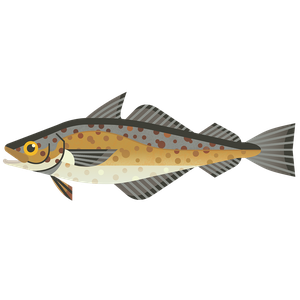
Atlantic cod
Gadus morhua
What to check for
Location
Baltic Sea (West) (Subdivisions 22-24)
Technical location
Atlantic, Northeast, Baltic Sea, Transition Area - Belt Sea, Transition Area - Sound
Caught by
Bottom trawl (otter)
Rating summary
Western Baltic cod is overfished and subject to overfishing, although the stock status seems to be improving. In 2020 the biomass of the stock remains below, but close to, MSY Btrigger, and is at the highest level since 2008. The stock has been subject to overfishing since the 1980s, although fishing pressure (F) has been declining since 2013. In 2019, fishing pressure was above FMSY but below Flim, and the lowest for over 30 years. Management measures are in place, and catch limits have followed scientific advice for the last two years. However, management has not yet succeeded in bringing fishing pressure and stock size to their respective targets. There has been a recent increase in unreported catches owing to restrictions on targeted fishing in some areas, while a closure to protect spawning cod has recently ceased. Recreational catches are significant, adding to the fishing pressure on this stock. This stock is caught by demersal trawling and gillnets. Trawling can have benthic impacts, while gillnetting can bycatch numerous vulnerable species, including harbour porpoise and seabirds.Rating last updated: June 2020
How we worked out this Rating
There are two cod populations in the Baltic Sea: eastern and western. The Eastern population is far larger, at around 90% of the total Baltic population, but is at very low levels. Western Baltic cod is overfished and subject to overfishing, but is in a better state than Eastern cod and the stock status seems to be improving.
Western Baltic cod remains in an overfished state, as it has been since 2008, but stock size has been increasing since it reached a record low of 9,410 tonnes in 2017. In 2020, cod biomass (B) was estimated at 19,992 tonnes - the highest since 2008 and above Blim (14,500t) but still below MSY BTrigger and Bpa (both of which are set at 21,876t). The stock is also subject to overfishing, as it has been since the 1980s, although fishing pressure (F) has been declining since a recent peak of 1.1 in 2013. In 2019, F was 0.52, which is above FMSY (0.26) but below Flim (1.45) and Fpa (0.99) and the lowest for over 30 years. In 2020 an update assessment was carried out, which downscaled SSB estimates and increased F compared to the 2019 assessment. There fishery is therefore perceived to be in a marginally worse state than it appeared last year.
Recruitment of young fish into the fishery has been low, with 2016 being the last large year class to spawn: the 2016 year class will be entering the fishery in 2020. 2019 cod surveys indicate that the 2016 year class is actually smaller than previously thought. 2019 may have had a moderately sized year class, but it is not clear how much it will contribute to the future Western Baltic cod stock.
ICES advises that when the EU multiannual plan (MAP) for the Baltic Sea is applied, catches in 2021 that correspond to the F ranges in the plan are between 4,275 tonnes and 9,039 tonnes, with a catch of 5,950 tonnes being equivalent to MSY. The entire range is considered precautionary when applying the ICES advice rule. Assuming recreational catches at 1,315 tonnes, this implies a commercial catch at FMSY of 4,635 tonnes, and a range of 2,960 “7,724 tonnes. A commercial catch of 4,635t is predicted to allow a 7.9% increase in the stock biomass. The catch advice for 2021 is an 18% decrease on the advice for 2020, which appears to be owing to a downward revision in stock size and an increased estimate of fishing pressure compared to the 2019 assessment. The low recruitment since 2017 may also have an influence, but owing to the provision of abbreviated advice during the Covid-19 disruption, there are no details.
Management measures are in place, and catch limits have followed scientific advice for the last two years. However, fishing pressure and stock size remain above and below their respective targets, although stock size is increasing and is approaching the target level. There has been a recent increase in unreported catches owing to restrictions on targeted fishing in some areas, while a closure to protect spawning cod has recently ceased.
Nine countries border the Baltic Sea, and all except Russia are EU member states. The EU Baltic Sea Multi-Annual Plan is the main piece of legislation guiding fisheries management in the Baltic Sea, and there are bilateral agreements with Russia.
Catches since 2003 have been broadly in line with, or below, the Total Allowable Catch (TAC) for this stock. However, TACs have frequently been set above scientific advice, sometimes significantly so, although in 2019 and 2020 the TACs were set at around 70% of the level that would be consistent with FMSY. In 2019, commercial catches were advised to be between 5,867 and 22,238 tonnes, with catches at FMSY equating to 13,267t; and the TAC was set at 9,515t. In 2020, commercial catches were advised to be between 3,065 and 8,866 tonnes, with catches at FMSY equating to 5,105 tonnes. The 2020 TAC was set at 3,806 tonnes and is the lowest catch limit for this stock since the 1980s. It is predicted to allow the stock to continue to increase.
Recreational catches on this stock are significant, and are expected to be around 1,315 tonnes in 2020. Average annual recreational catch prior to 2017 was over 3,000 tonnes, but has since declined owing to the introduction of bag limits.
Since 2015, all cod must be landed (no discarding at sea is permitted). There is a Minimum Conservation Reference Size of 35cm: cod below this size must be landed whole, but can't be used for human consumption. To decrease below-MCRS catches, a "Bacoma" codend with a 120 mm mesh was introduced by the International Baltic Sea Fisheries Commission (IBSFC) in 2010, and diamond mesh size must be 130 mm in traditional codends. An extended "Bacoma" window (5.5 m) is also required to further decrease undersize catches. The discard rate is low, at around 1.5%. Highgrading has been prohibited since 1 January 2010 in all Baltic Sea fisheries, and data from observer schemes indicate that it is a minor problem.
Since 2009 there has been a seasonal closure from 1 April to 30 April, and since 2016 there has been no directed cod fishery in February and March, to protect spawning aggregations of cod. However, in 2019 there was no spawning closure in the Western Baltic. Instead, there were closures to protect Eastern Baltic cod: subdivision 24, where there is significant mixing of the two stocks, was closed to directed cod fishing. Historically, SD24 has been responsible for around 25% of the total Western Baltic cod catch. Cod caught as bycatch in this area had to be discarded, and was primarily caught by the flatfish trawl fishery. The discard ratio in this area subsequently increased from 4.3%to 9.7% in 2019. There was a strong incentive to misreport landings (i.e. allocate them to a different area), and so this measure is likely to have increased unreported and unregulated landings.
The UK is due to leave the EU on 31st December 2020, and new UK Fisheries legislation is being developed during 2020. MCS will update ratings with new management information when new legislation comes into force.
In the European Union (EU), EU fishing vessels can fish up to 12 nautical miles of any Member State coast, and closer by agreement. There is overarching fisheries legislation for all Member States, but implementation varies between fisheries, Member States and sea basins.
The EU Common Fisheries Policy (CFP) is the primary overarching policy. Its key environmental objectives are to restore and maintain harvested species at healthy levels (above BMSY), and apply the precautionary and ecosystem-based approaches to fisheries management. To achieve the MSY objective, the MSY exploitation rate is supposed to be achieved by 2020, but this seems unlikely to happen.
The CFP also introduced a Landing Obligation (LO) which bans the discarding at sea of species which are subject to catch limits. Some exemptions apply to species with high post-capture survival, and where avoiding unwanted catches is very difficult. These exemptions are outlined in regional discard plans. Despite quota 'uplift' being granted to fleets under the LO, available evidence suggests there has been widespread non-compliance with the policy, and illegal and unreported discarding is likely occurring.
Multi-Annual Plans (MAPs) are a tool for implementing the CFP regionally, with one in place or being developed for each sea basin. They specify fishing mortality targets and ranges for the main targeted species, as well as lower biomass reference points. If populations drop below these points it should trigger a management response. The MAPs also empower Member States to jointly apply measures such as closures, gear or capacity limits, and bycatch limits. There is concern however that the MAPs do not provide adequate safeguards to maintain all stocks at healthy levels.
The EU Technical Measures regulation addresses how, where and when fishing can take place in order to limit unwanted catches and ecosystem impacts. There are common measures that apply to all EU sea basins, and regional measures that vary between sea basins. Measures include Minimum Conservation Reference Sizes (MCRS, previously Minimum Landing Sizes, MLS), gear specifications, mesh sizes, closed areas, and bycatch limits.
The Control Regulation, which is being revised in 2019, addresses application of and compliance with the above, e.g. keeping catches within limits, recording and sharing data, and satellite tracking of vessels over 12 metres (VMS).

The main ecosystem impacts of this fishery are related to abrasion of the seabed from trawling. Bycatch of the eastern Baltic cod may also be of concern.
Commercial catches of Western Baltic cod are mainly taken by trawlers and gillnetters. There has been a trawling ban in place in subdivision SD 23 (the Sound) since 1932; so gillnetters take the majority of the commercial cod catches in that area. In SD 22 and 24 the main part of the catches are taken by trawlers. Overall catches are predominantly Danish, German, with smaller amounts from Sweden, and Poland.
Around 15% of the Baltic Sea is covered by Marine Protected Areas, which were primarily set up to protect marine and coastal habitats, and seabirds. Disturbance of seabed habitats due to physical abrasion from mobile bottom-contacting fishing gears, such as demersal trawls, occurs mostly in the southern Baltic Sea and may reduce benthic diversity and biomass depending on the substrate type. Frequent disturbance by bottom trawls reduces benthic diversity and biomass and changes the composition of benthic species. In SD 22 and 24 the substrate is a mixture of sand and mud. An assessment of the impacts of trawling in the Baltic Sea has not yet been carried out.
The collapsed eastern Baltic cod is caught in mixed fisheries with western Baltic cod in Subdivision (SD) 24. However, in 2019 under emergency measures, SD 24 was closed to targeted cod fishing to protect the Eastern Baltic cod stock. Most catch in this area was bycatch from flatfish trawlers, and had to be discarded. No similar closures appear to be in place in 2020. If the commercial catch of western Baltic cod in 2021 is in line with the advised catch of 4635 tonnes, and the ratios of stock mixing remain the same as in previous years, it is expected that 1532 tonnes of eastern Baltic cod will be caught in SD 24 in 2021.
Baltic Sea cod fisheries also bycatch flounder, but flounder stocks are currently increasing and so this is not of concern.
Trawling is not listed as having any significant impacts on Protected, Threatened or Endangered species.
In the late 1980s and early 1990s, the open central Baltic went through an ecosystem regime-shift due to environmental and anthropogenic changes, where cod biomass collapsed and that of sprat increased steeply. Simultaneously, changes were observed in the zooplankton composition. Many species and habitats of the Baltic Sea are not in good condition. This affects food web functionality, reduces resilience and resistance against further environmental changes, and diminishes prospects for socioeconomic benefits, including fishing opportunities. Key issues include nutrient overload, high contaminant levels, hypoxia or anoxia in deep-water areas, climate change driving water temperature and salinity changes, non-indigenous species, and abrasion and substrate loss.
References
EU. 2016. Regulation (EU) 2016/1139 of the European Parliament and of the Council of 6 July 2016 establishing a multiannual plan for the stocks of cod, herring and sprat in the Baltic Sea and the fisheries exploiting those stocks, amending Council Regulation (EC) No 2187/2005 and repealing Council Regulation (EC) No 1098/2007. Available at https://eur-lex.europa.eu/legal-content/en/TXT/?uri=CELEX:32016R1139 [Accessed on 30.06.2020].
ICES. 2020. Cod (Gadus morhua) in subdivisions 22- “24, western Baltic stock (western Baltic Sea). In Report of the ICES Advisory Committee, 2020. ICES Advice 2020, cod.27.22-24. Available at https://doi.org/10.17895/ices.advice.5942 [Accessed on 29.06.2020].
ICES. 2020. EU standing request on catch scenarios for zero TAC stocks 2020; the eastern Baltic cod (Gadus morhua) stock in subdivisions 24- “32. In Report of the ICES Advisory Committee, 2020. ICES Advice 2020, sr.2020.05a. Available at https://doi.org/10.17895/ices.advice.6029 [Accessed on 29.06.2020].
ICES. 2020. Baltic Fisheries Assessment Working Group (WGBFAS). ICES Scientific Reports. 2:45. 632 pp. Available at http://doi.org/http://doi.org/10.17895/ices.pub.6024 [Accessed on 30.06.2020].
ICES. 2019. Baltic Sea Ecoregion - “ Fisheries Overview. Version 2: 29 November 2019. In Report of the ICES Advisory Committee, 2019. ICES Advice 2019, section 4.2. 28 pp. Available at https://www.ices.dk/sites/pub/Publication%20Reports/Advice/2019/2019/BalticSeaEcoregion_FisheriesOverviews.pdf [Accessed on 30.06.2020].
ICES. 2018. Baltic Sea Ecoregion - “ Ecosystem overview. Version 2: 21 January 2019. Available at https://doi.org/ 10.17895/ices.pub.4665 [Accessed on 30.06.2020]/
Sustainable swaps
Learn more about how we calculate our sustainability ratings.
How our ratings work