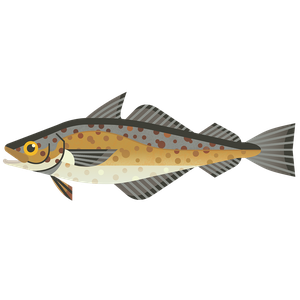
Celtic Sea cod scores a Critical Fail and the rating is a default red due to continued fishing pressure despite the stock having dangerously low reproductive capacity. There is no precautionary recovery plan in place.This stock is assessed by the International Council for the Exploration of the Sea (ICES). Catches peaked in 1989 at over 19,000 tonnes, but have since declined. Celtic Sea cod is no longer a target species, but is caught as bycatch in haddock and whiting fisheries. Recent catches have averaged around 1,600 tonnes.ICES advises that there should be zero catch in 2023 because the reproductive capacity of the stock or spawning stock biomass (SSB) is below minimum scientific levels needed to sustain the population (Blim). SSB in 2022 is 1,196 tonnes, while Blim is 4,200t. The stock is therefore in a severely depleted state.Fishers in the Celtic Sea have a bycatch allowance. In 2021 landings exceeded allowable catches by 47% (1,360 versus the 644 tonnes allowed). Fishing pressure on the stock in 2021 was 1.05. This is higher than levels associated with Maximum Sustainable Yield (FMSY, 0.29) and close to the maximum limit (Flim, 1.13). The stock is therefore subject to heavy overfishing.Discards of cod in the area continue to remain relatively high and accounted for more than 50% of the catch in 2021, largely due to small young fish being caught as bycatch.If fishing pressure in 2023 matches the level in 2022, the stock is projected to increase by 1.5%. If scientific advice was followed, and there was zero catch, the stock is projected to increase by 162%. Recruitment of young fish into the stock has been very variable over time, but has been very low since 2012, with a small peak in 2014.