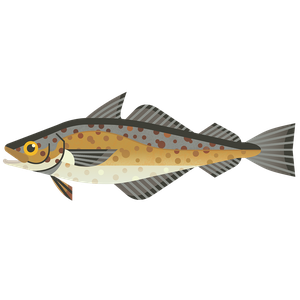
Atlantic cod
What to check for
Location
Northeast Arctic (Barents and Norwegian Sea)
Technical location
Atlantic, Northeast, Barents Sea, Norwegian Sea, Spitzbergen, and Bear Island
Caught by
Bottom trawl (otter)
Rating summary
The population of cod in the northeast Arctic is subject to overfishing and is being overfished. There is a management plan, which is responsive to stock status to an extent, but it has not protected the stock from overexploitation. Most Arctic cod catches are by otter trawls, which are likely to cause some damage to the seabed. There are measures to protect habitats and reduce bycatch in this fishery. However, there is unsustainable bycatch of endangered golden redfish, which is of significant concern.Rating last updated August 2025.
Technical consultation summary
The population of cod in the northeast Arctic is declining but remains above target levels. However, it is being overfished. The most recent stock assessment was carried out by the Joint Russian-Norwegian Arctic Fisheries Working Group (JRN-AFWG) in 2025 using data up to 2025. In 2025 the biomass was 330,486t, this is below MSY BTrigger (460,000t) and the halfway point between Btrigger and Blim (340,000t), but is above Blim (220,000t). The stock considered in an overfished state and there is concern for the biomass levels. Fishing mortality (F) decreased from a peak of 0.94 in the 1990s to a low of 0.29 in 2012. It has since increased to 0.627 in 2024. The F associated with Maximum Sustainable Yield (FMSY) is now between 0.4 and 0.6, depending on stock size, according to a Harvest Control Rule. For 2024, FMSY was set at 0.4. The current F is below Flim (0.74), which is the point at which fishing pressure would result in the stock falling to Blim. However, it is above the halfway point between FMSY and Flim (0.57), suggesting a concerning level of overfishing. There is a management plan, which is responsive to stock status to an extent. It is supported by a series of technical measures and appears to be well monitored. However, fishing pressure is above sustainable limits because the TAC is constrained to a 20% reduction and scientific advice is for more than this. Management has not protected the stock from overexploitation. Most Arctic cod catches are by otter trawls, which are likely to cause some damage to the seabed. There are measures to protect habitats and reduce bycatch in this fishery. However, there is unsustainable bycatch of golden redfish, which is of significant concern. ICES indicates that there is no sustainable catch level of this species. In 2021, over 10,000 tonnes were caught. Although other fisheries may take a higher bycatch (e.g. beaked redfish), trawlers targeting Northeast Arctic (NEA) cod and haddock are likely to have a significant impact on this species. Based on Marine Stewardship Council assessments for some certified cod, haddock and saithe fisheries, catches by certified fisheries appear to add up to over 2,000 tonnes. Therefore, bycatch by this fishery is very likely causing the population to decline and/or is preventing its recovery. The sea basin in this area can be up to 5,000m deep and contains a number of vulnerable marine ecosystems. Protections are in place, but more data is needed to confirm that trawling is not having long term impacts on VMEs.