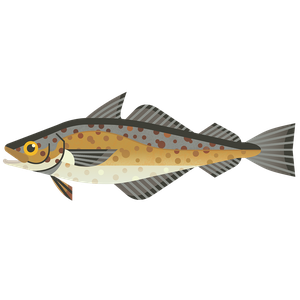
There are two cod populations in the Baltic Sea: eastern and western. The Eastern population is far larger, at around 90% of the total Baltic population, but is at very low levels. Western Baltic cod is overfished and subject to overfishing, but is in a better state than Eastern cod and the stock status seems to be improving.
Eastern Baltic cod is severely overfished, with spawning stock biomass (SSB) in 2020 at 68,652 tonnes - the lowest since the year 2000 and below Blim (102,702t). Blim is defined as the SSB in 2012, which is when the last strong year-class was produced in the recent period of low productivity. There is no reference point for MSY BTrigger or FMSY. Fishing mortality has been broadly declining since a peak of 1.04 in 2000, and in 2019 it was 0.117. Recruitment in 2018 appears to have been close to zero. Estimated recruitment for 2019 and 2020 is higher, but is based on a recent average rather than surveys. Size at maturity has substantially declined: in the early 1990s 50% of the population matured at 35-40cm; in the late 2000s it was 20cm.
ICES advises that when the precautionary approach is applied, there should be zero catch in 2021, which is the same as the advice in 2020. However, Russia and the EU set a Total Allowable Catch in 2020 totalling 7,500 tonnes, and therefore this advice is not being followed. The ICES advice applies to all catches from the stock in subdivisions 24 “32; in subdivision 24 Eastern Baltic cod is caught as bycatch in the Western Baltic cod fishery but this area was closed to targeted cod fishing in 2019.
The poor status of the Eastern Baltic cod is largely driven by biological changes in the stock during recent decades. Growth, condition (weight at length), and size at maturity have substantially declined. These developments indicate that the stock is distressed and is expected to have reduced reproductive potential. The recruitment of this stock is strongly driven by environmental factors, e.g. whether oxygen and salinity levels are sufficient for eggs to survive, which depends on the inflow of high salinity water from the North Sea. Natural mortality has increased, and is estimated to be considerably higher than the fishing mortality in recent years. The size of the largest fish in the population has declined since 1990. Changes in maturity over time mean the development of the exploitable stock size is not consistently represented by SSB, especially in recent years. The biomass of commercial sized cod (over 35 cm) was 50,205 tonnes in 2019 - the lowest level since records began in 1946. The low growth, poor condition, and high natural mortality of cod are related to changes in the ecosystem, including low oxygen levels, low prey availability (sprat and herring have moved northwards and overlap less with the cod stock) and high parasite levels, related to increased abundance of grey seals. A recent study into feeding level and body length indicates that young cod (post-settlement, pre-spawning) are experiencing severe growth limitation and increased starvation-related mortality, likely owing to a decrease in prey because of increased hypoxic areas.