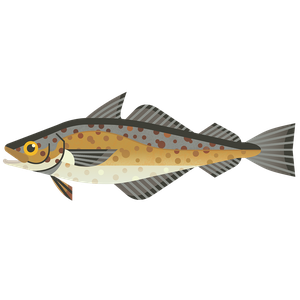
Atlantic cod
Gadus morhua
What to check for
Location
West Greenland: Offshore
Technical location
Atlantic, Northwest, NAFO 1
Caught by
Bottom trawl (otter)
Rating summary
West Greenland offshore cod is being overfished and is depleted. Few appropriate management measures are in place. There is no management plan and catch limits have substantially exceeded scientific advice. Most offshore west Greenland cod is caught by trawling, which is likely to cause some damage to the seabed.Rating last updated July 2023.
Technical consultation summary
West Greenland offshore cod is being overfished and is depleted. The most recent stock assessment was carried out by the International Council for the Exploration of the Seas (ICES) in 2023, using data up to 2023. The stock was benchmarked in 2023 and new models were used. Spawning stock biomass (SSB) in 2023 it is predicted to be below MSY BTrigger but above the precautionary limit. F in 2022 was 250% of FMSY but is below the precautionary limit. Few appropriate management measures are in place. There is no management plan and catch limits have substantially exceeded scientific advice. Due to overfishing and deteriorating environmental conditions, the stock size declined and the fishery collapsed in the early 1990s. ICES advised zero catch from 2005-2023. However, a targeted fishery was allowed. Average catch of this stock from 2016-2020 was around 2,400t. Management measures have therefore allowed for overexploitation of a highly depleted stock. In 2023, ICES reviewed and improved its stock assessments. Total advice for the three stocks combined for 2024 is 29,021t. The combined TACs in 2023 were 51,445t. This implies a significant reduction in TACs to meet the new advice and prevent overexploitation. It is too early to tell whether management will follow the new advice. Most offshore west Greenland cod is caught by trawling, which is likely to cause some damage to the seabed. The footprint and depth of this fishery is unclear. However, in west Greenland, there is potential overlap between trawling and Vulnerable Marine Ecosystems (VMEs), including glass sponges, sea pens and corals. There is a risk of ship strikes with seabirds in southwest Greenland, which contain internationally important wintering areas.
How we worked out this Rating
West Greenland offshore cod is being overfished and is depleted.The cod caught around Greenland is from four separate stocks, which are defined based on where they spawn:Offshore Western GreenlandInshore West Greenland (aka West Greenland fiords)Offshore Eastern and South GreenlandInshore Icelandic waters.The proportional contribution of each stock to catches is highly uncertain. This rating is for Offshore West Greenland.The most recent stock assessment was carried out by the International Council for the Exploration of the Seas (ICES) in 2023, using data up to 2023. The stock was benchmarked in 2023 and new models were used. The advice in 2023 is not directly comparable to the stocks ICES gave advice for from 2015 to 2022.Spawning stock biomass (SSB) was below the point of reproductive impairment (3,219 tonnes) until 2011. It increased to above the level where management measures are triggered, MSY BTrigger (17,256t), in 2016. It has since declined and in 2023 is predicted to be 12,563t. The stock is depleted, but above the precautionary limit (4,473t) so there is not an imminent risk of returning to the point of reproductive impairment.Fishing pressure (F) has been above the level associated with Maximum Sustainable Yield (FMSY) since before the year 2000. FMSY is 0.18 and F in 2022 was 250% of this, at 0.46. This indicates that the stock is subject to overfishing. F is below the precautionary point (1.33), so there is a greater than 95% probability that the current pressure would not reduce biomass to Blim.ICES advises that when the MSY approach is applied, catches in 2024 should be no more than 2,398 tonnes. This is not comparable to previous year's advice.The new stock assessment uses genetics and information from tagging to separate the different stocks, and is therefore now of better quality.Cod from the two offshore spawning stocks migrate into the inshore areas used by Inshore West Greenland cod. This should be taken into account when defining management actions to avoid exceeding the advice for any of the stock units.
Few appropriate management measures are in place. There is no management plan and catch limits have substantially exceeded scientific advice.Fisheries in Greenland are managed by the Ministry of Fisheries, Hunting and Agriculture. Inshore fleets are mainly from Greenland, while offshore fishing is also conducted by EU, Iceland and Norway. There are four main stocks, defined by where they spawn: Offshore west Greenland, Inshore west Greenland, Offshore east and south Greenland, and Inshore Iceland. The first three stocks mix in the waters around west Greenland.There is no management plan in place. The main management measures are catch limits, known as a Total Allowable Catches (TACs). The International Council for the Exploration of the Seas (ICES) provides scientific advice on TACs, based on stock size.The offshore West Greenland commercial cod fishery started in the 1920s, with catch levels peaking at 400,000 tonnes in the 1960s. Due to overfishing and deteriorating environmental conditions, the stock size declined and the fishery collapsed in the early 1990s. The stock could not be targeted from 1993-2005.ICES advised zero catch from 2005-2023. Management measures from 2009 onwards have had the objective of rebuilding the stock by minimizing exploitation of young and potential spawning fish. However, a targeted fishery was allowed from 2005-2008, 2011-2013 and 2015-2019. TACs in this time ranged from 5,000-15,000t, although they were not specific to the offshore stock.ICES also highlighted that offshore cod could form up to 30% of the cod catches in inshore West Greenland. It highlighted that continued excessive fishing pressure in the inshore area would delay offshore stock recovery, but inshore TACs remained far in excess of advice. In addition, quota for the inshore fishery could be transferred to the offshore fishery, which had a much higher chance of catching offshore West Greenland cod. Although offshore TAC in 2019 was initially zero, a quota of 2,000 tonnes was transferred from the inshore fishery.Average catch of this stock from 2016-2020 was around 2,400t. Management measures have therefore been wholly inadequate for protecting the Inshore and Offshore stocks and allowed for overexploitation pf a highly depleted stock.In 2023, ICES reviewed and improved its stock assessments using genetic and tagging data, to account for the mixing of the three stocks. Advice is not therefore comparable to previous years. The offshore stock as defined by the new assessment is thought to have been above Blim since 2011, although it remains below target levels. Catch advice for 2024 is 2,398 tonnes.The three stocks mix outside of the spawning season, which should be taken into account when setting TACs and other management measures. Total advice for the three stocks combined for 2024 is 29,021t. The combined TACs in 2023 were 51,445t. This implies a significant reduction in TACs to meet the new advice and prevent overexploitation. It is too early to tell whether management will follow the new advice.Other management measures include:Vessels must have a license, which stipulates a specific vessel quotaThe offshore fleet cannot fish within 3nm of the coastThere is a minimum landing size of 40cm.Most catches are by trawl and longline, but may also be by poundnets, jigs, and gillnets.
Most offshore west Greenland cod is caught by trawling, which is likely to cause some damage to the seabed. There may also be relatively high quantities of bycatch.In recent years, fishing for offshore west Greenland cod has been at low levels. 100% of catches have been by trawling.Demersal trawls have contact with the seabed resulting in penetration and abrasion of habitat features. The impact of trawling on the seabed depends on the location and scale in which trawling occurs. For example, areas that are used to natural disturbance through tides and waves, are less sensitive to habitat impacts. Areas not used to mobile towed gears are typically more sensitive to trawling.The footprint and depth of this fishery is unclear. However, in west Greenland, there is potential overlap between trawling and Vulnerable Marine Ecosystems (VMEs), including glass sponges, sea pens and corals. These slow growing and delicate habitats are vulnerable to the effects of bottom trawling. Catches of corals and sponges must be recorded, and if they exceed certain thresholds vessels must move at least 2 nautical miles away. Trawling is not permitted in the 0-3nm zone and some areas are closed to trawling for halibut. However, there are few marine protected areas in Greenland's waters, and VMEs remain at risk from trawling in general.Trawls have the potential to take relatively high quantities of bycatch. In the Northeast Atlantic there are reported catches of demersal elasmobranchs and endangered, threatened and protected (ETP) species (e.g. sharks, rays and marine mammals). Bycatch data is not available for this fishery.There is a risk of ship strikes with seabirds in southwest Greenland, which contain internationally important wintering areas. Birds can be drawn to searchlights on ships, which are used for navigating in icy waters. Across navy, cargo and trawling vessels, estimates of seabird mortality are up to 2,000 birds, but further monitoring is needed to verify impacts.
References
Blicher, ME and Hammeken, Arboe N, 2021. Atlas of Vulnerable Marine Ecosystem (VME) indicators observed on Bottom Trawl Surveys in Greenland waters during 2015-2019. Technical Report nr. 113, Greenland Institute of Natural Resources, Greenland. ISBN 87-91214-91-2. https://natur.gl/wp-content/uploads/2021/01/113-Atlas-of-Vulnerable-Marine-Ecosystem-VME-indicators-observed-on-Bottom-Trawl-Surveys-in-Greenland-waters-during-2015-2019.pdfEigaard, O. R., Bastardie, F., Breen, M., Dinesen, G. E., Hintzen, N. T., Laffargue, P., Mortensen, L. O., Nielsen, J. R., Nilsson, H. C., O- Neill, F. G., Polet, H., Reid, D. G., Sala, A., Skold, M., Smith, C., Sorensen, T. K., Tully, O., Zengin, M. and Rijnsdorp, A. D., 2016. Estimating seabed pressure from demersal trawls, seines, and dredges based on gear design and dimensions. ICES Journal of Marine Science, 73:1, pp. i27- i43. https://doi.org/10.1093/icesjms/fsv099.Froese, R., N. Demirel, G. Coro, K.M. Kleisner and H. Winker, 2017. Estimating fisheries reference points from catch and resilience. Fish and Fisheries 18(3):506-526. Available at https://onlinelibrary.wiley.com/doi/abs/10.1111/faf.12190.Government of Greenland, 2023. Reporting: Bycatch. Available at https://gflk.gl/en/reporting/bycatch/ [Accessed on 28.07.2023].Hiddink, J., Jennings, S., Sciberras, M., Szostek, C.L., Hughes, K.M., Ellis, N., Rijnsdorp, A.D., McConnaughey, R.A., Mazor, T., Hilborn, R., Collie, J.S., Pitcher, C.R., Amoroso, R.O., Parma, A.M., Suuronen, P. and Kaiser, M.J. 2017. Global analysis of depletion and recovery of seabed biota after bottom trawling disturbance. PNAS. 114:31, pp. 8301-8306. https://doi.org/10.1073/pnas.1618858114.ICES, 2016. Stock Annex: Cod (Gadus morhua) in NAFO Subdivisions 1A–E, off-shore (West Greenland). https://ices-library.figshare.com/articles/report/Stock_Annex_Cod_Gadus_morhua_in_NAFO_Subdivisions_1A_E_offshore_West_Greenland_/18622265.ICES, 2021. Cod (Gadus morhua) in NAFO divisions 1.A-E, offshore (West Greenland). In Report of the ICES Advisory Committee, 2021. ICES Advice 2021, cod.21.1a-e, https://doi.org/10.17895/ices.advice.7739.ICES, 2022. Northwestern Working Group (NWWG). ICES Scientific Reports. 4:42. 755pp. http://doi.org/10.17895/ices.pub.19771381.ICES, 2023. Cod (Gadus morhua) in NAFO Subarea 1 (offshore) (West Greenland offshore spawning cod). In Report of the ICES Advisory Committee, 2023. ICES Advice 2023, cod.21.1.osc, https://doi.org/10.17895/ices.advice.23266232.Kennelly, S. J. & Broadhurst, M. K., 2021. A review of bycatch reduction in demersal fish trawls. Rev Fish Biol Fisheries 31, 289–318. https://doi.org/10.1007/s11160-021-09644-0.Kynoch, R., Fryer, R. & Neat, F., 2015. A simple technical measure to reduce bycatch and discard of skates and sharks in mixed-species bottom-trawl fisheries. ICES J Mar Sci,72(6):1861.Merkel, F.R. 2010. Light-induced bird strikes on vessels in Southwest Greenland. Technical Report No. 84, Pinngortitaleriffik, Greenland Institute of Natural Resources. Available at https://natur.gl/wp-content/uploads/2010/01/84-Light-induced-bird-strikes-on-vessels-in-Southwest-Greenland.pdf.Silva, F., Ellis, J. & Catchpole, T., 2012. Species composition of skates (Rajidae) in commercial fisheries around the British Isles and their discarding patterns. J Fish Biol., 80:1678–1703.van Denderen, P. et al., 2015. Similar effects of bottom trawling and natural disturbance on composition and function of benthic communities across habitats. Mar Ecol Prog Ser. 2015;541:31–43.
Sustainable swaps
Learn more about how we calculate our sustainability ratings.
How our ratings work