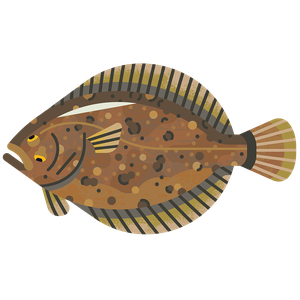
Atlantic halibut
Hippoglossus hippoglossus
What to check for
Location
All areas
Production method
Open net pen, marine
Certification
GLOBALG.A.P.
Rating summary
The GLOBALG.A.P. feed standard requires the majority of feed ingredients to be responsibly sourced. However, Atlantic halibut has a large dependency on wild fish in its diet. Halibut farming in marine pens can have negative environmental impacts, however, these impacts are reduced by the GLOBALG.A.P. standard. GLOBALG.A.P. also has criteria in place to ensure animal welfare and humane slaughter. Norway has a comprehensive range of regulations in place for the aquaculture industry, including a Marine Spatial Planning Programme.This rating is based on full compliance with certification requirements. Commercial buyers should therefore ensure that full compliance has been achieved in order for this rating to be applicable.Rating last updated May 2024.
Technical consultation summary
Although Atlantic halibut has a large dependency on wild fish in its diet, the GLOBALG.A.P. feed standard requires the majority of feed ingredients to be responsibly sourced. The GLOBALG.A.P. certification addresses a number of issues of environmental concern in halibut farming, the auditing of which requires farm inspections and standard criteria enforcement, however, the standard does not cover all areas of environmental concern and allows the lethal control of predators to take place. GLOBALG.A.P. has criteria in place to ensure there is adequate animal welfare and humane slaughter in place. Norway has a comprehensive range of regulations in place for the aquaculture industry, including a Marine Spatial Planning Programme.
References
FAO. National Aquaculture Legislation Overview. Norway. Available at http://www.fao.org/fishery/legalframework/nalo_norway/en#tcNB00CB [Accessed on 09.04.2024].GLOBALG.A.P. 2021. Integrated Farm Assurance. Version 5.4-1-GFS. All Farm Base - Aquaculture Module. Available at https://documents.globalgap.org/documents/220125_GG_IFA_CPCC_AQ_V5_4-1-GFS_en.pdf [Accessed on 09.04.2024].GLOBALG.A.P. 2022. Integrated Farm Assurance Smart/GFS. Version 6.0 June 2022. Available at https://www.globalgap.org/.content/.galleries/documents/220607_IFA_Smart_GFS_PCs_AQ_interim_final_amended_v6_0_Jun22_en.pdf [Accessed on 09.04.2024].GLOBALG.A.P. 2023. Compound Feed Manufacturing. Version 3.1 September 2024. Available at https://documents.globalgap.org/documents/240924_GG_CFM_CPCCs_v3_1_Sep23_en.pdf [Accessed on 09.04.2024].Intrafish. 2022. Thousands of fish escape from Nordic Halibut site. Available at https://www.intrafish.com/aquaculture/thousands-of-fish-escape-from-nordic-halibut-site/2-1-1264199?utm_source=email_campaign&utm_medium=email&utm_campaign=2022-07-22&utm_term=intrafish_com&utm_content=aquaculture [Accessed on 09.04.2024].Øivind Bergh, Frank Nilsen, Ole B. Samuelsen.2001. Diseases, prophylaxis and treatment of the Atlantic halibut Hippoglossus hippoglossus: a review. DISEASES OF AQUATIC ORGANISMS. Vol. 48: 57–74, 2001Seafish. 2020. Atlantic Halibut. Available at https://www.seafish.org/responsible-sourcing/aquaculture-farming-seafood/species-farmed-in-aquaculture/aquaculture-profiles/atlantic-halibut/ [Accessed on 09.04.2024].The Fish Site. 2015. A Quick Guide to Farming Halibut Fish. Available at https://thefishsite.com/articles/a-quick-guide-to-farming-halibut-fish [Accessed on 09.04.2024].UNESCO. Marine Spatial Planning Programme. Norway. Available at http://msp.ioc-unesco.org/world-applications/europe/norway/. [Accessed on 09.04.2024].
Sustainable swaps
Learn more about how we calculate our sustainability ratings.
How our ratings work