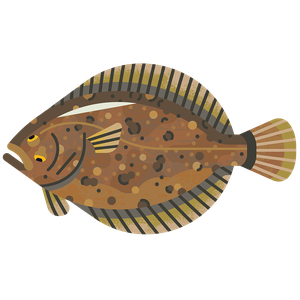
Atlantic halibut
Hippoglossus hippoglossus
What to check for
Location
Northeast Atlantic
Technical location
Atlantic, Northeast, All areas
Caught by
Net (gill or fixed)
Rating summary
Northeast Atlantic halibut is a data limited species, leading to concern for fishing pressure. There is also concern for biomass due to the lack of data, and an indication of recruitment failure within the region. Management of Atlantic halibut in this region remains minimal. Without significant improvements in understanding stock status, effective management cannot be implemented. While no quotas are in place, directed fishing of Atlantic halibut is prohibited in Iceland. Gillnets in this area can encounter bycatch of marine mammals, elasmobranchs, and seabirds, including Endangered, Threatened, or Protected (ETP) species. However, impacts to the seafloor are minimal.This rating does not include fisheries in the Northwest Atlantic where some well-managed Marine Stewardship Council certified fisheries are in place.Rating last updated December 2025.
Technical consultation summary
Northeast Atlantic halibut is a data limited species, leading to concern for fishing pressure. There is also concern for biomass due to the lack of data, and an indication of recruitment failure within the region. Management of Atlantic halibut in this region remains minimal. Without significant improvements in understanding stock status, effective management cannot be implemented. While no quotas are in place, directed fishing of Atlantic halibut is prohibited in Iceland. Gillnets in this area can encounter bycatch of marine mammals, elasmobranchs, and seabirds, including Endangered, Threatened, or Protected (ETP) species. However, impacts to the seafloor are minimal.This rating does not include fisheries in the Northwest Atlantic where some well-managed Marine Stewardship Council certified fisheries are in place.
How we worked out this Rating
Northeast Atlantic halibut is a data limited species, leading to concern for fishing pressure. There is also concern for biomass due to the lack of data, and an indication of recruitment failure within the region.Route 2 (data limited) scoring has been applied to this rating due to a lack of reference points for fishing pressure and biomass. Atlantic halibut is classed as Vulnerable in Europe (last assessed in 2013) and Near Threatened globally (last assessed in 2021). Atlantic halibut have a very low resilience to fishing pressure and it is likely that they are overfished in European waters. Due to the lack of available data there is concern for fishing pressure.Atlantic halibut stocks in the Northeast Atlantic are not currently assessment by ICES, and research at local or national levels remains very limited. A report published by Iceland in 2025 highlighted sharp declines in biomass and recruitment between 1985 and 1990, with stocks reaching a historic low from 2008 to 2014. Biomass dropped from 5913 tonnes in 1985 to just 150 tonnes in 2012. In the past five years (2020-2025), biomass has recovered slightly above the historic low, with 2025 estimates of 1898 tonnes. However, recruitment has continued to decline over the last two decades, and with ongoing recruitment failure, the stock is expected to remain at low levels in the near future despite reduced catches. Due to a lack of data, and indications that Atlantic halibut stocks remain at low levels across the Northeast Atlantic, there is concern for biomass.
Management of Atlantic halibut in this region remains minimal. Without significant improvements in understanding stock status, effective management cannot be implemented. While no quotas are in place, directed fishing of Atlantic halibut is prohibited in Iceland.In the Northeast Atlantic, there is currently no widespread management measures for halibut. Without stock assessments, it is difficult to determine the status of the population or whether current fishing levels are sustainable, so appropriate management cannot be implemented.After a prolonged decline in Atlantic halibut stocks around Iceland, all directed fishing for the species was prohibited in 2012. As halibut remain a bycatch species in many fisheries, there is a requirement to release any capture individuals if they are considered fit for survival.The Marine Conservation Society views Remote Electronic Monitoring (REM) with cameras is one of the most cost-effective tools for providing reliable fisheries data and aiding informed management decisions. Fully monitored fisheries enhance collaboration, data accuracy, stock recovery, and reduce impacts on marine wildlife and habitats. However, the full potential of REM may only be achieved when it tracks fishing location and documents catch and bycatch, particularly where vulnerable species and habitats are at risk. As of January 2024, the EU is introducing a Remote Electronic Monitoring (REM) mandate for EU vessels, including CCTV cameras on vessels 18m or more that pose a potential risk of non-compliance, within the next 4 years. Across the UK, different approaches to REM are being taken and legislation is expected to be in place across all 4 countries within the next few years.The Fisheries Act (2020) requires the development of Fisheries Management Plans (FMPs) (replacing EU Multi-Annual Plans) in the UK. 43 FMPs have been proposed and are at various stages of development and implementation, these should all be published by the end of 2028. FMPs have the potential to be very important tools for managing UK fisheries, although data limitations may delay them for some stocks. It is also essential the UK governments define and adopt a standardised approach or model across the four nations to a universally defined FMP design, to ensure the consistence, quality and coherence of all the proposal FMPs.The Marine Conservation Society is keen to see publicly available Fishery Management Plans for all commercially exploited stocks, especially where stocks are depleted, that include:An overview of the fishery including current stock status, spatial coverage, current fishing methods and impactsTargets for fishing pressure and biomass, and additional management when those targets are not being met, based on the best scientific evidenceTimeframes for stock recoveryImproved data collection, transparency, and accountability, supported by technologies such as Remote Electronic Monitoring (REM)Consideration of wider environmental impacts of the fishery, including habitat impacts and minimising bycatchStakeholder engagement
Gillnets in this area can encounter bycatch of marine mammals, elasmobranchs, and seabirds, including Endangered, Threatened, or Protected (ETP) species. However, impacts to the seafloor are minimal.Fixed nets, consisting of vertical net(s) suspended between a float line and a weighted ground line, have minimal impact on benthic habitats as they cause little disturbance to the seabed. However, they are associated with high levels of bycatch, including endangered, threatened, or protected (ETP) species.Globally, gillnet fisheries are recognised as posing the greatest threat to cetaceans, especially small coastal species. In this region, the harbour porpoise is the most frequently affected, though other species have also been reported. Given the overlap between gillnet use and cetacean distribution, many species are vulnerable to entanglement.Harbour porpoises are included on OSPAR’s List of Threatened and/or Declining Species and Habitats for the Greater North Sea and Celtic Seas, due to documented population declines and the ongoing threat of being bycaught. They are also considered a priority species under UK and EU law, under which there are explicit bycatch requirements. In the Icelandic waters ecoregion, annual bycatch rates of harbour porpoise are estimated at around 900 individuals, representing approximately 0.53% of the population in the area. Acoustic Deterrent Devices (ADDs), such as pingers, have demonstrated effectiveness in reducing harbour porpoise bycatch in gillnets. However, their deployment is inconsistent, and their efficacy is unknown for other species.Alongside cetaceans, elasmobranchs, seals, and seabirds are also at risk of gillnet bycatch. Reported captures include ray species, guillemots, northern fulmars (listed as Vulnerable in Europe), and northern gannets. Although bird scarers have been shown to reduce seabird bycatch, the use of these deterrents remains undocumented.Additional risks in the net fishery comes from gear loss, as nylon gillnets when lost at sea can continue fishing through ‘ghost fishing’ until they become tangled and sink or are removed. As all gear types require financial investment, there is incentive to maintain and retrieve lost nets and prevent ghost fishing.To improve monitoring and reporting of fishing activity, The Marine Conservation Society would like to see remote electronic monitoring (REM) with cameras implemented, used and enforced.
References
Cadrin, S., González Troncoso, D., Hallfredsson, E. & Munroe, T.A. 2022. Hippoglossus hippoglossus. The IUCN Red List of Threatened Species 2022: e.T10097A148035632. https://dx.doi.org/10.2305/IUCN.UK.2022-2.RLTS.T10097A148035632.en. [Accessed on 04.12.2025]FAO, 2025. Global capture production Quantity (1950 - 2023). Available at: FAO Fisheries & Aquaculture - Global capture production Quantity (1950 - 2023) [Accessed on 04.12.2025]Froese, R. and D. Pauly. Editors. 2025. Hippoglossus hippoglossus, Atlantic halibut. Available at: Hippoglossus hippoglossus, Atlantic halibut : fisheries, aquaculture, gamefish, aquarium [Accessed on 04.12.2025]Hiddink, J. et al., 2017. Global analysis of depletion and recovery of seabed biota after bottom trawling disturbance. Proc Natl Acad Sci. 114(31):8301–6.ICES. 2025. Arctic Fisheries Working Group (AFWG). ICES Scientific Reports. 7:66. 339 pp. https://doi.org/10.17895/ices.pub.29234186ICES. 2025. Northwestern Working Group (NWWG). ICES Scientific Reports. 07:58. 866 pp. https://doi.org/10.17895/ices.pub.29086181ICES. 2024. Icelandic Waters ecosystem – Fisheries overview. In Report of the ICES Advisory Committee, 2024. ICES Advice 2024, section 11.2, https://doi.org/10.17895/ices.advice.27879909ICES. 2024. Greenland Sea ecoregion – fisheries overview. In Report of the ICES Advisory Committee, 2024. ICES Advice 2024, section 10.2, https://doi.org/10.17895/ices.advice.27879759ICES. 2024. Oceanic Northeast Atlantic ecoregion – fisheries overview. In Report of the ICES Advisory Committee, 2024. ICES Advice 2024, section 13.2, https://doi.org/10.17895/ices.advice.27880092ICES. 2023. Greenland Sea ecoregion – Ecosystem overview. In Report of the ICES Advisory Committee, 2023. ICES Advice 2023, section 10.1, https://doi.org/10.17895/ices.advice.22664881ICES. 2022. Icelandic Waters ecoregion –Ecosystem overview. In Report of the ICES Advisory Committee, 2022. ICES Advice 2022, Section 11.1, https://doi.org/10.17895/ices.advice.21731663Kennelly, S. J. & Broadhurst, M. K., 2021. A review of bycatch reduction in demersal fish trawls. Rev Fish Biol Fisheries 31, 289–318.Kynoch, R., Fryer, R. & Neat, F., 2015. A simple technical measure to reduce bycatch and discard of skates and sharks in mixed-species bottom-trawl fisheries. ICES J Mar Sci,72(6):1861.Lindgård, E.L., Berg, E., Zimmermann, F. and Aschan, M., 2025. Recent recovery and future prospects of the northeast Atlantic halibut stock. ICES Journal of Marine Science, 82(9), p.fsaf166.MRFI, 2025. Atlantic Halibut. Available at: ATLANTIC HALIBUT Hippoglossus hippoglossus [Accessed on 04.12.2025]Munroe, T., Costa, M., Nielsen, J., Herrera, J., de Sola, L., Rijnsdorp, A.D. & Keskin, Ç. 2015. Hippoglossus hippoglossus (Europe assessment). The IUCN Red List of Threatened Species 2015: e.T10097A45790126. [Accessed on 04.12.2025]OSPAR, 2025. List of Threatened and/or Declining Species & Habitats. Available at: List of Threatened and/or Declining Species & Habitats | OSPAR Commission [Accessed on 05.12.2025]OSPAR, 2023. Report and assessment of the status of the OSPAR network of Marine Protected Areas in 2023. Available at: Report and assessment of the status of the OSPAR network of Marine Protected Areas in 2023 [Accessed on 04.12.2025]Rindorf, A., Gislason, H., Burns, F., Ellis, J. R., & Reid, D. 2020. Are fish sensitive to trawling recovering in the Northeast Atlantic? Journal of Applied Ecology, 57(10), 1936-1947. https://doi.org/10.1111/1365-2664.13693van Denderen, P. et al., 2015. Similar effects of bottom trawling and natural disturbance on composition and function of benthic communities across habitats. Mar Ecol Prog Ser. 2015;541:31–43.
Sustainable swaps
Learn more about how we calculate our sustainability ratings.
How our ratings work