Atlantic salmon
Atlantic salmon
(Salmo salar)
Overview
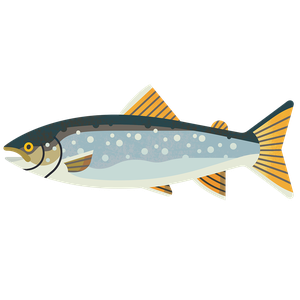
The Atlantic salmon is one of 4 species of salmonids indigenous to European waters. Salmon move between fresh and seawater during their lifecycle. This is referred to as being "anadromous". They spend most of their lives in fresh water and are termed benthopelagic. Atlantic salmon matures at a length of around 73 cm. Maximum length for males is 150 cm, 120 cm for females. Maximum reported age is 13 years, but most individuals only reach 4-6 years. Adult fish return to their birth or natal river from January until November and spawn in late Autumn/early Winter. The eggs, which are laid in nests termed "redds", hatch in April to May and are called alevins. Young fish, which are known firstly as fry and later as parr as they mature, remain in fresh water for 1 to 6 years, then migrate to coastal marine waters, or even the open oceans, between April and May. They have undergone a physiological change to enable them to live at sea and are now termed smolts. Adult salmon return to spawn after spending up to 4 years at sea. Many die after spawning but a number survive to spawn a second or third time. The mechanism by which salmon navigate with such precision back to their birth or natal river to spawn is not fully understood. In the ocean, the earth's magnetic field and the stars may be important. When the salmon reach coastal waters, smell and taste allow precise homing to their river of birth. One of the key biological differences between Atlantic salmon (Salmo) and Pacific salmon (Onchorynchus) is that Atlantic salmon are iteroparous, that is, they do not die after returning to spawn in the rivers in which they hatch. Pacific salmon, and other members of the Onchorynchus genus on the other hand, are referred to as being semelparous, with mature members of the population generally dying within a few days or weeks of spawning.
Ratings
Showing 12 results for Atlantic salmon