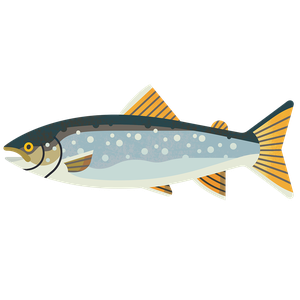
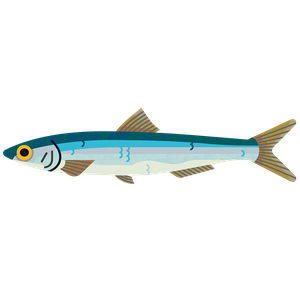
Atlantic salmon
Salmo salar
What to check for
Location
NE Atlantic (England and Wales)
Technical location
Atlantic, Northeast, All areas
Caught by
Net (drift), Net (gill or fixed)
Rating summary
Wild Atlantic salmon stocks are depleted over much of their range. The status of individual river stocks in England and Wales is evaluated annually against stock conservation limits (CLs) and management targets (MTs) in line with the requirements of ICES and NASCO. In 2022, just 16% rivers were assessed as meeting their CL, joint lowest in the time series. ICES advises that when the MSY approach is applied, fishing should only take place on salmon from rivers where stocks have been shown to be at full reproductive capacity. Regulatory provisions approved for England in 2018 include the closure of most net fisheries including all driftnet fisheries and mandatory release of salmon caught in net fisheries authorised to operate for sea trout.This rating applies to all rivers not classified as 'Not at risk' by the [Environment Agency](https://www.gov.uk/government/publications/fisheries-annual-report-2021-to-2022).Rating last updated June 2023.
Technical consultation summary
Wild Atlantic salmon stocks are depleted over much of their range. The status of individual river stocks in England and Wales is evaluated annually against stock conservation limits (CLs) and management targets (MTs) in line with the requirements of ICES and NASCO. In 2022, just 16% rivers were assessed as meeting their CL, joint lowest in the time series. ICES advises that when the MSY approach is applied, fishing should only take place on salmon from rivers where stocks have been shown to be at full reproductive capacity. Regulatory provisions approved for England in 2018 include the closure of most net fisheries including all driftnet fisheries and mandatory release of salmon caught in net fisheries authorised to operate for sea trout.
How we worked out this Rating
Wild Atlantic salmon populations are at historically low levels and scientific advice recommends that no catch takes place. Information and data on the status of salmon stocks in England and Wales is compiled by the Centre for Environment, Fisheries and Aquaculture Science (Cefas), the Environment Agency and Natural Resources Wales (NRW). There are 49 rivers in England and 31 rivers in Wales that regularly support salmon, although some of the stocks are very small and support minimal catches. Of these, 64 have been designated 'principal salmon rivers'.Conservation limits (CLs) and management targets have been set for the 64 principal salmon rivers and are used to give annual advice on stock status and to assess the need for management and conservation measures. Returning stock estimates and counts for rivers in 2021 were below the values recorded in 2020, with estimated returns being the lowest in the time series for one river. Overall, there has been a marked decline in the numbers of returns to most rivers over the last decade, particularly in the South West, Wales, and North West. However, for a number of rivers in southern England, there is evidence of stocks stabilising and showing signs of recovery.Egg deposition levels in 2021 were estimated to be above the CL on 10 of the 64 principal salmon rivers in England and Wales (16% of all rivers), which is the joint lowest in the 29-year time series. Rivers where egg deposition levels were below the CL were widely distributed across England and Wales. Formal compliance assessment in the current year (2021) classified 1 river as ‘not at risk’ (>95% probability of achieving the management objective or MO – namely to meet or exceed the CL in at least 4 years out of 5, on average), 4 rivers (6%) as ‘probably not at risk’ (50-94% probability of achieving the MO), 8 rivers (13%) as ‘probably at risk’ (5- 49% probability of achieving the MO), and 51 rivers (80%) as ‘at risk’ (<5% probability of achieving the MO) which is the highest in the time series. Fishing pressure is thought to have decreased as new regulatory provisions in England (2019) and Wales (2020) have substantially reduced the retention of salmon in 2021. The measures included the closure of many net fisheries and mandatory catch and release in others. In many rod fisheries, there were increased levels of catch and release, some mandatory and others voluntary, although further progress still needs to be made on some river catchments. ICES recommends that when the MSY approach is applied, fishing for salmon only takes place in rivers where stocks are known to be above CLs and at full reproductive capacity.
References
Cefas, EA and NRW. 2021. Salmon Stocks and Fisheries in England and Wales in 2021. Available at https://assets.publishing.service.gov.uk/government/uploads/system/uploads/attachment_data/file/1093963/SalmonReport-2021-assessment.pdf [Accessed on 20.06.2023].ICES. 2023. North Atlantic salmon stocks. In Report of the ICES Advisory Committee, 2023. ICES Advice 2023, sal.oth.all. Available at https://doi.org/10.17895/ices.advice.22699276 [Accessed on 20.06.2023].ICES. 2023. Working Group on North Atlantic Salmon (WGNAS). ICES Scientific Reports. 5:41. 478 pp. Available at https://doi.org/10.17895/ices.pub.22743713 [Accessed on 20.06.2023].NASCO. Salmon at sea. Available at https://salmonatsea.com/ [Accessed on 20.06.2023].NASCO. NASCO Implementation Plan for the period 2019-2024. Available at https://www2.gov.scot/Resource/0054/00546369.pdf [Accessed on 20.06.2023].Myrvold, K.M., Mawle, G. W., Andersen, O. & Aas, Ø. 2019. The Social, Economic and Cultural values of wild Atlantic salmon. A review of literature for the period 2009-2019 and an assessment of changes in values. NINA Report 1668. Norwegian Institute for Nature Research. Available at https://brage.nina.no/nina-xmlui/handle/11250/2627172?locale-attribute=no [Accessed on 20.06.2023].Windsor, M.L., Hutchinson, P., Hansen, L.P. and Reddin, D.G. 2012. Atlantic salmon at sea: Findings from recent research and their implications for management. NASCO document CNL(12)60. Edinburgh, UK. 20pp. Available at http://www.nasco.int/sas/pdf/archive/other_reports/Salmon_at_sea.pdf [Accessed on 20.06.2023].
Sustainable swaps
Learn more about how we calculate our sustainability ratings.
How our ratings work