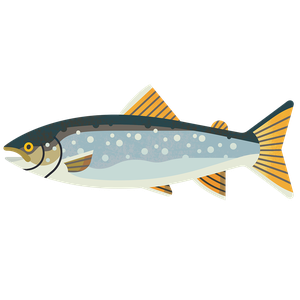
Atlantic salmon
Salmo salar
What to check for
Location
NE Atlantic
Technical location
Atlantic, Northeast, All areas
Caught by
Net (drift), Net (gill or fixed)
Rating summary
Wild Atlantic salmon stocks across the North Atlantic remain at historically low levels. This is despite restrictive management measures and reductions in fisheries and exploitation rates. Due to the Atlantic salmons oceanic migrations, international cooperation is essential to its conservation, restoration and rational management. ICES advises that when the MSY approach is applied, fishing should only take place on salmon from rivers where stocks have been shown to be at full reproductive capacity. High seas and coastal drift netting captures large numbers of fish as they return to rivers to spawn.Rating last updated June 2023.
Technical consultation summary
Wild Atlantic salmon stocks across the North Atlantic remain at historically low levels. This is despite restrictive management measures and reductions in fisheries and exploitation rates. Due to the Atlantic salmons oceanic migrations, international cooperation is essential to its conservation, restoration and rational management. ICES advises that when the MSY approach is applied, fishing should only take place on salmon from rivers where stocks have been shown to be at full reproductive capacity. High seas and coastal drift netting captures large numbers of fish as they return to rivers to spawn.
How we worked out this Rating
Wild Atlantic salmon populations are at historically low levels and scientific advice recommends that no catch takes place. Despite restrictive management measures and reductions in exploitation rates, salmon stocks across the Northeast Atlantic remain at historically low levels. ICES recommends that fishing for salmon only takes place in rivers where stocks have been shown to be at full reproductive capacity i.e. above conservation limits (CLs). Atlantic salmon is also listed by OSPAR as a threatened and declining species.Exploitation rates on Northeast Atlantic stocks continue to decline and catches in 2022 were 568 tonnes. This was a reduction from recent years and both 2021 (487 tonnes) and 2022 were notably lower than the preceding years and below the previous 5 year average (897 tonnes, 2016-2020) and 10 year average (1027 tonnes, 2011-2020). The 2021 total catch in the Northeast Atlantic area was the lowest in the time-series. The reported catch do not include salmon that have been caught and released (these are reported separately).In addition to fishing, the decline in salmon stocks is also attributed to freshwater habitat deterioration and impediments (e.g. dams) to upstream movements. Fishing pressure on wild stocks has decreased due to intensive farming of salmon and worldwide production of farmed salmon is over 1000 times the reported catch of Atlantic salmon in the Northeast Atlantic, but other problems have increased such as disease spread. Climatic factors modifying ecosystem conditions and impact of predators of salmon at sea are also considered to be contributory factors to low productivity of wild salmon.
References
ICES. 2023. North Atlantic salmon stocks. In Report of the ICES Advisory Committee, 2023. ICES Advice 2023, sal.oth.all. Available at https://doi.org/10.17895/ices.advice.22699276 [Accessed on 20.06.2023].ICES. 2023. Working Group on North Atlantic Salmon (WGNAS). ICES Scientific Reports. 5:41. 478 pp. Available at https://doi.org/10.17895/ices.pub.22743713 [Accessed on 20.06.2023].ICES. 2023. Atlantic salmon at West Greenland. In Report of the ICES Advisory Committee, 2023. ICES Advice 2023, sal.wgc.all. https://doi.org/10.17895/ices.advice.22699288 [Accessed on 20.06.2023].NASCO. Salmon at sea. Available at https://salmonatsea.com/ [Accessed on 20.06.2023].NASCO. NASCO Implementation Plan for the period 2019-2024. Available at https://www2.gov.scot/Resource/0054/00546369.pdf [Accessed on 20.06.2023].Myrvold, K.M., Mawle, G. W., Andersen, O. & Aas, Ø. 2019. The Social, Economic and Cultural values of wild Atlantic salmon. A review of literature for the period 2009-2019 and an assessment of changes in values. NINA Report 1668. Norwegian Institute for Nature Research. Available at https://brage.nina.no/nina-xmlui/handle/11250/2627172?locale-attribute=no [Accessed on 20.06.2023].
Sustainable swaps
Learn more about how we calculate our sustainability ratings.
How our ratings work