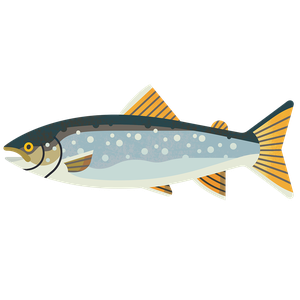
Atlantic salmon
Salmo salar
What to check for
Location
NE Atlantic (Scotland)
Technical location
Atlantic, Northeast, All areas
Caught by
Net (drift), Net (gill or fixed)
Rating summary
Wild Atlantic salmon stocks are depleted over much of their range. In Scotland, each year, Marine Scotland carry out an assessment of the conservation status of each river. ICES advises that when the MSY approach is applied, fishing should only take place on salmon from rivers where stocks have been shown to be at full reproductive capacity. The Scottish Government has identified 12 high level pressures impacting salmon in Scotland and further afield. Management measures in place to protect declining stocks include prohibiting the retention of salmon caught in coastal waters and the requirement of mandatory catch-and-release of Atlantic salmon in areas which fall below their defined conservation level.This rating applies to rivers listed as Grade 2 or 3 by Marine Scotland.Rating last updated June 2023.
Technical consultation summary
Wild Atlantic salmon stocks are depleted over much of their range. In Scotland, each year, Marine Scotland carry out an assessment of the conservation status of each river. ICES advises that when the MSY approach is applied, fishing should only take place on salmon from rivers where stocks have been shown to be at full reproductive capacity. The Scottish Government has identified 12 high level pressures impacting salmon in Scotland and further afield. Management measures in place to protect declining stocks include prohibiting the retention of salmon caught in coastal waters and the requirement of mandatory catch-and-release of Atlantic salmon in areas which fall below their defined conservation level.
How we worked out this Rating
Wild Atlantic salmon populations are at historically low levels and scientific advice recommends that no catch takes place. In line with advice from the North Atlantic Salmon Conservation Organisation (NASCO) the conservation status of stocks is assessed on a river by river basis, except those areas where fishery catch cannot be assigned to individual rivers. The Conservation of Salmon (Scotland) Regulations 2016 regulates the killing of Atlantic salmon in inland waters, managing stocks on an annual basis by categorising their conservation status.The conservation status of each stock is defined using the probabilities of meeting the conservation limit over a five-year period. Rather than a simple pass or fail stocks are allocated to one of three grades each with their own recommended management actions. Grade 1 rivers (29 proposed in 2023) are rivers in which exploitation is sustainable and no additional management action is currently required. Grade 2 rivers (31 proposed in 2023) are those in which management action is necessary to reduce exploitation and the need for mandatory catch and release will be reviewed annually. Grade 3 rivers (113 proposed in 2023) are those In which exploitation is unsustainable and management actions are required to reduce exploitation for a year. In 2023, only 1 river has improved its grading, while 20 have moved down a grade.In general terms the Regulations: prohibit the retention of salmon caught in coastal waters; permit the killing of salmon within inland waters where stocks are above a defined conservation limit i.e. those rivers accorded grade 1 or 2 status for the fishing season; require mandatory catch and release of salmon in areas which fall below their defined CL following the assessment of salmon stocks i.e. grade 3 rivers.Statutory conservation measures ensure that no salmon is taken in Scotland before 1 April each year. ICES advises that when the MSY approach is applied, fishing should only take place on salmon from rivers where stocks have been shown to be at full reproductive capacity. Mixed-stock fisheries present particular threats, and should be managed based on the individual status of all stocks exploited in the fishery.
References
Cefas, EA and NRW. 2021. Salmon Stocks and Fisheries in England and Wales in 2021. Available at https://assets.publishing.service.gov.uk/government/uploads/system/uploads/attachment_data/file/1093963/SalmonReport-2021-assessment.pdf [Accessed on 20.06.2023].ICES. 2023. North Atlantic salmon stocks. In Report of the ICES Advisory Committee, 2023. ICES Advice 2023, sal.oth.all. Available at https://doi.org/10.17895/ices.advice.22699276 [Accessed on 20.06.2023].ICES. 2023. Working Group on North Atlantic Salmon (WGNAS). ICES Scientific Reports. 5:41. 478 pp. Available at https://doi.org/10.17895/ices.pub.22743713 [Accessed on 20.06.2023].NASCO. Salmon at sea. Available at https://salmonatsea.com/ [Accessed on 20.06.2023].NASCO. NASCO Implementation Plan for the period 2019-2024. Available at https://www2.gov.scot/Resource/0054/00546369.pdf [Accessed on 20.06.2023].Myrvold, K.M., Mawle, G. W., Andersen, O. & Aas, Ø. 2019. The Social, Economic and Cultural values of wild Atlantic salmon. A review of literature for the period 2009-2019 and an assessment of changes in values. NINA Report 1668. Norwegian Institute for Nature Research. Available at https://brage.nina.no/nina-xmlui/handle/11250/2627172?locale-attribute=no [Accessed on 20.06.2023].Scottish Government. Salmon and recreational fisheries. Available at https://www.gov.scot/policies/salmon-and-recreational-fisheries/conservation/ [Accessed on 20.06.2023].Scottish Government. 2022. Scottish wild salmon strategy. Available at https://www.gov.scot/publications/scottish-wild-salmon-strategy/ [Accessed on 20.06.2023].Windsor, M.L., Hutchinson, P., Hansen, L.P. and Reddin, D.G. 2012. Atlantic salmon at sea: Findings from recent research and their implications for management. NASCO document CNL(12)60. Edinburgh, UK. 20pp. Available at http://www.nasco.int/sas/pdf/archive/other_reports/Salmon_at_sea.pdf [Accessed on 20.06.2023].
Sustainable swaps
Learn more about how we calculate our sustainability ratings.
How our ratings work