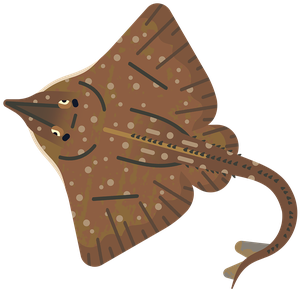
Blonde ray
Raja brachyura
What to check for
Location
Western English Channel
Technical location
Atlantic, Northeast, English Channel (West)
Caught by
Net (gill or fixed)
Rating summary
For more information about this rating please visit: http://www.cornwallgoodseafoodguide.org.uk/fish-guide/blonde-ray.php
Technical consultation summary
Blonde ray are a poorly studied species, with low resilience to fishing due to slow growth and reproduction rate. Managed under a combined total allowable catch (TAC) limit for skates and rays. This means the species cannot be managed individually, and is instead grouped with all other rays. For areas 7f and g (North Cornish coast) and 7a ICES recommends a 20% reduction in landings as there is such limited data on stocks or exploitation. This equates to no more than 573 tonnes is landed in 2023/4. Last assessed by IUCN in 2014 as Near Threatened and declining. Value and landings in Cornwall remaining stable. For more information about this rating please visit: http://www.cornwallgoodseafoodguide.org.uk/fish-guide/blonde-ray.php
How we worked out this Rating
There is concern for the biomass of blonde ray in the Western English Channel, and concern for the fishing pressure.Route 2 (data limited) scoring has been applied to this rating owing to the lack of reference points for biomass and fishing pressure. Blonde ray is considered to have a low resilience to fishing pressure. Blonde ray in the western English Channel has a patchy distribution, and is locally abundant on certain grounds. This makes it difficult for scientists to interpret survey data, and its tendency to form aggregations makes it vulnerable to localised depletion. There are a lack of surveys conducted in the area in recent years and very little is known about the biomass in this area. Therefore, there is concern for the biomass.Blonde ray is an important commercial species and landings have been increasing since 2017. However, misidentification still occrus between blonde ray and spotted ray and this could have impacted previous reports on landings data. It is a bycatch species in demersal fisheries but may be targeted in areas of high local abundance due to its large size and high market value. Restrictions on fishing for undulate ray from 2009 onwards may have redirected fishing effort to this species. ICES advises that when the precautionary approach is applied, landings should be no more than 213 tonnes in each of the years 2023 and 2024. This is a 20% decrease in the advice for 2021 and 2022 because the precautionary buffer has been applied.Landings in recent years have greatly exceeded the advice given by ICES (by over 300%) and therefore, there is concern for fishing pressure.
For more information about this rating please visit: http://www.cornwallgoodseafoodguide.org.uk/fish-guide/blonde-ray.php
References
For more information about this rating please visit: http://www.cornwallgoodseafoodguide.org.uk/fish-guide/blonde-ray.php

Sustainable swaps
Learn more about how we calculate our sustainability ratings.
How our ratings work