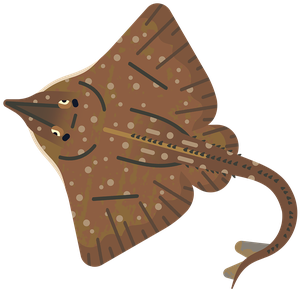
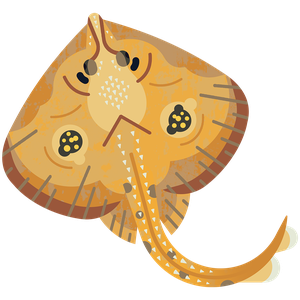
Blonde ray
Raja brachyura
What to check for
Location
Irish Sea, Bristol Channel, Celtic Sea North
Technical location
Atlantic, Northeast, Bristol Channel, Celtic Sea (North), Irish Sea
Caught by
Bottom trawl (otter)
Rating summary
There is concern for the biomass of blonde ray in the Irish Sea, Bristol Channel and Celtic Sea North, and concern for the fishing pressure. There is no management plan for skates and rays and the joint TAC has been deemed an unsuitable method for protecting individual species. However, in this area, the North Devon Fishermen's Association have implemented some management measures to help conserve stocks. Otter trawling is likely to cause some damage to the seabed. Bycatch is moderate and may include vulnerable species.Rating last updated January 2023.
Technical consultation summary
Blonde ray in the Irish Sea, Bristol Channel and Celtic Sea North is data limited. There is concern for the biomass as very little is known about its abundance and its tendency to form aggregations makes it vulnerable to localised depletion. There is also concern for fishing pressure as landings in recent years have greatly exceeded the advice given by ICES (by over 200%). There is no management plan for skates and rays and the joint TAC has been deemed an unsuitable method for protecting individual species. However, in this area, the North Devon Fishermen's Association have implemented some management measures to help conserve stocks. Otter trawling is likely to cause some damage to the seabed. Bycatch is moderate and may include vulnerable species.
How we worked out this Rating
There is concern for the biomass of blonde ray in the Western English Channel, and concern for the fishing pressure.Route 2 (data limited) scoring has been applied to this rating owing to the lack of reference points for biomass and fishing pressure. Blonde ray is considered to have a low resilience to fishing pressure.Blonde ray in the Irish Sea, Bristol Channel and North Celtic Sea have a patchy distribution, and it is locally abundant in certain areas, including off southwest Ireland. A patchy distribution makes it difficult for scientists to interpret survey data, and its tendency to form aggregations makes it vulnerable to localised depletion. As very little is known about the biomass in this area, there is concern for the biomass.Blonde ray is an important commercial species, however, the quality of landings data is considered too poor to create stock assessments. Misidentification also occurs between blonde ray and spotted ray and this could impact the accuracy of landings data. Blonde ray is a bycatch species in demersal fisheries but it may also be targeted in areas of high local abundance due to its large size and high market value.ICES advises that when the precautionary approach is applied, landings should be no more than 573 tonnes in each of the years 2023 and 2024. This is a 20% decrease from the advice for 2021 and 2022 because the precautionary buffer has been applied.Landings in recent years have greatly exceeded the advice given by ICES (by over 200%) and therefore, there is concern for fishing pressure.
There is no management plan for skates and rays and the joint TAC has been deemed an unsuitable method for protecting individual species. However, in this area, the North Devon Fishermen's Association have implemented some management measures to help conserve stocks.There is no direct management plan for skates and rays in these waters. They are usually caught as bycatch in otter and beam trawl fisheries, which target finfish (including flatfish and gadoids).Skates and rays are managed under five regional quotas (called TACs) which are applied to a group of species, rather than individual skate and ray species. This includes cuckoo ray, thornback ray, blonde ray, spotted ray, and small-eyed ray (undulate ray has a separate TAC). This has been deemed as an unsuitable method for protecting individual species, but species-specific quotas may increase discarding. Alternatives to the current TAC system are being explored, which may include the possible introduction of individual TACs for key stocks.A high-survivability exemption to the Landings Obligation was provided for skates and rays in the Celtic Seas ecoregion. Any skates and rays that are discarded are required to be released immediately and below the sea surface.Other management methods being considered are fishing gear modifications, education, conservation measures (such as closed seasons during spawning times). Some protected areas have been designated in these waters but offshore areas are not sufficiently managed. There are no official minimum landing sizes except for some IFCAs, which, mandate a minimum landing size (40-45 cm disc width) in inshore waters in England and Wales.In the Bristol Channel, the North Devon Fishermen's Association (NDFA) are ensuring fishing methods are up date, and are introducing new and innovative methods of sustainably catching fish. In 2005, over 300 square km north of Lundy Island prohibited mobile fishing (trawling) for six months of the years. Known locally as the 'ray box', this area was developed to protect juvenile ray and other breeding stocks. The NDFA also introduced a voluntary minimum landing size, which was initially set at 38cm across the wingtips, which was then increased to 45cm to assist growth and spawning. A local fisherman has also been helping tag blonde and thornback rays to collect more data to help inform management decisions.Whilst some of these measures may be effective at protecting the species, minimum size restrictions may be limited in their efficacy as some skate and ray species are not mature at this size e.g. a 45cm disc width for blonde ray correspond to 63.6cm long, yet around 50% of blonde rays only mature at 78.2cm and 85.6cm for males and females respectively. All rays below the minimum size are handled with care and returned immediately to the sea in order to increase its chance of survival.Both the EU and UK have fishery management measures in place, which can include catch limits, targets for population sizes and fishing mortality, and controls on what fishing gear can be used and where. In the EU, compliance with regulations has been variable, and there are ongoing challenges with implementing some of them. There was a target for fishing to be at Maximum Sustainable Yield by 2020, but this was not achieved. The Landing Obligation (LO), an EU law that the UK has kept after Brexit, requires all quota fish to be landed, even if they are unwanted (over-quota or below minimum size). It aims to promote more selective fishing methods, reduce bycatch, and improve recording of everything that is caught, not just what is wanted. Compliance with the LO is generally poor and actual levels of discards are difficult to quantify using the current fisheries observer programme. UK administrations are in the process of replacing the landing obligation with country-specific Catching Policies.In the UK, it is too early to tell how effective management is, as the Fisheries Act only came into force in January 2021. The Act requires the development of Fisheries Management Plans (FMPs) (replacing EU Multi-Annual Plans). FMPs are currently in development, but the scope of them remains unclear. They have the potential to be very important tools for managing UK fisheries, although data limitations may delay them for some stocks. MCS is keen to see publicly available FMPs for all commercially exploited stocks, especially where stocks are depleted, that include:Targets for fishing pressure and biomass, and additional management when those targets are not being met, based on the best available scientific evidenceTimeframes for stock recoveryImproved data collection, transparency and accountability, supported by technologies such as Remote Electronic Monitoring (REM)Consideration of wider environmental impacts of the fishery
Otter trawling is likely to cause some damage to the seabed. Bycatch is moderate and may include vulnerable species.Skate and rays are normally caught as bycatch but blonde ray from this area is sometimes targeted due to its high value and large size. The species is also targeted by sea anglers. Blonde rays in this area are mostly caught in bottom trawls or fixed nets.Otter trawls are not a very selective gear: the catch may include a large variety of species such as various soles, plaice, monkfish, haddock, cod, John Dory, red gurnard, horse mackerel, boar fish and grey gurnard, skates, rays and starry smooth-hound. Endangered, Threatened and Protected (ETP) species can occasionally be caught such as blue and flapper skate in offshore otter trawl fisheries but it is illegal to land these species.Discard rates of skates and rays vary dramatically (30-70%), depending on the marketability and management measures in place. For example, nearly all skates below 30 cm LT are discarded by English vessels. Bycatch can include juvenile skate as they can hatch from their egg cases at sizes of 10-20 cm LT and therefore, may be able to escape through the nets. Their survival rates upon discarding is extremely variable, depending on the fishing and handling methods used to capture them. Elasmobranchs have the potential for relatively high survival rates because they do not have swim bladders (and thereby are not as impacted by pressure changes), they can have thick and abrasive skins and thorns (which protect them) and some have spiracles and a buccal-pump respiratory which excrete a mucus, which allows the skate or ray to ventilate and acquire oxygen when out of the water. Inshore and coastal fisheries using trawls, longlines, gillnets and tangle nets generally show low at-vessel mortality. There are a lack of studies available on long-term skate and ray survival when they are released into the wild.Demersal trawls have contact with the seabed resulting in penetration and abrasion of habitat features. The impact of trawling on the seabed depends on the location and scale in which trawling occurs. For example, areas that are used to natural disturbance through tides and waves, are less sensitive to habitat impacts. Areas not used to mobile towed gears are typically more sensitive to trawling. Blonde rays inhabit offshore sandbanks and coastal shallows. They occur over sandy, mud and gravel substrates.There are Marine Protected Areas (MPAs) in this area, some of which are designated to protect seabed features from damaging activities. This fishery overlaps with parts of these MPAs, but the proportion of the catch coming from these areas is expected to be relatively low in relation to the unit of assessment (i.e. less than 20% of the catch or effort), and so these impacts have not been assessed within the scale of this rating. Given the important role that MPAs have in recovering the health and function of our seas, MCS encourages the supply chain to identify if their specific sources are being caught from within MPAs. If sources are suspected of coming from within designated and managed MPAs, MCS advises businesses to establish if the fishing activity is operating legally inside a designated and managed MPA, and request evidence from the fishery or managing authority to demonstrate that the activity is not damaging to protected features or a threat to the conservation objectives of the site(s).To improve monitoring and reporting of fishing activity, MCS would like to see remote electronic monitoring (REM) with cameras implemented, used and enforced. To reduce the impacts of fishing on the marine environment we would like to see a just transition to the complete removal of bottom towed gear from offshore Marine Protected Areas designated to protect the seabed. We also want to see reduction and mitigation of environmental impacts including emissions and blue carbon habitat damage.
References
Cook, R., Gaudian, G., des Clers, S. and Seip- Markensteijn, C.M., 2022. Marine Stewardship Council (MSC) Public Certification Report: Scottish Fisheries Sustainable Accreditation Group (SFSAG) Northern Demersal Stocks. Prepared by Control Union (UK) Limited on behalf of Scottish Fisheries Sustainable Accreditation Group (SFSAG). May 2022. Available at https://cert.msc.org/FileLoader/FileLinkDownload.asmx/GetFile?encryptedKey=BdxOJoY7Sf4DmNJEB/m47M6xx0rRfgP/niGx3vj5Ud8hadYI3XCNrnlSFL/jlTgK [Accessed on 13.07.2022].Eigaard, O.R., Bastardie, F., Breen, M., Dinesen, G.E., Hintzen, N.T., Laffargue, P., Mortensen, L.O., Nielsen, J.R., Nilsson, H.C., O'Neill, F.G., Polet, H., Reid, D.G., Sala, A., SkOld, M., Smith, C., Sorensen, T.K., Tully, O., Zengin, M., Rijnsdorp, A.D., 2016. Estimating seabed pressure from demersal trawls, seines, and dredges based on gear design and dimensions. ICES Journal of Marine Science, Volume 73, Issue suppl 1. Pages i27-i43. Available at https://academic.oup.com/icesjms/article/73/suppl_1/i27/2573989 [Accessed on 12.07.2022].Froese, R. and D. Pauly. Editors. 2022. FishBase. Blonde ray. Available at https://www.fishbase.de/summary/SpeciesSummary.php?ID=4552&AT=blonde+ray [Accessed on 16.01.2023].Hiddink, J., Jennings, S., Sciberras, M., Szostek, C.L., Hughes, K.M., Ellis, N., Rijnsdorp, A.D., McConnaughey, R.A., Mazor, T., Hilborn, R., Collie, J.S., Pitcher, C.R., Amoroso, R.O., Parma, A.M., Suuronen, P. and Kaiser, M.J. 2017. Global analysis of depletion and recovery of seabed biota after bottom trawling disturbance. PNAS. 114:31, pp. 8301-8306. https://doi.org/10.1073/pnas.1618858114.ICES. 2022. Blonde ray (Raja brachyura) in Division 7.e (western English Channel). In Report of the ICES Advisory Committee, 2022. ICES Advice 2022, rjh.27.7e. Available at https://doi.org/10.17895/ices.advice.19754449 [Accessed on 10.01.2023].ICES. 2022. Working Group on Elasmobranch Fishes (WGEF). ICES Scientific Reports, 4:74. Available at http://doi.org/10.17895/ices.pub.21089833 [Accessed on 10.01.2023].Kennelly, S. J. & Broadhurst, M. K., 2021. A review of bycatch reduction in demersal fish trawls. Rev Fish Biol Fisheries 31, 289–318. https://doi.org/10.1007/s11160-021-09644-0.Kynoch, R., Fryer, R. & Neat, F., 2015. A simple technical measure to reduce bycatch and discard of skates and sharks in mixed-species bottom-trawl fisheries. ICES J Mar Sci,72(6):1861.North Devon Fishermen's Association. What we do. Available at http://www.northdevonfishermen.co.uk/what-we-do [Accessed on 10.01.2023].Shark Trust. 2020. Blonde Ray ID Guide. Available at https://www.sharktrust.org/faqs/blonde-ray-id-guide [Accessed on 10.01.2023].Silva, F., Ellis, J. & Catchpole, T., 2012. Species composition of skates (Rajidae) in commercial fisheries around the British Isles and their discarding patterns. J Fish Biol., 80:1678–1703.van Denderen, P. Bolam, S., Hiddink, J.G., Jennings, S., Kenny, A., Rijnsdorp, A., and van Kooten, T., 2015. Similar effects of bottom trawling and natural disturbance on composition and function of benthic communities across habitats. Mar Ecol Prog Ser. 2015;541:31–43.

Sustainable swaps
Learn more about how we calculate our sustainability ratings.
How our ratings work