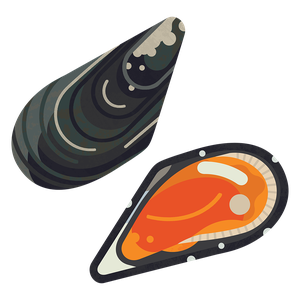
Blue mussel
Mytilus edulis
What to check for
Location
Northern Ireland (benthic cultivated)
Technical location
Atlantic, Northeast, Irish Sea
Caught by
Dredge
Certification
Marine Stewardship Council (MSC)
Rating summary
Blue mussels dredged around the island or Ireland are data limited. There is concern for biomass due to the lack of information, but they do not seem to subject to overexploitation. There are some management measures in place. Blue mussels from this area are harvested using dredges, which may cause habitat impacts. Some measures are in place to protect vulnerable habitats and to reduce bycatch. The MSC certified fishery has taken measures to monitor and mitigate impacts.Rating last updated January 2023
Technical consultation summary
As cultivated mussels are harvested by dredge they are assessed using the wild methodology for the Good Fish Guide. Blue mussels cultivated in Northern Irish waters are data limited. There is concern for biomass of mussels due to limited information and indications of low biomass in some areas, however, fishing only targets a small proportion of blue mussels and they are not considered overfished. There are some management measures in place for wild mussel harvesting, including for seed mussels. Licences and compliance with restrictions are required for all vessels. This fishery is independently certified to Marine Stewardship Council standards, with additional monitoring and reporting requirements. However, it is not possible to fully assess the appropriateness or effectiveness of management measures due to the challenges in monitoring wild mussels. Blue mussels for seed and cultivated for market are predominantly harvested using dredges. Fishing using dredge methods are likely to cause some or moderate habitat impacts as they disturb sediments and benthic species. On-growing of mussels means a second habitat is dredged. In seed harvesting and cultivation areas some management measures are in place to protect vulnerable habitats and to reduce bycatch.
How we worked out this Rating
Wild blue mussel populations around the island of Ireland are data limited. There is concern for biomass of mussels due to the lack of information and indications of low biomass in some areas. However, there is no concern for fishing pressure.Mussel cultivation involves collecting juvenile, or ‘seed’ mussels from natural beds and relaying them in another area. There, they are left on the seabed until they are large enough to be removed and sold to the market. Usually, dredges are used for both seed collection and final harvesting. Between 2016 and 2020, most wild UK mussels were cultivated using this process, accounting for 92% of all mussel landings.This rating covers mussels cultivated in Northern Ireland from wild seed, which is the source of the majority of dredged mussels in the UK (1,397 tonnes in 2020). Seed mussels for this system are harvested from both Northern Irish and Republic of Ireland waters, and then on-grown in Northern Ireland. Stock scoring for this rating is therefore focused on the seed mussel beds around the island of Ireland.Route 2 (data limited) scoring has been applied to this rating owing to the lack of reference points for biomass and fishing pressure. Blue mussels are considered to have moderate vulnerability to fishing (scoring 36 out of 100).The structure of blue mussel stocks is complicated. There appears to be no clear genetic separation over the species’ range, suggesting no clear stock structure. Following a period as larvae in the water column, they settle in beds. While some beds are permanent, and likely to be a source of larvae, others change location depending on water conditions and may disappear entirely each winter. The latter are known as ephemeral beds and are the ones used as seed beds for mussel harvesting. These are challenging to monitor because locations and sizes change.Due to the challenge in monitoring seedbeds, research is underway to further understand the abundance of mussel larvae in the water column and where they settle. This has resulted in greater understanding about the role of wind and tidal currents in determining where larvae settle. Available data from 2015-2018 in the Irish Sea indicates declines in larvae over time. However, larval quantities are reported as ‘unlikely to be coupled to ‘on-the-ground’ biomass’ due to the small proportion of larvae that survive and settle on the seabed.The management approach in this system is to allow complete removal of ephemeral beds by the fishery. Therefore, there are no targets for biomass or fishing pressure on these beds. Instead, surveys of mussel beds are carried out by Bord Iascaigh Mhara (BIM) in the Republic of Ireland and Agri-Food and Biosciences Institute (AFBI) in Northern Ireland. If the seed beds are above a certain threshold, harvesting may proceed.In the 2021 surveys in Northern Ireland, stock levels were assessed as being too low for exploitation. However, around the Republic of Ireland, 2021 surveys showed spat levels of 9295 tonnes - above the minimum exploitable biomass of 1500t. As there are conflicting trends in seed bed size, and there is no data to indicate overall biomass, we consider there to be insufficient data relating to stock/habitat size in this area. We therefore consider there to be concern for biomass.Fishing pressure for this mussel fishery is measured by the number of seed mussels collected from wild stocks. There are no catch limits. The average number of seed mussels removed annually between 2014 and 2021 is 8377t (from data available for 2014, 2016, 2018, 2020, 2021 so recent landings of 9270t in 2021 are a little above the recent average. As there is no evidence that harvesting mussel seed impacts stocks overall there is currently no concern for fishing pressure.After seed mussels have been relain for on-growing, they are able to keep producing eggs until the final harvest. This means that they can contribute to the wider mussel population. The areas selected for relaying are sheltered, and therefore relain mussels are more likely than those on wild beds to reach maturity and breed. Therefore, seed harvesting is not expected to compromise overall stock levels.Until recently, it was assumed that mussel beds do not survive winter months and are entirely removed each year by natural processes. Fishing of the seed beds, which also removes most of the bed, was considered to replicate natural patterns. However, recent data has indicated that some mussels do survive the winter. Further evidence is therefore needed to confirm the impacts of harvesting on wild mussel beds and how this affects stock levels, habitats and reproductive capacity. If stability and productivity of seed beds is shown to be impacted by fishing, this could be cause for increased concern for stocks.
There are several management measures in place for wild mussel harvesting. Licences and compliance with restrictions are required for all vessels. This fishery is independently certified to Marine Stewardship Council standards. However, it is not possible to fully assess the appropriateness or effectiveness of management measures due to the challenges in monitoring wild mussels.The majority of dredged mussels in the UK are from the coast around Northern Ireland. This rating covers the Northern Irish Marine Stewardship Council (MSC) certified fishery. In this area, the fishery dredges wild seed from both Northern Irish and Republic of Ireland waters. It is then transplanted to licenced on-growing sites in Northern Ireland. Once at market size the mussels are then harvested, predominantly by dredge. The management of both seed and on-growing (aka transplanted or relay) sites is considered in this criterion.There is limited accessible information about the collated management measures in place to manage mussel seed fisheries and relain mussel beds. Transplanted mussel beds are also often private and there is limited accessible information about how these are managed. There are, however, several management measures to control fishing activity in mussel seed and relay sites, as indicated by a range of sources including MSC certification reports.In Ireland:Surveys must indicate that there is a minimum exploitable biomass of 1500t for the seed fishery to be opened in the Irish Sea.Fishing for seed mussels and relaying them requires authorisation. Authorisation is specific to certain dates and tides. There are also curfews, e.g. fishing is prohibited between 18:00hrs and 06:00hrs.There must be accurate reporting of catches. Vessel Monitoring Systems (VMS) must be in use to track vessel locations.There are defined levels of starfish predation to indicate ‘imminent danger’ to stocks. These trigger the use of a force majeure allowing beds to be opened to protect fishers’ harvests.Fisheries only remain open until 1) fishers have reached their allocation, 2) the date of closure is reached or 3) the fishery is closed early for whatever reason.In the Northern Ireland:Fishery stock surveys determine when stocks are too low to be fished, and implement closures, as in 2021.In Northern Ireland a fishery may be closed early on conservation grounds by the Fisheries Inspectorate should the mussel to waste ratio be deemed inappropriate and likely to damage the substrate.Much of the management of mussel harvesting has focussed on the effects of fisheries on marine protected areas (MPAs), rather than the impact on the target stock. The seed fishery for MSC certified mussels uses an Appropriate Assessment (AA) for this purpose. This has been considered an appropriate approach as seedbeds have been considered ephemeral (short lived) and unlikely to survive winter storms or predation. It was therefore thought that complete removals of beds by fishing would replicate natural conditions and would not increase pressure on wild stocks. However, some seed bed surveys in the Irish Sea have been shown to survive between years, indicating that the beds may not all be ephemeral. Additional research in the Wadden Sea indicates that fished beds are less stable over time than those not fished. As the sustainability of the fishery is predicated on the understanding that seed beds are ephemeral, further evidence is needed to support the assertion. There is a recommendation in the most recent MSC certification review to provide this evidence, however, it is not a condition of certification.There are also indications of concern for stock biomass in Northern Ireland, where regular repeated surveys are undertaken suggesting that current management has not protected these areas from stock declines. However, the closure of the beds to fishing indicates that appropriate management measures are currently in place for seedbed mussels in Northern Ireland.Alternative seed sources are being explored, such as using seed settled on ropes, but no information regarding the adoption of this is available.In 2019, a public consultation was held for a “Review of management arrangements for the Irish Sea mussel seed fishery”. A report summarising responses highlights the challenges of managing dispersed seed beds and the lack of appetite for protecting spawning potential of seed beds.Further evidence is needed to confirm that the current management approaches are appropriate for this fishery. Additionally, greater transparency about the management measures in place and compliance with them is needed across the Irish Sea and Northern Ireland in relation to mussels ultimately harvested in Northern Ireland.
Blue mussels are predominantly harvested using dredges. Fishing using dredge is likely to cause habitat impacts as it disturbs sediments and benthic species. Some management measures are in place to protect vulnerable habitats and to reduce bycatch.Mussel cultivation involves collecting juvenile, or ‘seed’ mussels from natural beds and relaying them in another area. There, they are left on the seabed until they are large enough to be removed and sold to the market. Usually, dredges are used for both seed collection and final harvesting, meaning that the seabed is dredged in two different places during the process. Between 2016 and 2020, most wild UK mussels were cultivated using this process, accounting for 92% of all mussel landings.The Northern Irish MSC certified mussel fishery use modified Dutch bottom dredge gear that are lighter than standard dredges.Mussel dredges do not use teeth, which is the main source of habitat damage in scallop dredging. However, studies indicate that mussel dredging results in 2-5cm furrows in the seabed. Medium- and long-term impacts appear to vary. In Denmark, species diversity on the seabed was reduced where mussel dredging occurred less than 4 months prior. However, this has not been shown to affect the sediment texture or organic content. In areas not dredged for over 4 years, results varied, with one area showing long term impacts on the epibenthic community whilst another did not. A more recent study showed changes in species and reduced biomass. In all dredged areas included in one study, there was less shell debris and gravel, which may impact settlement of bivalves and other species that attach to shells.There is also evidence that disturbance of mussel bed structure reduces growth and accumulation of biomass in the mussels directly. In high densities, mussels can bind to some areas of seabed and provide a habitat for many other species. Through seabed disturbance, mussel collection has the potential to impact habitats including wild mussel beds, sediments and wider associated species.More broadly, studies on dredging have indicated a wide range of habitat impacts, although they are not specific to mussel dredges. The impacts vary, depending on the ecosystem, including type of seabed, the species that live there, and the level of natural disturbance from waves and storms. In more disturbed areas, the habitats and species may be faster growing and more easily able to recover. Sheltered and inshore areas are more likely to have slow-growing, delicate species, like maerl, seagrass, horse mussels and seafans. Sandy areas are generally less sensitive and more easily able to recover. Gravelly seabed communities are more susceptible because they are quite stable and therefore more likely to have larger, longer-lived species.Where extensive fisheries occur, the depletion of wild seed stocks may have an effect on the trophic interaction within the system. In the Northern Ireland Skullmartin mussel seed bed, a study covering two seed fishing seasons concluded that there appears to be no long-term impact of dredging on the biodiversity of the beds but wider ecosystem impacts have not been explored. In the Irish Sea there are provisions to allow emergency fishing of seed beds if predator (starfish) numbers reach threshold levels that threaten the viability of beds prior to harvest. It is not known whether this intervention impacts on the wider ecosystem and food chain. Additionally, where extensive fisheries occur, the depletion of wild seed stocks may have an effect on trophic interaction (food chain links) within the system.In the Irish Sea, management measures are in place to protect sensitive habitats from seed fishing, including fully closed areas such as the legally protected Wicklow Reef Special Area of Conservation (SAC) where mussel dredging could cause significant impacts on reef habitat. In Northern Irish waters, Statutory Instruments have been enacted to protect areas from mussel seed fishing. This includes areas where seed fishing is prohibited and takes account of SACs and other vulnerable marine habitats and species such as the herring spawning box (Mourne Shore). Where relaying occurs in an area with special protection for habitats and vulnerable species, fisheries are assessed to see if they will cause any adverse impact (alone or in combination with other activities) to the features of interest. Relay sites a fisheries can only be opened if the assessments confirm that the fishery will not cause adverse impacts on habitats.MSC certification reports indicate that the measures are considered sufficient to ensure the protection of vulnerable habitats. However, new or unsurveyed areas may not be appropriately protected and further published information is needed to be able to assess the habitat impacts of the fishery as a whole.In areas where mussels have been relain, the low frequency of dredging activity at relay sites is identified as having a low risk of affecting the benthic community. There are some indications of positive impacts from relaying. There are records of an increase in certain species, i.e. small polychaete worms, after more intensive dredging activity, which may benefit protected species. If relay locations restore lost bivalve beds, some changes could be positive as these filter feeders recover ecosystem services and habitats. Mussel cultivation has been shown to significantly change the occurrence of some species of the infaunal community, which in some areas has been shown to increase in the number of epibenthic species.Reports suggest that farming of mussels may provide a direct food source for species such as Goldeneye ducks, which are in unfavourable condition, and curlew and redshank. There is no information about approaches fishers may use to control this predation. Relay sites for mussels may also attract predators, such as crabs and starfish. They may be removed using pots, dredges or mop like tools to entangle starfish.Deposits from shellfish beds, known as mussel mud or pseudofaeces, will change the local environment. Most mussel farms occupy shallow coastal waters with soft sediment, dominated by detrital organisms. They are not expected to be negatively impacted by the deposits.Through translocating mussel seed to cultivation sites, there is some risk of introduction and spread of pathogens, parasites, and/or non-native invasive species. Available information indicates that the risks of this are currently relatively low for mussel relay.Non-target and endangered, threatened and protected (ETP) species are rarely reported in mussel dredge fisheries. Monitoring in the Irish Sea showed negligible impact on non-target species. In the Southern IFCA district, specific gear restrictions limit the catch to predominantly shellfish.
References
AFBI, 2021. Seed Mussel Stock Assessment_Summer_2021_V1.0. Agri-food and Businesses Institute. Available at: https://www.daera-ni.gov.uk/sites/default/files/publications/daera/Seed%20Mussel%20Stock%20Assessment_Summer_2021_V1.0.pdf [Accessed on 21.6.22]Alexander, J., Malham, S., Smyth, D., Webb, J., Fidler, D., Bayford, P., McDonald, J., and Le Vay, L., 2021. Improving quantification of bivalve larvae in mixed plankton samples using qPCR: A case study on Mytilus edulis, Aquaculture, Volume 532, 2021, https://doi.org/10.1016/j.aquaculture.2020.736003.Beadman, H.A., Kaiser, M.J., Galanidi, M., Shucksmith, R. And Willows, R.I. (2004), Changes in species richness with stocking density of marine bivalves. Journal of Applied Ecology, 41: 464-475. https://doi.org/10.1111/j.0021-8901.2004.00906.x.BIM, 2007. The Rising Tide – A Review of the Bottom Grown Mussel Sector on the Island of Ireland. Bord Iascaigh Mhara (BIM). Available at: https://bim.ie/ (wp-content/uploads/2021/02/bim_146THE,RISING,TIDE,-,A,Review,of,the,Bottom,Grown,(BG),Mussel,Sector,on,the,Island,of,Ireland.pdf [Accessed on 21.6.22].BIM, 2018. 2018 Spring Mussel Larvae Monitoring Aquaculture Technical Shellish Report. Available at: https://ispp.ie/research-and-case-studies/mussel-settlement-survey/ [Accessed on 3.3.23].Bromhall, K., Dinesen, G. E., McLaverty, C., Eigaard, O. R., Petersen, J. K., & Saurel, C., 2022. Experimental effects of a lightweight mussel dredge on benthic fauna in a eutrophic MPA. Journal of Shellfish Research, 40(3), 519-531.https://doi.org/10.2983/035.040.0309.Criquet, G., Guilfoyle, F., and Garforth, D. 2015. Marine Stewardship Council Second Surveillance Report: Ireland Bottom Grown Mussel (Mytilus edulis) Fishery and the linked Northern Ireland Bottom Grown Mussel (Mytilus edulis) Fishery. Carried out by SAI Global Assurance Services on behalf of Bord Iascaigh Mhara (BIM) and The Cross Border Aquaculture Initiative (CBAIT). November 2015. Available at https://cert.msc.org/FileLoader/FileLinkDownload.asmx/GetFile?encryptedKey=kjmqsAcBugyjT7DsiNRzM+RIUZanod7oi0J1LRKNDTTy1FH1XS1pCTyEoZAbLUcC.DAERA, 2022. Mussel seed fishery, Department of Agriculture, Environment and Rural Affairs. Available at: https://www.daera-ni.gov.uk/articles/mussel-seed-fishery [Accessed on 21.6.22].DAFM, 2019. Review of management arrangements for the Irish Sea mussel seed fishery. Available at: http://www.fishingnet.ie/media/fishingnet/content/sea-fisheriesconsultations/irishseamusselseedfishery/1MusselSeedManagement290620.pdf [Accessed on 23.12.22].Demmer, J., 2020. PhD Thesis. Simulating the Temporal and Spatial Variability of North Wales Mussel Populations. Available at: https://www.proquest.com/openview/58bb8058bf6b2e155bcc0a3f75e6f57e/1?pq-origsite=gscholar&cbl=18750&diss=y [Accessed on 3.3.23].Demmer, J., Neill, S.P., Andres, O., Malham, S., Jones, T. & Robins, P. 2022. Larval dispersal from an energetic tidal channel and implications for blue mussel (Mytilus edulis) shellfisheries. Aquacult Int 30, 2969–2995. https://doi.org/10.1007/s10499-022-00948-x.Demmer, J., Robins, P., Malham, S., Lewis, M., Owen, A., Jones T. & Neill, S., 2022. The role of wind in controlling the connectivity of blue mussels (Mytilus edulis L.) populations. Mov Ecol 10, 3. https://doi.org/10.1186/s40462-022-00301-0.Dignan, S., Hoare, D., Guilfoyle, F., and Donnelly, C., 2018. Marine Stewardship Council 4th Surveillance Report: Ireland Bottom Grown Mussel Fishery And The Linked Northern Ireland Bottom Grown Mussel Fishery. Carried out by SAI Global on behalf of Bord Iascaigh Mhara (BIM) And The Aquaculture Initiative EEIG. https://cert.msc.org/FileLoader/FileLinkDownload.asmx/GetFile?encryptedKey=nYMLApVaSXYItc89v6zYqIBduaKWEB3DwnVyB8FuqSfC6fuD9cw6mK4Kn/3Xinv0.Dignan, S., Hoare, D., Guilfoyle, F. and Donnelly, C., 2018b. Marine Stewardship Council Public Certification Report: Northern Ireland Bottom Grown Mussel Fishery and the linked Ireland Bottom Grown Mussel Fishery. Carried out by SAI Global on behalf of the Aquaculture Initiative EEIG and Bord Iascaigh Mhara (BIM). July 2018. Available at https://cert.msc.org/FileLoader/FileLinkDownload.asmx/GetFile?encryptedKey=ixb39wJUwPdqnhxOTgAX3JLEgSQ4suLMmhHRKqNLrLcOmGYj0JwVbrxdAaC4NH14 [Accessed on 10.03.2023].Dolmer, P., Kristensen, T., Christiansen, M.L., Petersen, M.F., Kristensen, P.S., Hoffmann, E., 2001. Short-term impact of blue mussel dredging (Mytilus edulis L.) on a benthic community. In: Burnell, G. (eds) Coastal Shellfish — A Sustainable Resource. Developments in Hydrobiology, vol 160. Springer, Dordrecht. https://doi.org/10.1007/978-94-010-0434-3_12.Dolmer, P., 2002. Mussel dredging: Impact on epifauna in Limfjorden, Denmark. Journal of Shellfish Research, 21(2), 529-538. https://orbit.dtu.dk/en/publications/mussel-dredging-impact-on-epifauna-in-limfjorden-denmark.Donnelly, C., & Dignan, S., 2020. Marine Stewardship Council First Surveillance Report: Ireland Bottom Grown mussel. Carried out by SAI Global on behalf of Bord Iascaigh Mhara and the Aquaculture Initiative EEIG. Available at https://cert.msc.org/FileLoader/FileLinkDownload.asmx/GetFile?encryptedKey=qlz/T2TlI8ZYDLHuW0711cxM2KZv5kXtCgUBZ2mhQ6zklIRky06WLLs7HAK9hAsy.Donnelly, C., Gascoigne, J., and Lebechnech, L., 2022. Marine Stewardship Council Third Surveillance Report: Ireland bottom grown mussel. Carried out by Global Trust Certification on behalf of An Bord Iascaigh Mhara. October 2022. Available at https://cert.msc.org/FileLoader/FileLinkDownload.asmx/GetFile?encryptedKey=rh0G3L8C8du5tJDKARZJCzGbKPlxhEk5EZWd58+0CBbuV+6y75hLrRFi2+PmjgJh.Frandsen, R. P., Eigaard, O. R., Poulsen, L. K., Tørring, D., Stage, B., Lisbjerg, D. and Dolmer, P., 2015. Reducing the impact of blue mussel (Mytilus edulis) dredging on the ecosystem in shallow water soft bottom areas. Aquatic Conserv: Mar. Freshw. Ecosyst., 25: 162– 173. doi: 10.1002/aqc.2455.Gallardi, D., 2014. Effects of Bivalve Aquaculture on the Environment and Their Possible Mitigation: A Review. Fish Aquac J 5: 105. https://www.longdom.org/open-access/effects-of-bivalve-aquaculture-on-the-environment-and-their-possible-mitigation-a-review-43227.html.JNCC, 2022. Description of biotope or habitat type. Mytilus edulis beds on littoral sediments. Available at: https://mhc.jncc.gov.uk/biotopes/jnccmncr00000063#:~:text=Other%20beds%20are%20ephemeral%2C%20an,be%20washed%20away%20during%20gales. [Accessed on 21.6.22].Kaiser, M., Laing, I., Utting, S., and Burnell, G. M. 1998. Environmental impact of bivalve mariculture. Journal of Shellfish Research. 17: 58-66.Lambert, G.I., Jennings, S., Kaiser, M.J., Davies, T.W. and Hiddink, J.G., 2014. Quantifying recovery rates and resilience of seabed habitats impacted by bottom fishing. Journal of Applied Ecology. 51:5, pp. 1326-1336. https://doi.org/10.1111/1365-2664.12277.Long, S., Constant, R.F., Metcalfe, K., and Witt, M.J., 2017. Have Centuries of Inefficient Fishing Sustained a Wild Oyster Fishery: a Case Study. Fish Aqua J 8: 198. doi:10.4172/2150-3508.1000198.Loughs Agency, 2022. Seed Mussels. Available at: https://www.loughs-agency.org/managing-our-loughs/shellfisheries/research-monitoring/shellfish-stock-assessments/seed-mussels/ [Accessed on 21.6.22].Maguire, J. A., Knights, T., Burnell, G., Crowe, T., O'Beirn, F., McGrath, D., Ferns, M., McDonough, N., McQuaid, N., O'Connor, B., Doyle, R., Newell, C., Seed, R., Smaal, A., O'Carroll, T., Watson, L., Dennis, J., Ó Cinneide, M., 2007. Management recommendations for the sustainable exploitation of mussel seed in the Irish Sea, Marine Environment and Health Series No. 31, Marine Institute. Available at https://oar.marine.ie/handle/10793/271 [Accessed on 09.03.2023].McLaverty C., Eigaard O.R., Dinesen G.E., Gislason H., Kokkalis A., Erichsen A.C. and Petersen J.K., 2020. High-resolution fisheries data reveal effects of bivalve dredging on benthic communities in stressed coastal systems. Mar Ecol Prog Ser 642:21-38. https://doi.org/10.3354/meps13330.MMO, 2020. UK sea fisheries annual statistics report 2020. UK fleet landings by rectangle stock and estimated EEZ 2016 2020. Available at: https://www.gov.uk/government/statistics/uk-sea-fisheries-annual-statistics-report-2020 [Accessed 18.11.21].Palomares, M.L.D. and D. Pauly. Editors. 2022. SeaLifeBase. Mytilus edulis, Blue mussel. World Wide Web electronic publication, Version (04/2022). Available at: www.sealifebase.org [Accessed on 21.6.22].Pitcher, C.R., Hiddink, J.G., Jennings, S., Collie, J., Parma, A.M., Amoroso, R., Mazor, T., Sciberras, M., McConnaughey, R.A., Rijnsdorp, A.D., Kaiser, M.J., Suuronen, P. and Hilborn, R., 2022. Trawl impacts on the relative status of biotic communities of seabed sedimentary habitats in 24 regions worldwide. PNAS 119:2. https://doi.org/10.1073/pnas.2109449119.Polonio, V., Guilfoyle, F., Dignan, S., 2017. Marine Stewardship Council 3rd Surveillance Report: Northern Ireland Bottom Grown Mussel (Mytilus edulis) Fishery and the linked Ireland Bottom Grown Mussel (Mytilus edulis) Fishery. Carried out by SAI GLobal on behalf of Cross Border Aquaculture Initiative (CBAIT) And the Bord Iascaigh Mhara (BIM). Available at: https://cert.msc.org/FileLoader/FileLinkDownload.asmx/GetFile?encryptedKey=unWGpKUclPby4fqjFm2W49LKuZV29qqCG2GMTaIVLBTvICbqhZFcTtJBc2s0uKM9 [Accessed on 22.12.22].Sciberras, M., Hiddink, J.G., Jennings, S., Szostek, C.L., Hughes, K.M., Kneafsey, B., Clarke, L.J., Ellis, N., Rijnsdorp, A.D., McConnaughey, R.A., Hilborn, R., Collie J.S., Pitcher, C.R., Amoroso, R.O., Parma, A.M., Suuronen, P. and Kaiser, M.J. 2018. Response of benthic fauna to experimental bottom fishing: A global meta- analysis. Fish and Fisheries, 19:4, pp 698-715. https://doi.org/10.1111/faf.12283 [Accessed on 15.06.2022].Seafish, 2022. Mussels, Various species, Wild Seed. Available at: https://www.seafish.org/responsible-sourcing/aquaculture-farming-seafood/species-farmed-in-aquaculture/aquaculture-profiles/mussels/wild-seed/ [Accessed on 28.6.22].Seafood Watch, 2020. Marine Mussels, Worldwide On and Off Bottom Culture. Available at: https://www.seafoodwatch.org/recommendation/mussels/mussels-29904?species=3454 [Accessed on 21.6.22].SIFCA, 2020. Poole Harbour Special Protection Area (SPA) Appropriate Assessment - Issue of Leases under the Poole Harbour Fishery Order 2015 for 2020-25. Available at: https://secure.toolkitfiles.co.uk/clients/25364/sitedata/Redesign/Aquaculture-Fisheries/HRA-PooleOrder-2020-25-v.1.3-Oct-21-.pdf [Accessed on 21.6.22].SIFCA, 2022c. Poole Harbour Aquaculture. Available at: https://www.southern-ifca.gov.uk/district-aquaculture [Accessed on 21.6.22].Ysebaert, T., Hart, M. & Herman, P.M.J. 2009. Impacts of bottom and suspended cultures of mussels Mytilus spp. on the surrounding sedimentary environment and macrobenthic biodiversity. Helgol Mar Res 63, 59–74. https://doi.org/10.1007/s10152-008-0136-5.

Sustainable swaps
Learn more about how we calculate our sustainability ratings.
How our ratings work