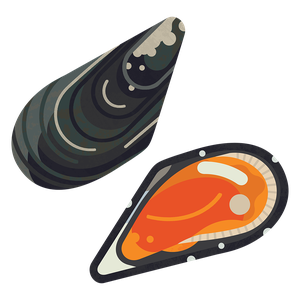
Blue mussel
Mytilus edulis
What to check for
Location
Dorset (Poole Harbour)
Technical location
Atlantic, Northeast, English Channel (East)
Caught by
Dredge (suction)
Rating summary
Mussels are widely cultivated and stocks generally considered to be under-exploited. The main methods of harvesting for wild and farmed mussels are dredging and hand-gathering. Hand-gathering is a more selective and sustainable method of harvesting mussels in the wild, and causes less disturbance than mechanical methods. The hydraulic elevator mussel fishery in the Exe estuary was certified as an environmentally fishery in July 2012.
How we worked out this Rating
Wild blue mussel populations in Dorset are data limited. There is concern for biomass of mussels due to the lack of information. However, there is no concern for fishing pressure. Mussel cultivation involves collecting juvenile, or ‘seed’ mussels from natural beds and relaying them in another area. There, they are left on the seabed until they are large enough to be removed and sold to the market. Usually, dredges are used for both seed collection and final harvesting. Between 2016 and 2020, most wild UK mussels were cultivated using this process, accounting for 92% of all mussel landings. 15% of the landings were from Poole Harbour in Dorset. This rating covers mussels cultivated in Poole Harbour from wild seed. Mussel dredging in this area has taken place since 1991. Route 2 (data limited) scoring has been applied to this rating owing to the lack of a reference point for biomass and uncertainty in the data. Blue mussels are considered to have moderate vulnerability to fishing (scoring 36 out of 100). The structure of blue mussel stocks is complicated. There appears to be no clear genetic separation over the species’ range, suggesting no clear stock structure. Following a period as larvae in the water column, they settle in beds. While some beds are permanent, and likely to be a source of larvae, others change location depending on water conditions and may disappear entirely each winter. These are challenging to monitor because locations and sizes change. Stock scoring for this rating is focused on seed mussel beds. In the Southern IFCA district, there appears to have been no assessment or survey of seed mussel beds since 2015. The bed disappeared entirely during the winter of 2014-2015, which was attributed to storms, although there is no published research available to confirm the cause. Information relating to the beds since then has been anecdotal, but indicates that the bed is now the same size as it was prior to winter 2014/15. As there is no actual data to indicate the current extent and density of the mussel bed, and no indication of what would be considered a sustainable size, we consider there to be insufficient data relating to stock/bed size in this area. We therefore consider there to be concern for biomass. There is limited available data about fishing pressure on mussels in the Southern IFCA district. The IFCA reports that average annual removals from 2001-2010 were around 2,000 tonnes. In 2011 an annual catch limit of 2,000t was introduced. From 2011-2013, surveys indicated that fishing activity had not caused changes in density or population structure. Catches appear to have declined after this, with a total of 70t of mussels landed between 2016 and 2020 in the Southern IFCA area. In recent years catches have increased to around 400t, and the catch limit has been set at 1000t. Catch records do not indicate a decline in CPUE, and the IFCA has therefore decided that the fishery is sustainable at these levels. As recent catches are below long-term averages, and CPUE is stable, we conclude that there is no concern for fishing pressure. In this area, seed mussel beds are close to the Studland to Portland Special Area of Conservation (SAC). Because of the proximity to this marine protected area, a Test of Likely Significant Effect (TLSE) must be carried out to assess the impact of dredging. The most recent TLSE was carried out in 2022. It recommended that fishing could occur if catch limits and restrictions were adhered to. However, this is not an assessment of stock size or fishing pressure and therefore does not affect the stock score. After seed mussels have been relain for on-growing, they are able to keep producing eggs until the final harvest. This means that they can contribute to the wider mussel population. The areas selected for relaying are sheltered, and therefore relain mussels are more likely than those on wild beds to reach maturity and breed. Therefore, seed harvesting is not expected to compromise overall stock levels. Until recently, it was assumed that mussel beds do not survive winter months and are entirely removed each year by natural processes. Fishing of the seed beds, which also removes most of the bed, was considered to replicate natural patterns. However, recent data has indicated that some mussels do survive the winter. Further evidence is therefore needed to confirm the impacts of harvesting on wild mussel beds and how this affects stock levels, habitats and reproductive capacity. If stability and productivity of seed beds is shown to be impacted by fishing, this could be cause for increased concern for stocks.

There are several management measures in place for wild mussel harvesting in the Southern IFCA district. However, it is not possible to fully assess the appropriateness or effectiveness of management measures due to the challenges in monitoring wild mussels.The majority of dredged mussels in the UK are from the coast around Northern Ireland. MMO data from 2016-2020 indicates Northern Irish landings were 1397 tonnes, with smaller fisheries around the coasts of Dorset (70 t), Cornwall (25 t) and South Wales (17 t).In Dorset, within the Southern IFCA district, the fishery dredges wild seed, which is then transplanted to licenced on-growing sites. Once at market size the mussels are then harvested, predominantly by dredge. The management of both seed and on-growing (aka transplanted or relay) sites is considered in this criterion.There is no harvest strategy for blue mussels in this area, and there appear to have been no recent surveys of wild mussel beds. Transplanted mussel beds are often private, meaning that publicly available information about these beds is limited. There are, however, a number of management measures to control fishing activity in mussel seed and relay sites.For seed mussels:Applications must be made to remove seed mussels. Southern IFCA set a catch limit of 1,000 tonnes in 2021 and 2022, and catches appear to have been within this limit at 380t in 2021 and 430t in 2022.There are area restrictions limiting where mussel seed fishing can take place.Mussels smaller than 50mm cannot be removed unless they are going to be relain.For relaying:All mussels must be relayed for a minimum of 6 months on a Several Fishery lay within Poole Harbour.Transplanted shellfish beds must be established before being fished, and permits are required to dredge areas where mussels have been relain.Other measures include:Fishers must notify SIFCA before they start fishing for mussel, and they must have satellite tracking (Vessel Monitoring System, VMS) switched on during fishing.There are gear and usage restrictions for dredges to ensure only shellfish are caught.Fishing is prohibited in some areas to protect vulnerable habitats like seagrass, although exceptions for relaying may be allowed.Habitat Regulation Assessments set conditions about how and where fishing can take place.Much of the management of mussel harvesting has focussed on the effects of fisheries on marine protected areas (MPAs). This has been considered an appropriate approach, as seedbeds have been considered ephemeral (short lived) and unlikely to survive winter storms or predation. It was therefore thought that complete removals of beds by fishing would replicate natural conditions and would not increase pressure on wild stocks. However, some seed beds have been shown to survive between years, indicating that the beds may not all be ephemeral. Additional research in the Wadden Sea indicates that fished beds are less stable over time than those not fished. As the sustainability of the fishery is predicated on the understanding that seed beds are ephemeral, further evidence is needed to support this management approach.Alternative seed sources are being explored, such as using seed settled on ropes, but no information regarding the adoption of this is available.Further evidence is needed to confirm that the current management approaches are appropriate for this fishery.
The main methods of harvesting for wild and farmed mussels are dredging and hand-gathering. Hand-gathering is a more selective and sustainable method of harvesting mussels in the wild, and causes less disturbance than mechanical methods. Hydraulic elevators either use jets of water to disturb the ground in front of a towed dredge to capture bivalves, like razorshells and cockles, or use a pump to suck bottom sediments on board ship where bivalves are screened out and the spoil discharged back to sea. Impacts associated with this type of fishing can include removal of local populations of the target species, removal and disturbance of sediment with consequences for other species living there, and creation of spoil plumes and siltation.
References
www.marlin.ac.uk/speciesfullreview.php?speciesID=3848; www.iucnredlist.org/search; www.mcsuk.org/downloads/fisheries/Most%20sustainable%20fishing%20methods.pdf; https://www.msc.org/track-a-fishery/fisheries-in-the-program/certified/north-east-atlantic/exmouth_mussels
Sustainable swaps
Learn more about how we calculate our sustainability ratings.
How our ratings work