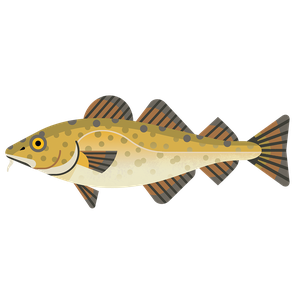
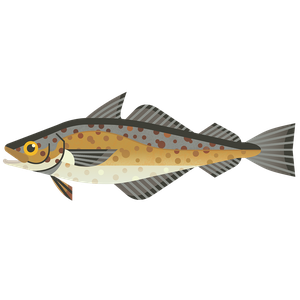
Coley
Pollachius virens
What to check for
Location
Northeast Arctic (Barents and Norwegian Sea)
Technical location
Atlantic, Northeast, Barents Sea, Norwegian Sea, Spitzbergen, and Bear Island
Caught by
Net (purse seine or ring)
Rating summary
The population of coley, or saithe, in the northeast Arctic is abundant and fishing is within sustainable limits. Some appropriate management measures are in place. However, management has not adequately addressed bycatch issues. Some Arctic saithe catches are by purse seine netting. This has low bycatch levels and is unlikely to have any habitat impacts.Rating last updated July 2023.
Technical consultation summary
The population of coley, or saithe, in the northeast Arctic is abundant and fishing is within sustainable limits. The most recent stock assessment was carried out by the International Council for the Exploration of the Sea (ICES) in 2023 using data up to 2022. Spawning-stock biomass (SSB) in 2022 was 741,480t. It is predicted to be 727,666t in 2023. These figures are well above the management target (SSB MGT), which is 220,000t. Fishing mortality (F) in 2022 it was 0.20. This is below the target in the management plan (FMP), which is 0.32. Some appropriate management measures are in place. This stock is managed through the Norwegian Management Plan. ICES considers it to be precautionary. The plan uses a Harvest Control Rule to calculate TACs based on the spawning stock biomass. From 2018 - 2022, Norwegian TACs have been set in line with scientific advice, but catches have varied from 95-109% of TACs. Therefore, management seems to be responsive to the status of the stock and is following scientific advice, but catches are excessive in some years. Discarding of unwanted or below-minimum-size fish is illegal. It is reported to take place in the saithe fishery at low levels, but there are no estimates to quantify it. Some Arctic saithe catches are by purse seine netting. This has low bycatch levels and is unlikely to have any habitat impacts.
How we worked out this Rating
The population of coley, or saithe, in the northeast Arctic is abundant and fishing is within sustainable limits.NE Arctic saithe catches have fluctuated since the 1960s, exceeding 250,000 tonnes in the 1970s. Recent catches have averaged around 180,000 tonnes.The most recent stock assessment was carried out by the International Council for the Exploration of the Sea (ICES) in 2023 using data up to 2022. The reference points for this stock are based on the Norwegian management plan, rather than Maximum Sustainable Yield. ICES has evaluated the management plan and found it to be precautionary.It shows that spawning-stock biomass (SSB) declined from around 500,000 tonnes in the 1960s and 70s to below the point of reproductive impairment (Blim, 136,000t) during the 1980s-1990s. SSB has since increased and in 2022 it was 741,480t. It is predicted to be 727,666t in 2023. These figures are well above the management target (SSB MGT), which is 220,000t. The stock is therefore not in an overfished state.Fishing mortality (F) peaked at 0.71 in the 1980s, which is above Flim (0.58) - the level of pressure that could bring the stock to Blim. It fell to a low of 0.179 in the 2000s and increased again to 0.39 in the 2010s. It has again declined, and in 2022 it was 0.20. This is below the target in the management plan (FMP), which is 0.32. Therefore, the stock is not subject to overfishing.ICES advises that when the Norwegian management plan is applied, catches in 2024 should be no more than 223,123 tonnes. This is very similar to the advice from the previous year (-2% change).
Some appropriate management measures are in place. There is a management plan, that follows scientific advice. However, catches are excessive in some years and there is a small amount of discarding.Northeast Arctic (NEA) saithe is mainly caught by Norway, accounting for over 90% of the total catch. Most of the rest is caught by Russia, with some catches by the EU, UK, and Faroe Islands. Most of this fishery is MSC-certified. This rating covers uncertified fleets.This stock is managed through the Norwegian Management Plan. ICES considers it to be precautionary. The goal is to maintain the saithe stock at a level that allows for sustainable fishing, known as Maximum Sustainable Yield (MSY). To determine the amount that can be caught, the plan has used a Harvest Control Rule since 2007, revised in 2013. It calculates catch limits, called Total Allowable Catches (TACs), based on the size (spawning biomass) of the stock. These catch limits are then divided among the countries involved in fishing. The TACs can change by a maximum of 15% from one year to the next, unless the stock falls below a certain threshold. This stability helps to ensure the sustainability of the fishery even if the saithe stock size fluctuates. Stock assessments are carried out by the International Council for the Exploration of the Sea (ICES).From 2018 - 2022, Norwegian TACs have been set in line with scientific advice. The average was 177,805 tonnes. Catches have varied from 95-109% of TACs, averaging 181,543t - 102% of the advised limits. Therefore, management seems to be responsive to the status of the stock, is following scientific advice, and catches are generally compliant but are excessive in some years.In addition to the Harvest Control Rule described above, there are various other regulations. There is a minimum landing size to protect juveniles, which varies from 35-45cm, depending on capture method and location. There are limits on how many undersize fish can be caught (15% for cod, haddock and saithe combined of the total catch). Bottom trawlers and seines must use at least 130mm mesh size north of 64N and 120mm south of this. North of 64N, sorting grids in the net, which help small fish and other species to escape, are mandatory. Some areas are closed to fishing to protect juveniles, and vessels that catch too many juveniles must move 5nm away from the location.Discarding of unwanted or below-minimum-size fish is illegal. It is reported to take place in the saithe fishery at low levels, but there are no estimates to quantify it. As juvenile saithe stay mainly inshore, they are mostly inaccessible to the fishery. In the purse seine fishery, slipping is known to happen to reduce below-minimum-size catches. This is where fishers allow fish to escape from the net before it is hauled out of the water. It can have high mortality owing to the stress of being in the net. Data from observers indicates that fishers may also discard saithe when they are targeting other species and take it as bycatch, but don't have quota for it.Vessel monitoring systems are required on all Norwegian vessels, regardless of size, allowing real-time tracking of fishing locations and compliance with closed areas. Catches are reported electronically, which helps to monitor compliance with catch limits.Increased surveillance and monitoring at sea and in the air by Russian and Norwegian authorities, including greater participation by regulation-compliant fishing vessels, and greater cooperation from receiving port authorities, is reported to have practically eradicated Illegal, Unreported and Unregulated fishing in the Barents Sea.A small part of the centre of the Barents Sea is beyond national jurisdiction and is therefore an area of high seas. It is known as “the Loophole”. Fishing here is managed through the Northeast Atlantic Fisheries Commission (NEAFC) and by coastal states.
Some Arctic saithe catches are by purse seine netting. This has low bycatch levels and is unlikely to have any habitat impacts.Some northeast Arctic (NEA) saithe (around 40%) is caught by trawling. Purse seine accounts for 20% of catches, and gillnet, 15%. Most catches are by Norway. The fishery covers the Barents and Norwegian Seas.Most of the NEA saithe fishery is MSC certified. Certification reports indicate that there is almost no bycatch in the purse seine fleet, unlike the trawl and gillnet fleets. There does not appear to be a threat to endangered, threatened or protected species.Purse seines tend not to have habitat impacts if correctly used, as they should not make contact with the seabed. There are designated MPAs in Norwegian and Russian waters, within which all fishing is prohibited. It is an offence for any fishing vessel to fish on or in close proximity to known areas of coral reef or coral garden. Norwegian vessels must report the presence of cold-water corals or sponges in a catch and then move 2-5 miles away to continue fishing - this is monitored through Vessel Monitoring Systems.
References
Bostrom, J., Hønneland, G. and Lassen, H., 2022. Marine Stewardship Council Reassessment. Announcement Comment Draft Report: Norway North East Arctic Saithe. Carried out by DNV Business Assurance on behalf of Norges Fiskarlag. 9 December 2022. Available at https://fisheries.msc.org/en/fisheries/norway-north-east-arctic-saithe/@@assessments [Accessed on 06.07.2023].ICES, 2022. Norwegian Sea ecoregion - fisheries overview. In Report of the ICES Advisory Committee, 2022. ICES Advice 2022, section 12.2. https://doi.org/10.17895/ices.advice.21640826.ICES, 2023. Arctic Fisheries Working Group (AFWG; outputs from 2022 meeting). ICES Scientific Reports. 5:18. 507 pp. https://doi.org/10.17895/ices.pub.20012675.ICES, 2023. Saithe (Pollachius virens) in subareas 1 and 2 (Northeast Arctic). In Report of the ICES Advisory Committee, 2023. ICES Advice 2023, pok.27.1-2, https://doi.org/10.17895/ices.advice.21828384 [Accessed on 10.07.2023].Norwegian government, 2023. FOR-2021-12-23-3910: Regulations on changes to regulations on the implementation of fishing, catching and harvesting of wild marine resources (harvesting regulations). Forskrift om gjennomføring av høsting av viltlevende marine ressurser (høstingsforskriften). Available at https://lovdata.no/dokument/LTI/forskrift/2021-12-23-3910 [Accessed on 12.07.2023].
Sustainable swaps
Learn more about how we calculate our sustainability ratings.
How our ratings work