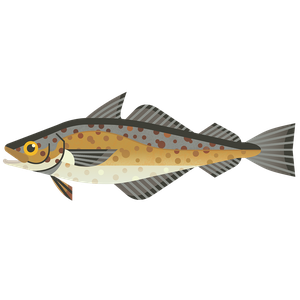
Coley
Pollachius virens
What to check for
Location
Iceland
Technical location
Atlantic, Northeast, Iceland Grounds
Caught by
Bottom trawl (otter)
Certification
Marine Stewardship Council (MSC)
Rating summary
Icelandic coley, or saithe, is not in an overfished state. However, fishing pressure is slightly too high. There is a management plan in place, which has successfully reduced fishing pressure. Catch limits are set in line with scientific advice and are expected to keep the stock at target levels. All Icelandic saithe landed by the Icelandic fleet is MSC certified. Most catches are by otter trawling, which is likely to cause some damage to the seabed. Bycatch is moderate. There are a number of measures in place to mitigate impacts on species and habitats, but more needs to be done to ensure they are effective.Rating last updated July 2022.
How we worked out this Rating
Icelandic coley, or saithe, is not in an overfished state. However, fishing pressure is slightly too high.Coley fishing in Iceland dates back to at least the early 1900s. Catches peaked at 100,000 tonnes in the early 1990s before dropping sharply to 30,000t by the early 2000s. Recent catches have been around 50,000t.The spawning-stock biomass (SSB) was around 130,000t throughout the 1980s, fell to 60,000t in the mid-90s and has since increased. In 2022 it is 167,743t, which is well above target levels (MSY BTrigger , 61,000t) and among the highest on record. The stock is therefore not in an overfished state.The Harvest Rate (HR) was was high between 1989 and 2013, exceeding levels associated with Maximum Sustainable Yield (HR MSY, 0.2). After briefly falling below this level from 2016-2020, it is now just above MSY. In 2021, HR was 0.21, indicating that the stock is being subjected to overfishing. However, it is below the precautionary limit of 0.36, so there is not an immediate risk of depleting the stock below safe levels.There is quite high uncertainty in these estimates, but the saithe management plan has been designed to take this into account.Based on Iceland's management plan, catches in the fishing year 2022/2023 should be no more than 71,300 tonnes. This is an 8% decrease on the advice from the previous year because the stock is smaller than previously thought, and is expected to decline in the coming years.
There is a management plan in place, which has successfully reduced fishing pressure. Catch limits are set in line with scientific advice and are expected to keep the stock at target levels. All Icelandic saithe landed by the Icelandic fleet is MSC certified.This fishery is MSC certified with conditions relating to bycatch and environmental impacts. There are no requirements or recommendations to make any improvements to management.The Icelandic Ministry of Industries and Innovation (MII) is responsible for management of the Icelandic fisheries and implementation of legislation. Improved management measures by Iceland for most of its major stocks, including cod, haddock, saithe, redfish and herring have resulted in decreased fishing mortality, increased stocks and reduced pressure on benthic habitats.A Harvest Control Rule (HCR) is in place for saithe and is reviewed every five years. ICES considers it to be precautionary. It sets catch limits (Total Allowable Catches, TACs) with the aim of maintaining saithe at Maximum Sustainable Yield. There is quite high uncertainty in estimates for stock size, but the saithe management plan has been designed to take this into account. TACs have been set in line with scientific advice since 2013/14. Landings have been smaller than the TACs, even when including foreign fleets (to whom the TAC does not apply). Total catch from 2016-2020 averaged 57,600t, which is 83% of the average TAC (701,700t).According to the most recent stock assessment in 2022, the stock biomass is among the highest levels on record but estimated fishing pressure is slightly above MSY.Saithe is often caught as part of the cod fishery, meaning catch limits for cod may be keeping saithe catches low, and also making it likely that saithe quota is being transferred to other, more economically viable, species. It is also possible that the stock size has been overestimated and the TACs have been set too high. This is somewhat mitigated by the management plan accounting for the uncertainty in the stock assessment.In addition to TACs, the following measures are in place:There is no minimum landing size because all catches must be landed by law. To prevent catching juveniles, there are some dynamic closures in areas when a certain proportion of catches includes undersize fish.Since 1998 the minimum codend mesh size allowed in the trawling fishery has been 135 mm, which could reduce the catch of undersize fish.Spawning areas are closed for 2-3 weeks during the spawning season for all fisheries.The effects of these measures have not been evaluated.Discarding unwanted fish at sea is banned by the Icelandic government. The estimated discarding of saithe is low, likely because the saithe quota has often been difficult to catch. For the same reason incentive for misreporting is considered to be small.There are a series of measures for monitoring and enforcement, including: publication of individual vessel quotas, independent verification and recording of landings, gear restrictions (and inspections), catch logs, and the coast guard has powers to intercept and inspect vessels.
Most Icelandic saithe catches are by otter trawling, which is likely to cause some damage to the seabed. Bycatch is moderate. There are a number of measures in place to mitigate impacts on species and habitats, but more needs to be done to ensure they are effective.100% of Icelandic saithe landed by the Icelandic fleet is MSC certified. Around 90% of saithe catches are from bottom trawling and 5% from gillnetting.Demersal otter trawls have the potential to take relatively high quantities of bycatch. In the Northeast Atlantic there are reported catches of demersal elasmobranchs and endangered, threatened and protected (ETP) species (e.g. sharks, rays and marine mammals). The Marine Stewardship Council certification indicates that there may be low levels of bycatch in this fishery, although better observer coverage is needed for greater confidence in the data. An instance of bycatch of a harbour seal has been recorded, but the trawl fishery is not considered to be having population-level effects.Sharks and skates are taken as bycatch in Icelandic fisheries, but catch rates are incomplete and the status of stocks is unknown. The endangered Atlantic halibut is impacted by fisheries around Iceland, so a mandatory release of viable halibut and a landings ban were introduced in 2012. Interactions with and impacts on Protected, Endangered and Threatened species by the fishery are very unlikely.Demersal trawls have contact with the seabed resulting in penetration and abrasion of habitat features. The impact of trawling on the seabed depends on the location and scale in which trawling occurs. In the Icelandic area, ICES indicates that abrasion from bottom trawling has affected fragile biogenic habitats (e.g. sponge aggregations, coral gardens, and coral reefs), mainly in deeper waters below 200m. Effects of bottom trawling on soft substrates in shallow waters have been shown to be minor. Approximately 90% of saithe catches are from shallower than 300m. Bottom trawling takes place offshore, where the habitat is generally sandy mud to muddy sand. There has been a general reduction in bottom trawling across all Icelandic fisheries, which has led to reduced pressure on the seabed. Data from 2018 indicates that trawling was happening on 17.5% of the seabed area.The Marine Stewardship Council assessment considers it unlikely that otter trawling is overlapping with any vulnerable seabed habitats (e.g., maerl, coral, sponges) owing to the depth range of the fishery and the inability of trawling to take place on steep slopes. There are closed areas to protect hard corals and hydrothermal vents, and these protections are being extended to other biogenic habitats such as deep-sea sponges and soft corals.
References
Gaudian, G., Gascoigne, J., Medley, P., O´Boyle, R. and Cappell, R., 2019. ISF Iceland Multi-Species Demersal Fishery: Public Certification Report. Carried out by Vottunarstofan Tún ehf. on behalf of Iceland Sustainable Fisheries ehf. (ISF). Published on 10 September 2019. Available at https://fisheries.msc.org/en/fisheries/isf-iceland-multi-species-demersal-fishery/@@assessments [Accessed on 15.07.2022].Government of Iceland, 2018. Management Strategy and Harvest Control Rules Available at https://www.government.is/news/article/2018/05/15/Haddock/ [Accessed on 14.07.2022].Government of Iceland, 2022. Ministry of Food٫ Agriculture and Fisheries: Fisheries Management. Available at https://www.government.is/topics/business-and-industry/fisheries-in-iceland/fisheries-management/ [Accessed on 14.07.2022].ICES. 2021. Icelandic Waters ecoregion –Ecosystem overview. In Report of the ICES Advisory Committee, 2021. ICES Advice 2021, Section 11.1, https://doi.org/10.17895/ices.advice.9440 [Accessed on 14.07.2022].ICES, 2021. Icelandic Waters ecosystem – Fisheries overview. In Report of the ICES Advisory Committee, 2021. ICES Advice 2021, section 11.2. https://doi.org/10.17895/ices.advice.9167 [Accessed on 14.07.2022].ICES. 2022. Northwestern Working Group (NWWG). ICES Scientific Reports. 4:42. 734 pp. http://doi.org/10.17895/ices.pub.19771381 [Accessed on 14.07.2022].ICES. 2022. Saithe (Pollachius virens) in Division 5.a (Iceland grounds). In Report of the ICES Advisory Committee, 2022. ICES Advice 2022, pok.27.5a, https://doi.org/10.17895/ices.advice.19453652 [Accessed on 15.07.2022].MFRI, 2020. State of Marine Stocks and Advice 2020: Fisheries Overview. Marine and Freshwater Research Institute. Published 16 June 2020. Available at https://www.hafogvatn.is/static/files/2020-sidur/00d-fishoverview.pdf [Accessed on 06.07.2021].MFRI, 2022. MFRI Assessment Reports 2022: Saithe, Pollachius virens. Marine and Freshwater Research Institute, published 15 June 2022. Available at https://www.hafogvatn.is/static/extras/images/03-saithe_tr1325969.pdf [Accessed on 15.07.2022].MFRI, 2022. State of Marine Stocks and Advice 2022: Saithe, Pollachius virens. Marine and Freshwater Research Institute, published 15 June 2022. Available at https://www.hafogvatn.is/static/extras/images/03-saithe1325968.pdf [Accessed on 15.07.2022].Poliono, V. and Scarcella, G., 2021. ISF Iceland multi-species demersal fishery: 1st Surveillance Report. Carried out by Global Trust Certification on behalf of Iceland Sustainable Fisheries (ISF). Published on 14 September 2021. Available at https://fisheries.msc.org/en/fisheries/isf-iceland-multi-species-demersal-fishery/@@assessments [Accessed on 15.07.2022].Reeves, S. A., Bell, J. B., Cambie, G., Davie, S. L., Dolder, P., Hyder, K., Pontalier, H., Radford Z. and Vaughan, D., 2018. An international review of fisheries management regimes. Cefas. Issued 2 August 2018. Available at http://randd.defra.gov.uk/Document.aspx?Document=14357_A_Review_of_International_Fisheries_Management_Regimes.pdf [Accessed on 06.07.2021].

Sustainable swaps
Learn more about how we calculate our sustainability ratings.
How our ratings work