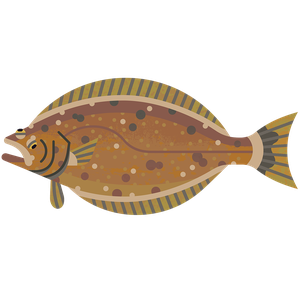
Dover sole
Solea solea
What to check for
Location
Baltic Sea (West), Skagerrak and Kattegat (Subdivisions 20-24)
Technical location
Atlantic, Northeast, Baltic Sea, Skagerrak and Kattegat, Transition Area - Belt Sea, Transition Area - Sound
Caught by
Bottom trawl (otter)
Rating summary
Updated: July 2020.
Spawning-stock biomass has increased slowly over the last five years and the stock is now in a healthy state and fishing pressure is within sustainable limits. Total Allowable Catches (TACs) have been reduced over the years, successfully reducing fishing pressure. In 2020, the TAC is not expected to be fully utilised. Discards of sole are low, at 4%, but bycatch and discarding of other species could be a concern. In the trawl fisheries, the Kattegat cod stock may be bycaught, which has a recommendation for zero catch owing to its very overfished state.
How we worked out this Rating
This stock is in a healthy state and fishing pressure is within sustainable limits. Spawning-stock (SSB) in the past five years has increased slowly and in 2019 is estimated to be at 2561 tonnes and above MSY Btrigger (2,600 tonnes). Fishing mortality (F) is below FMSY (0.23) and in 2020 is estimated to be 0.197. Recruitment was low from 2010-2015 but has increased since with good years in 2018 and 2019.
ICES advises that when the EU multiannual plan (MAP) for the North Sea and adjacent waters is applied, catches in 2021 that correspond to the F ranges in the plan are between 502 tonnes and 665 tonnes. According to the MAP, catches higher than those corresponding to FMSY (596 tonnes) can only be taken under conditions specified in the MAP, whilst the entire range is considered precautionary when applying the ICES advice rule.
Although this stock straddles the Baltic and the North Sea, it is managed under the EU multiannual management plan (MAP) for stocks in the North Sea and adjacent waters. A Total Allowable Catch (TAC) is in place but these have not been fully utilised, including in 2019 and preliminary information on Danish catches in the first quarter of 2020 are the lowest in the time series. The TAC of 533 tonnes for 2020 is assumed unlikely to be caught. The average discard ratio from 2014-2018 was 4%. Danish discard sampling at sea is carried out within EU programmes that began in 1995 in both Kattegat and Skagerrak.
The UK is due to leave the EU on 31st December 2020, and new UK Fisheries legislation is being developed during 2020. MCS will update ratings with new management information when new legislation comes into force.
In the European Union (EU), EU fishing vessels can fish up to 12 nautical miles of any Member State coast, and closer by agreement. There is overarching fisheries legislation for all Member States, but implementation varies between fisheries, Member States and sea basins.
The EU Common Fisheries Policy (CFP) is the primary overarching policy. Its key environmental objectives are to restore and maintain harvested species at healthy levels (above BMSY), and apply the precautionary and ecosystem-based approaches to fisheries management. To achieve the MSY objective, the MSY exploitation rate is supposed to be achieved by 2020, but this seems unlikely to happen.
The CFP also introduced a Landing Obligation (LO) which bans the discarding at sea of species which are subject to catch limits. Some exemptions apply to species with high post-capture survival, and where avoiding unwanted catches is very difficult. These exemptions are outlined in regional discard plans. Despite quota 'uplift' being granted to fleets under the LO, available evidence suggests there has been widespread non-compliance with the policy, and illegal and unreported discarding is likely occurring.
Multi-Annual Plans (MAPs) are a tool for implementing the CFP regionally, with one in place or being developed for each sea basin. They specify fishing mortality targets and ranges for the main targeted species, as well as lower biomass reference points. If populations drop below these points it should trigger a management response. The MAPs also empower Member States to jointly apply measures such as closures, gear or capacity limits, and bycatch limits. There is concern however that the MAPs do not provide adequate safeguards to maintain all stocks at healthy levels.
The EU Technical Measures regulation addresses how, where and when fishing can take place in order to limit unwanted catches and ecosystem impacts. There are common measures that apply to all EU sea basins, and regional measures that vary between sea basins. Measures include Minimum Conservation Reference Sizes (MCRS, previously Minimum Landing Sizes, MLS), gear specifications, mesh sizes, closed areas, and bycatch limits.
The Control Regulation, which is being revised in 2019, addresses application of and compliance with the above, e.g. keeping catches within limits, recording and sharing data, and satellite tracking of vessels over 12 metres (VMS).

Sole is taken in this area in a directed trawl fishery (mesh sizes 90-105 mm) with bycatch of Nephrops, plaice and cod and as bycatch in the Nephrops trawl fishery. There is also a directed gillnet fishery (mesh sizes of 90-120 mm), mainly in Skagerrak in spring and summer. Denmark took 88% of the total catch in 2019.
Minimum landing size for sole in EU waters is 24.5cm; sole mature at 30cm.
The bycatch of cod is of concern in this fishery, particularly in the Kattegat, where advice is for zero catches of cod. Better selectivity and area restrictions could help to mitigate this. The introduction of sorting grids in trawls may have resulted in smaller bycatch and improved selectivity on sole, and since 2008, square mesh exit panels have been mandatory in the trawl fishery to reduce bycatches of cod.
Although discarding of sole in the demersal trawl fishery is estimated to be low, bycatches of vulnerable marine species in 2015 (e.g. sharks, rays and turtles) were estimated to be 15-39% of total catch weight.
Demersal otter trawls use doors to hold nets open that penetrate the seabed, resulting in the abrasion of habitat features. The ground ropes, sweeps and bridles of the trawl can have similar abrasive impact. However, most otter trawling occurs within core areas where yields are high and it is safe to trawl because the habitats there are already accustomed to disturbance.
References
EU. 2018. Regulation (EU) 2018/973 of the European Parliament and of the Council of 4 July 2018 establishing a multiannual plan for demersal stocks in the North Sea and the fisheries exploiting those stocks, specifying details of the implementation of the landing obligation in the North Sea and repealing Council Regulations (EC) No 676/2007 and (EC) No 1342/2008. Official Journal of the European Union, L. 179. 13 pp. Available at http://data.europa.eu/eli/reg/2018/973/oj. [Accessed on 22.07.2020].
ICES. 2020. Baltic Fisheries Assessment Working Group (WGBFAS). ICES Scientific Reports, 2:45. 632 pp. Available at http://doi.org/10.17895/ices.pub.6024. [Accessed on 22.07.2020].
ICES. 2020. Sole (Solea solea) in subdivisions 20- “24 (Skagerrak and Kattegat, western Baltic Sea). In Report of the ICES Advisory Committee, 2020. ICES Advice 2020, sol.27.20-24. Available at https://doi.org/10.17895/ices.advice.5854. [Accessed on 22.07.2020].
Seafish, 2019. RASS Profile: Sole in Skagerrak, Kattegat and the Belts, Demersal trawls. Available at https://www.seafish.org/risk-assessment-for-sourcing-seafood/profile/sole-in-skagerrak-kattegat-and-the-belts-demersal-trawls [Accessed on 22.07.2019].
Sustainable swaps
Learn more about how we calculate our sustainability ratings.
How our ratings work