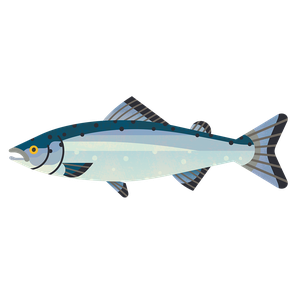
European anchovy
Engraulis encrasicolus
What to check for
Location
Bay of Biscay
Technical location
Atlantic, Northeast, Bay of Biscay
Caught by
Net (purse seine or ring)
Certification
Marine Stewardship Council (MSC)
Rating summary
Although anchovy are data deficient in this area, the available biomass data and fishing records show the stock is increasing and fishing pressure is not too high. Management measures including: a full fishery closure between 2005-2010; precautionary catch limits; area closures; and a minimum conservation reference size have been effective at supporting stock levels. European anchovy is predominantly caught by purse seiners in the Bay of Biscay. Bycatch is low and habitat impacts are unlikely in this fishery. Anchovy is a species at or near the base of the food chain and the impact of their large-scale removal on the marine ecosystem is poorly understood.The Marine Stewardship Council (MSC) has certified the Cantabrian Sea purse seine anchovy fishery as a sustainably managed fishery since 2015.Rating last updated July 2022.
How we worked out this Rating
For European anchovy in the Bay of Biscay there is no concern for the biomass, and no concern for catch levels.Route 2 (data limited) scoring has been applied to this rating owing to the lack of a reference point for fishing pressure. European anchovy is considered to have medium resilience to fishing pressure.ICES assesses that the spawning-stock size is above the limit biomass reference point (Blim). Reference points for MSY Btrigger and Bpa have not been defined for this stock. No reference points have been defined for fishing pressure as ICES does not use F reference points to determine exploitation status for short-lived species. The spawning-stock biomass (SSB) has been above the biomass reference point (Blim), at 21,000 tonnes, since 2010. In 2021, SSB was assessed as the highest in the historical series (206,215 tonnes: mid-May), significantly above the SSB management plan reference points (SSBmgt: 24,000 tonnes (lower trigger); 89,000 tonnes (upper trigger)) and almost ten times the value of Blim. SSB in 2022 is estimated to be 32% lower than that in 2021. Recruitment has been mostly above the long-term average since 2010 but is estimated to be considerably below average in 2022. Therefore, there is no concern for biomass.Harvest rates have been below the long-term average since the reopening of the fishery in 2010 and so there is no concern for fishing pressure.ICES advises that when the EU management strategy is applied, catches in 2022 should be no more than 33,000 tonnes. The advice for 2022 is the same as in 2021 and 3% higher than the advice for 2020. This catch level corresponds to the maximum total allowable catch (TAC) in the management plan for this area.
There are management measures in place for this fishery, which are precautionary and effective in managing the stock. This fishery is independently certified to the MSC standard with no conditions to meet the certification.The Cantabrian Sea Purse Seine Anchovy Fishery is certified as a responsibly managed fishery by the Marine Stewardship Council (MSC), and became the first anchovy fishery in Europe to achieve MSC certification in 2015. There are no conditions the fishery must meet to maintain certification. However, the most recent certification report flags concerns that observer data is not available, interactions with vulnerable species are not consistently recorded, data for certain fleets is not available and that the management plan, although implemented, has not been adopted formally.An EU management strategy is in place for this stock. A set of harvest control rules were evaluated by the Scientific, Technical and Economic Committee for Fisheries in 2013 and 2014. The European Commission requested that ICES provided its advice in 2015 according to one of these rules, and according to a different one since 2016. ICES considers the harvest control rule selected in 2016 to be precautionary, with a 5% probability of the spawning-stock biomass falling below the limit biomass reference point (Blim) in the long-term.The fisheries targeting the Bay of Biscay anchovy are managed through Total Allowable Catch (TAC) set following the harvest control rule adopted in 2016, and technical measures such as gear and vessels specifications, a minimum conservation reference size, closed areas and seasons.The fishery closed between July 2005 and June 2010 due to very low stock abundance. Since the reopening of the fishery, catches have been increasing overall whilst following scientific advice and the TAC has been effectively implemented.TAC has been in line with that advised by scientists in recent years (2015-21). Except in 2016, initially in accordance with advice and later raised 32% above advised limits. Compliance to the TAC has been high. Actual landings are generally lower than the TAC agreed, last exceeding TAC in 2015 by 13%. In accordance with the management strategy, TAC is set to zero if spawning-stock biomass (SSB) is below the lower trigger, and to 33,000 tonnes if SSB is above the upper trigger. The TAC cap becomes effective if the projected SSB is 89,000 tonnes or larger, which resulted in advised catches for 2022 being capped at the highest level allowed under the management strategy, despite the high SSB.Discarding is considered negligible.European anchovy inhabiting the Atlantic waters were separated into two distinct stock units; one distributed in the Bay of Biscay, in ICES area 8, which this rating covers and the other distributed in Atlantic Iberian waters, ICES area 9a (Spanish Southern Galicia, Portuguese coast and Spanish waters of the Gulf of Cadiz), which is captured in a separate ICES assessment and MCS rating. The anchovy stock covered in this assessment are caught to a small extent in ICES subarea 7 which should be considered in fisheries management, although this accounts for less than 2% of catches of the stock.Both the EU and UK have fishery management measures in place, which can include catch limits, targets for population sizes and fishing mortality, and controls on what fishing gear can be used and where. In the EU, compliance with regulations has been variable, and there are ongoing challenges with implementing some of them. There was a target for fishing to be at Maximum Sustainable Yield by 2020, but this was not achieved. The Landing Obligation (LO), an EU law that the UK has kept after Brexit, requires all quota fish to be landed, even if they are unwanted (over-quota or below minimum size). It aims to promote more selective fishing methods, reduce bycatch, and improve recording of everything that is caught, not just what is wanted. Compliance with the LO is generally poor and actual levels of discards are difficult to quantify using the current fisheries observer programme. UK administrations are in the process of replacing the landing obligation with country-specific Catching Policies.In the UK, it is too early to tell how effective management is, as the Fisheries Act only came into force in January 2021. The Act requires the development of Fisheries Management Plans (FMPs) (replacing EU Multi-Annual Plans). FMPs are currently in development, but the scope of them remains unclear. They have the potential to be very important tools for managing UK fisheries, although data limitations may delay them for some stocks. MCS is keen to see publicly available FMPs for all commercially exploited stocks, especially where stocks are depleted, that include:Targets for fishing pressure and biomass, and additional management when those targets are not being met, based on the best available scientific evidenceTimeframes for stock recoveryImproved data collection, transparency and accountability, supported by technologies such as Remote Electronic Monitoring (REM)Consideration of wider environmental impacts of the fishery

European anchovy is predominantly caught by purse seiners in the Bay of Biscay. Bycatch is low and habitat impacts are unlikely in this fishery.The anchovy (Engraulis encrasicolus) stock in the area has been targeted by the Spanish and French fleets since the 1940s. The Spanish purse-seine fleet is the main fleet targeting anchovy in the Bay of Biscay. In 2020, the anchovy fishery was almost exclusively harvested by purse-seine fleets (99.9% of total catches), with the remainder harvested by pelagic trawlers (0.1%). There is little to no impact on ecosystems caused by purse seiners. The gear in the Bay of Biscay has been shown to be highly selective and catches of vulnerable species practically non-existent. The main impacts to the ecosystems may be the removal of anchovy on the food chain rather than through bycatch.Anchovy is a small pelagic species, predominantly targeted by seine nets that can reach depths ranging between 80 and 550 m in this fishery. Seine net fisheries are not deemed to significantly impact the seafloor unless used in shallow waters, as nets are generally deployed at greater depths where bottom contact does not occur. To protect shallow coastal zones and benthic habitats, purse seiners can only operate in waters deeper than 35 m depth at low tide, and are prohibited in areas such as the Zumaia biotope. The fishery rarely makes contact with the seafloor and usually operates over the same fishing grounds, over sandy bottoms and in offshore areas, areas that do not contain vulnerable habitats such as cold-water coral reefs or sea fans, minimising possible impacts in benthic communities.Bycatch of non-target species is low. The purse seine fishery targets a variety of species during the year depending on the season and area (i.e. European pilchard, Sardina pilchardus; European anchovy, Engraulis encrasicolus; Atlantic horse mackerel, Trachurus trachurus; Atlantic chub mackerel, Scomber colias; and Atlantic mackerel, Scomber scombrus). When vessels are targeting anchovy (corresponding to an average of 91.77% of landings in 2016-2018), the main retained species are: Atlantic mackerel (3.32%), European pilchard (2.88%), Atlantic chub mackerel (0.63%) and Atlantic horse mackerel (0.58%).Although purse seiners are highly mono-specific, they can be associated with cetacean bycatch. Interactions with Endangered, Threatened or Protected (ETP) species are very rare in this fishery and information gathered from observers and recent research indicates a low impact. Marine mammals that are caught in a purse-seine are usually released alive using the slipping technique, and the contact with the gear is minimised by the fishers as this can damage the gear and causes substantial costs for fishers. The fishery is known to interact with birds (such as the yellow-legged gull, Larus michahellis), sharks (e.g. blue shark, Prionace glauca; Tope shark, Galeorhinus galeus; and shortfin mako, Isurus oxyrinchus), cetaceans (i.e., Short-beaked common dolphin, Delphinus delphis; Common bottlenose dolphin, Tursiops truncates; Rissos dolphin, Grampus griseus; Humpback whale, Megaptera novaeangliae; and Southern right whale, Eubalaena australis), turtles and rays. Developments to improve knowledge on the impacts of the fishery on ETP species is required, specifically relation to gathering and reporting of ETP interactions.The greatest impact of this fishery may be a reduction in food availability, decreasing the availability of anchovy as an important prey for many pelagic and demersal species in the Bay of Biscay, cetaceans, seabirds and other ETP species. Anchovy is a species at or near the base of the food chain and the impact of their large-scale removal on the marine ecosystem is poorly understood.To improve monitoring and reporting of fishing activity, MCS would like to see remote electronic monitoring (REM) with cameras implemented, used and enforced. To reduce the impacts of fishing on the marine environment we would like to see a just transition to the complete removal of bottom towed gear from offshore Marine Protected Areas designated to protect the seabed. We also want to see reduction and mitigation of environmental impacts including emissions and blue carbon habitat damage.
References
Binohlan, C. and Valdestamon, R. (2020). European Anchovy (Engraulis encrasicolus). Available at http://fishbase.org/summary/Engraulis-encrasicolus.html [Accessed 05.07.22]ICES, 2017. Stock Annex: Anchovy (Engraulis encrasicolus) in Subarea 8 (Bay of Biscay). Available at: https://www.ices.dk/sites/pub/Publication%20Reports/Stock%20Annexes/2017/ane.27.8_SA.pdf [Accessed on 7.7.22]ICES (2019): Working Group on Southern Horse Mackerel, Anchovy and Sardine (WGHANSA). ICES Scientific Reports. Report. https://doi.org/10.17895/ices.pub.4983ICES. 2021. Anchovy (Engraulis encrasicolus) in Subarea 8 (Bay of Biscay). In Report of the ICES Advisory Committee, 2021. ICES Advice 2021, ane.27.8, Available at: https://doi.org/10.17895/ices.advice.7721 [Accessed 05.07.22]ICES (2021b). Bay of Biscay and Iberian Coast ecoregion – Fisheries overview. ICES Advice: Fisheries Overviews. Report. https://doi.org/10.17895/ices.advice.9100ICES (2021c): Bay of Biscay and the Iberian Coast ecoregion – Ecosystem Overview. ICES Advice: Ecosystem Overviews. Report. https://doi.org/10.17895/ices.advice.9436ICES (2022): Anchovy (Engraulis encrasicolus) in Division 9.a (Atlantic Iberian waters). ICES Advice: Recurrent Advice. Report. https://doi.org/10.17895/ices.advice.19447751.v1MSC (2020). Cantabrian Sea purse seine anchovy fishery. Available at https://fisheries.msc.org/en/fisheries/cantabrian-sea-purse-seine-anchovy-fishery/about/ [Accessed 13.10.2020]MSC, 2021. CANTABRIAN SEA PURSE SEINE ANCHOVY FISHERY. First Surveillance Report. Available at: https://cert.msc.org/FileLoader/FileLinkDownload.asmx/GetFile?encryptedKey=vI9dTGiDToIcYSs9Y+YvS66RUsvZ2ZgCG6OdSZ1TNHmJggqIiHio6OHW0n75QxZz [Accessed on 7.7.22]Ruiz, J., Louzao, M., Oyarzabal, I., Arregi, L., Mugerza, E., & Uriarte, A. (2021). The Spanish purse-seine fishery targeting small pelagic species in the Bay of Biscay: Landings, discards and interactions with protected species. Fisheries research, 239, 105951. doi: 10.1016/j.fishres.2021.105951
Sustainable swaps
Learn more about how we calculate our sustainability ratings.
How our ratings work