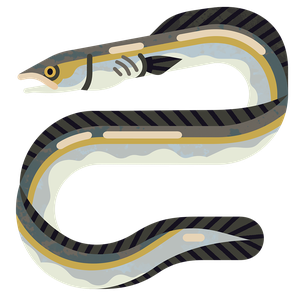
European eel
Anguilla anguilla
What to check for
Location
Northeast Atlantic
Technical location
Atlantic, Northeast, All areas
Caught by
Electrical fishing, Hook & line (pole & line), Net (demersal seine), Net (gill or fixed), Pot, trap or creel
Rating summary
European eel is a critically endangered species, and zero catch is highly advised. It is therefore a Fish to Avoid. There is no sustainable source of this species, even if certifications are in place.Rating last updated December 2025.
Technical consultation summary
European eel is a critically endangered species. There is no sustainable source of this species, and zero catch is recommended. It therefore receives a critical fail red rating and is a Fish to Avoid. Total catches are unknown because landings and effort data are incomplete and IUU fishing is known to occur. Provisional estimates for 2025 show that glass eel recruitment in 'Elsewhere Europe' was 12.1% of the level in 1960-1979, and in the 'North Sea' this falls to 0.7%. Yellow eel recruitment estimates for 2024 were 14.3% of the historical baseline. European eel is exploited throughout its lifecycle and across Europe, with fishing pressure ranging from minimal to severe overexploitation. ICES has advised a precautionary approach, recommending zero catches in all habitats for 2026. This applies to both recreational and commercial fisheries, including the capture of glass eels for restocking and aquaculture.Management measures for European eel have been ineffective in recovering the stock, with the species still listed as Critically Endangered. A 2020 European Commission report concludes that the status of European eel remains critical, with the regulation’s main target (40% escapement) unmet, and the effectiveness of national measures questionable. The European Parliament has similar concerns, with a 2023 resolution highlighting the need to address non-fisheries factors contributing to mortality, e.g. habitat loss, water quality deterioration, disease, etc. Eels are caught using many different fishing methods. As this species is a Fish to Avoid, capture method impacts have not been scored.The Sustainable Eel Group (SEG) have a standard for European eel producers, however it is currently not able to demonstrate measurable improvements in wild European eel stocks. The most recent ICES advice is for zero removals. SEG certified eel is therefore included within this assessment and is also red rated.
How we worked out this Rating
European eel is a critically endangered species. There is no sustainable source of this species, and zero catch is recommended. It therefore receives a critical fail red rating and is a Fish to Avoid.There is a single European eel stock, for which scientific advice on fishing and management is provided by the International Council for the Exploration of the Sea (ICES). The species is considered to be at critically low levels, with the International Union for the Conservation of Nature (IUCN) listing European eel as ‘Critically Endangered’ since 2008.Data on this stock has many uncertainties. Total landings and fishing effort are incomplete, with reporting inconsistent between countries, and illegal, unreported, and unregulated (IUU) fishing known to occur. As a result, total catches remain unknown. Reference points to define a healthy stock size of sustainable fishing level are not available.European eel is monitored at various life stages. After spawning in the Sargasso Sea, larvae migrate to European rivers and develop into glass eels. They then develop into yellow eels during their freshwater phase, before maturing into silver eels which return to the Sargasso Sea to spawn and die. Recruitment through these stages declined sharply between 1980 and 2011 and has remained low since.Provisional estimates of recent recruitment show mixed trends. In ‘Elsewhere Europe’, glass eel recruitment rose from 7.2% to 12.1% of the 1960-1979 baseline between 2024 and 2025 – the highest since 2003, but still a very small fraction of historical levels. In contrast, ‘North Sea’ recruitment of glass eels fell from 1.3% to 0.7% of the historical baseline over the same period. For yellow eels, recruitment estimates are provided for only ‘Europe’. In 2024, yellow eel recruitment was estimated as 14.3% of the historical mean – the highest value since 2020, but again a small proportion of historic levels. These figures and trends must be treated cautiously due to the unpredictable nature of recruitment. European eel is exploited throughout its lifecycle and across Europe, with fishing pressure ranging from minimal to severe overexploitation. ICES has advised a precautionary approach, recommending zero catches in all habitats for 2026. This applies to both recreational and commercial fisheries, including the capture of glass eels for restocking and aquaculture.The poor status of the species reflects multiple pressures which are encountered throughout the species’ life cycle and migration through diverse habitats. Pressures and threats, other than fishing, include:Barriers to migration – including damage by hydropower turbinesClimate change – including changes in oceanic currents and climate related hydrological changes.Disease and parasitesLegal and illegal exploitation and trade of eelsHabitat loss and associated resource declinePollutantsPredation
References
CITES, 2025. Appendices I, II and III. Available at: CITES Appendices I, II and III valid from 21.05.2023 [Accessed on 11.12.2025]EU, 2007. COUNCIL REGULATION (EC) No 1100/2007 of 18 September 2007 establishing measures for the recovery of the stock of European eel. Available at: eur-lex.europa.eu/legal-content/EN/TXT/PDF/?uri=CELEX:32007R1100 [Accessed on 11.12.2025]European Commission. 2020. Commission Working Document: Evaluation of Council Regulation (EC) No 1100/2007 of 18 September 2007 establishing measures for the recovery of the stock of European eel. Available at: eur-lex.europa.eu/legal-content/EN/TXT/PDF/?uri=CELEX:52020SC0035 [Accessed on 211.12.2025]European Parliament, 2024. Addressing the critical state of European eel stocks. Available at: Addressing the critical state of European eel stocks [Accessed on 11.12.2025]Hanel, R., Briand, C., Diaz, E., DOring, R., Sapounidis, A., Warmerdam, W., Andres, M., Freese, M., Marcelis, A., Marohn, L., Pohlmann, J.-D., van Scharrenburg, M., Waidmann, N., Walstra, J., Werkman, M., de Wilde, J., Wysujack, K. 2019. Research for PECH Committee - Environmental, social and economic sustainability of European eel management, European Parliament, Policy Department for Structural and Cohesion Policies, Brussels. Available at https://www.europarl.europa.eu/RegData/etudes/STUD/2019/629189/IPOL_STU(2019)629189_EN.pdf [Accessed on 11.12.2025]ICES. 2025. European eel (Anguilla anguilla) throughout its natural range. In Report of the ICES Advisory Committee, 2025. ICES Advice 2025, ele.2737.nea. https://doi.org/10.17895/ices.advice.27203028 ICES. 2025. Joint EIFAAC/ICES/GFCM Working Group on Eels (WGEEL). ICES Scientific Reports. 7:99. 134 pp. https://doi.org/10.17895/ices.pub.30488120 Pike, C., Crook, V. & Gollock, M. 2020. Anguilla anguilla. The IUCN Red List of Threatened Species 2020: e.T60344A152845178. https://dx.doi.org/10.2305/IUCN.UK.2020-2.RLTS.T60344A152845178.en. [Accessed on 11.12.2025]Sustainable Eel Group, 2025. SEG Standard. Available at: About the SEG Standard | Sustainable Eel Group [Accessed on 11.12.2025]
Sustainable swaps
Learn more about how we calculate our sustainability ratings.
How our ratings work