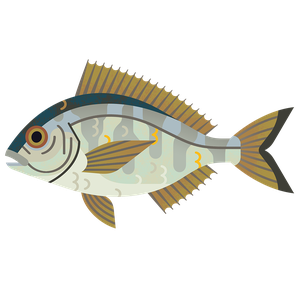
European hake
Merluccius merluccius
What to check for
Location
Northern stock (North Sea, Celtic Seas, Bay of Biscay (north))
Technical location
Atlantic, Northeast, Bay of Biscay (Central), Bay of Biscay (North), Bay of Biscay (Offshore), Irish Sea, Porcupine Bank, English Channel, Bristol Channel, Celtic Seas, West and Southwest of Ireland, North Sea, Rockall, West of Scotland, Skagerrak and Kattegat
Caught by
Net (gill or fixed)
Rating summary
Northern hake is not overfished and not subject to overfishing. Emergency management of this stock in 2001 has recovered it to very good levels. Ongoing management measures appear to be controlling the fishery, but discarding can be an issue in some areas and catch limits do not cover all of the countries accessing the stock. Gillnetting for hake can have a bycatch of harbour porpoises. Based on the available information, gillnet fisheries in some areas could be over-exploiting this species and causing it to decline.Rating last updated July 2022.
How we worked out this Rating
Northern hake is not overfished and not subject to overfishing.The most recent stock assessment was published by the International Council for the Exploration of the Sea (ICES) in 2022, using data up to 2022. It defines reference points for fishing pressure (F) and biomass (B). For fishing pressure, there is a target to keep F at or below Maximum Sustainable Yield (MSY). For biomass, there is no target. However, there is a trigger point (MSY BTrigger). Below this level, F should be reduced to allow the stock to increase. Because BMSY is not defined, the Good Fish Guide applies its own definition of 1.4 x MSY BTrigger. The stock assessment was benchmarked in 2022, and the new estimates of stock size are 71% larger over time. Estimates of spawning stock biomass (SSB) now only include females, whereas previously they included males as well.The spawning-stock biomass (SSB) has increased substantially from being outside biologically safe levels in 2006 (around 45,000 tonnes) to peak at almost 300,000t in 2015. It has since declined to 186,358t in 2022. This is well above MSY Btrigger (78,405t). The stock is therefore not in an overfished state.Fishing mortality (F) decreased significantly between 2005 and 2012, and has been fluctuating below levels associated with Maximum Sustainable Yield (FMSY, 0.24) since then. In 2021 it was 0.184 - below FMSY. The stock is therefore not subject to overfishing.ICES advises that when the MSY approach is applied, catches in 2023 should be no more than 83,130 tonnes. This is an 11% increase on the previous year's advice, because of revised new stock assessment.There is some uncertainty in this stock assessment. The biomass surveys don't cover the entire stock distribution area, and changes in distribution are known to increase uncertainty in the assessment. Analyses show that the new assessment tends to revise historical SSB downwards and F upwards when a new year’s data is added. If this pattern continues, this may result in an inflated advised catch.
Emergency management of this stock in 2001 has recovered it to very good levels. Ongoing management measures appear to be controlling the fishery, but discarding can be an issue in some areas and catch limits do not cover all of the countries accessing the stock.Northern hake is a shared stock between the UK, EU, and Norway. There is no joint management plan, although one is being considered. The main management measure is to set catch limits (Total Allowable Catches, TACs).ICES recommends catch limits for the northern hake stock as a whole. However, TACs apply only to the UK and EU member states and waters, so there is potential for overfishing if other states are accessing the stock (e.g. Norway). The agreed TACs were set just below the scientific advice between 2016 and 2019, and in 2021. However, in 2020 and 2022, the TACs exceeded the advice by 8% and 5% respectively. In both cases, ICES had recommended a greater than 20% decrease in catch, but hake TACs can't change by more than 20% in one year, so TACs remained above the advice.Between 2017 and 2021, actual catches averaged 88,684 tonnes, which equates to 76% of the advice (117,801t). This could be an indication that the stock biomass has been overestimated. Caution is needed because hake are fast growing with a high natural mortality rate, so if the biomass starts to decline it could drop rapidly. A Harvest Control Rule would help to mitigate this, as it would reduce exploitation rates when certain biological reference points are approached.Overall, currently, catch limits appear to be set in line with scientific advice and actual catches are within these limits.Other measures include:Minimum conservation reference size: hake can legally be caught and sold at 27cm (30cm in Skagerrak and Kattegat). Below this size, hake have to be landed but can't be sold for human consumption and so have a lower value. Hake mature at around 35-45cm, so this doesn't prevent juveniles from being caught.Landing obligation: it is illegal to discard unwanted (e.g. below-minimum-size, BMS) hake at sea. Overall, around 6% of the catch has been discarded in the last three years, and discarding rates have decreased since 2015. However, discarding of juvenile hake (both above and below MCRS) can be substantial in some areas and fleets, particularly gillnetting. Recently, discarding of large individuals increased because of quota restrictions in certain fleets. Continued monitoring is required.An Emergency Plan was brought in in 2001 to recover the stock, involving a TAC reduction and minimum mesh size of 100mm (depending on vessel size, location and proportion of hake in the total catch). It included targets for increasing stock size and reducing fishing mortality, and limited changes in TAC from year to year. The stock is now in a very good state, and fishing pressure is at sustainable levels, although this has been strongly influenced by good spawning years in 2008 and 2012.Both the EU and UK have various fishery management measures in place. In the EU, compliance with regulations has been variable, and there are ongoing challenges with implementing some of them. The Landing Obligation (LO), an EU law that the UK has kept after Brexit, requires all quota fish to be landed, even if they are unwanted (over-quota or below minimum size). It aims to promote more selective fishing methods, reduce bycatch, and improve recording of everything that is caught, not just what is wanted. Compliance with the LO is generally poor and actual levels of discards are difficult to quantify using the current fisheries observer programme. UK administrations are in the process of replacing the landing obligation with country-specific Catching Policies.In the UK, it is too early to tell how effective management is, as the Fisheries Act only came into force in January 2021. The Act requires the development of Fisheries Management Plans (FMPs) (replacing EU Multi-Annual Plans). FMPs are currently in development, but the scope of them remains unclear. They have the potential to be very important tools for managing UK fisheries, although data limitations may delay them for some stocks. MCS is keen to see publicly available FMPs for all commercially exploited stocks, especially where stocks are depleted, that include:Targets for fishing pressure and biomass, and additional management when those targets are not being met, based on the best available scientific evidenceTimeframes for stock recoveryImproved data collection, transparency and accountability, supported by technologies such as Remote Electronic Monitoring (REM)Consideration of wider environmental impacts of the fishery
Gillnets in this area can encounter bycatch of non-target fish, mammals and birds. This includes the harbour porpoise, which is vulnerable in Europe.Hake is caught by longlines, gillnets, and bottom trawls in mixed fisheries alongside megrim, anglerfish and Norway lobster.Gillnets and fixed nets can be very size selective, but can bycatch species such as sharks, cetaceans and other marine mammals. In particular, there is concern about bycatch of harbour porpoise. The IUCN lists harbour porpoise as being of least concern globally, but vulnerable in Europe. OSPAR has included the species on its List of Threatened and / or Declining Species and Habitats for the Greater North Sea and Celtic Seas, owing to evidence of a decline in populations, their sensitivity and the threat of incidental capture and drowning in fishing nets. They are also classified as a priority species in UK and EU law, under which there are explicit bycatch requirements. To comply with this, the UK recently designated five Special Areas for Conservation for harbour porpoises, but these areas are not yet managed. The UK Dolphin and Porpoise Conservation Strategy lists harbour porpoise as having 'medium' vulnerability to gillnetting for the UK as a whole. This is based on the species having a high sensitivity to gillnetting and medium exposure.The area of most concern is in the Celtic Seas, southwest of the UK, where most of the UK's gillnetting activity takes place. Exposure to gillnetting is high. A review of activities in the Bristol Channel Approaches Harbour Porpoise SAC lists "commercial fisheries with bycatch (predominantly static nets)" as a high risk, and a strandings report by Cornwall Wildlife Trust also shows that common dolphin bycatch is very high in this area.There is also bycatch of elasmobranch species which may be threatened or endangered. Porbeagle sharks are being caught as bycatch in gillnets but as they are a prohibited species, there is no official data on the numbers being caught and discarded. Spurdog bycatch is also thought to be of concern. The National Evaluation of Populations of Threatened and Uncertain Elasmobranchs (NEPTUNE) highlighted continued problems of spurdog bycatch and despite a supposed real time avoidance programme being implemented, 50 tonnes were still landed in Cornish ports in 2019.There is a relative lack of knowledge on the overall impact of fishing on seabird populations in Europe. Increasing evidence over the last decade has shown that seabirds are suffering mortality from bycatch, particularly in gillnets. Bycatch of seabirds in gillnet fisheries alone is estimated to kill around 400,000 birds globally each year. Diving seabirds, such as guillemots and cormorants, are generally more vulnerable to bycatch in gillnets than surface feeding seabirds. Most of the UK’s gillnetting takes place in the Celtic Seas, southwest of the UK and therefore there is concern for seabird populations here. In particular, species of concern include the razorbill (listed as Near Threatened in Europe by IUCN), puffin (listed as Endangered in Europe by IUCN) and the herring gull, arctic skua and roseate tern which are all classified in the UK as Red under the Birds of Conservation Concern 4: the Red List for Birds (2015).Some pilot projects are underway to improve reporting of bycatch and find ways to reduce it. This includes trialling various types of 'pingers' that would discourage cetaceans from approaching the nets. Pingers have been very effective at reducing porpoise and dolphin bycatch in some fisheries, but haven't been adopted on a large enough scale to significantly tackle the issue. Testing and trials are crucial and may need to be supported by other measures such as seasonal closures.Because of gillnets' durability (they are made of nylon), if lost, they can continue to fish for several weeks before becoming tangled and bundled up, a phenomenon known as 'ghost fishing'. However, static nets, as with all gear, represent an investment by fishermen, and therefore there are incentives to avoid losing or damaging gear.
References
Bradbury, G., Shackshaft, M., Scott-Hayward, L., Rexstad, E., Miller, D., and Edwards, D., 2017. Risk assessment of seabird bycatch in UK waters. Produced by Wildfowl & Wetlands Trust (Consulting) Ltd for Defra project MB0126. Available at http://sciencesearch.defra.gov.uk/Document.aspx?Document=14620_MB0126RiskassessmentofseabirdbycatchinUKwaters_updated21Oct2019.pdf [Accessed on 13.07.2022].Calderan, S. and Leaper, R., 2019. Review of harbour porpoise bycatch in UK waters and recommendations for management. January 2019, WWF. Available at https://www.wwf.org.uk/sites/default/files/2019-04/Review_of_harbour_porpoise_in_UK_waters_2019.pdf [Accessed on 13.07.2022].Chadwick, H., Clear, N., Crosby, A., Hawtrey-Collier, A. and Williams, R. Marine Strandings in Cornwall and the Isles of Scilly: 2019 Annual Report. Report by Cornwall Wildlife Trust and Marine Strandings Network. Available at https://www.cornwallwildlifetrust.org.uk/sites/default/files/2020-12/2019%20Summary%20Report%20-%20Marine%20Strandings%20in%20Cornwall%20and%20the%20Isles%20of%20Scilly.pdf [Accessed on 13.07.2022].Cornwall Wildlife Trust. Seabirds. Available at https://www.cornwallwildlifetrust.org.uk/wildlife-explorer/birds/seabirds [Accessed on 13.07.2022].Ellis, J. R., Bendall, V. A., Hetherington, S. J., Silva, J. F. and McCully Phillips, S. R. 2016. National Evaluation of Populations of Threatened and Uncertain Elasmobranchs (NEPTUNE). Project Report (Cefas) V1.4. Available at http://randd.defra.gov.uk/Document.aspx?Document=13513_MB5201NEPTUNEFinalReportv1.4.pdf [Accessed on 13.07.2022].Glemarec, G., Kindt-Larse, L., Scherffenberg Lundgaard, L. and Larsen, F. 2020. Assessing seabird bycatch in gillnet fisheries using electronic monitoring. Biological Conservation. 243. 108461. Available at https://doi.org/10.1016/j.biocon.2020.108461 [Accessed on 13.07.2022].ICES. 2020. Celtic Seas Ecoregion – Ecosystem overview. In Report of the ICES Advisory Committee, 2020. ICES Advice 2020, Section 7.1, https://doi.org/10.17895/ices.advice.7631 [Accessed on 15.07.2021.ICES, 2022. Hake (Merluccius merluccius) in subareas 4, 6, and 7, and in divisions 3.a, 8.a–b, and 8.d, Northern stock (Greater North Sea, Celtic Seas, and the northern Bay of Biscay). In Report of the ICES Advisory Committee, 2022. ICES Advice 2022, hke.27.3a46-8abd. Available at https://doi.org/10.17895/ices.advice.19448012 [Accessed on 12.07.2022]ICES. 2021. Working Group for the Bay of Biscay and the Iberian Waters Ecoregion (WGBIE). ICES Scientific Reports. 3:48. 1101 pp. Available at https://doi.org/10.17895/ices.pub.8212 [Accessed on 12.07.2022].JNCC. 2019. Harbour porpoise (Phocoena phocoena) Special Area of Conservation: Bristol Channel Approaches / Dynesfeydd Môr Hafren. Conservation Objectives and Advice on Operations. Available at https://data.jncc.gov.uk/data/505b3bab-a974-41e5-991c-c29ef3e01c0a/BCA-ConsAdvice.pdf [Accessed on 15.07.2022].Omeyer, L.C.M., Doherty, P.D., Dolman, S., Enever, R., Reese, A., Tregenza, N., Williams, R. and Godley, B.J. 2020. Assessing the Effects of Banana Pingers as a Bycatch Mitigation Device for Harbour Porpoises (Phocoena phocoena). Frontiers in Marine Science. Front. Mar. Sci. https://doi.org/10.3389/fmars.2020.00285.OSPAR, 2017. Intermediate Assessment 2017: Harbour Porpoise Bycatch. Available at https://oap.ospar.org/en/ospar-assessments/intermediate-assessment-2017/biodiversity-status/marine-mammals/harbour-porpoise-bycatch/ [Accessed on 15.07.2022].Piñeiro, C. and Saínza, M, 2003. Age estimation, growth and maturity of the European hake (Merluccius merluccius (Linnaeus, 1758)) from Iberian Atlantic waters. ICES Journal of Marine Science, 60: 5, pp 1086–1102. https://doi.org/10.1016/S1054-3139(03)00086-9Scottish Government, 2021. UK Dolphin and Porpoise Conservation Strategy: Technical Report. Published 22 March 2021. ISBN: 9781800048522. Available at https://www.gov.scot/publications/uk-dolphin-porpoise-conservation-strategy-technical-report/documents/ [Accessed on 15.07.2022].Species account by IUCN SSC Cetacean Specialist Group; regional assessment by European Mammal Assessment team. 2007. Phocoena phocoena. The IUCN Red List of Threatened Species 2007: e.T17027A6734714. Available at https://www.iucnredlist.org/species/17027/6734714 [Accessed on 15.07.2022].UK Government, 2022. Agreed record of fisheries consultations between the European Union, Norway and the United Kingdom for 2022. Available at https://assets.publishing.service.gov.uk/government/uploads/system/uploads/attachment_data/file/1040249/fisheries-trilateral-agreed-record-211210.pdf [Accessed on 13.07.2022].

Sustainable swaps
Learn more about how we calculate our sustainability ratings.
How our ratings work