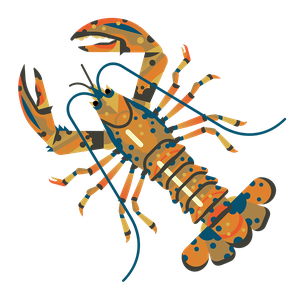
European lobster
Homarus gammarus
What to check for
Location
England (Northwest)
Technical location
Atlantic, Northeast, Irish Sea
Caught by
Pot, trap or creel
Rating summary
This stock is data limited and the stock status of European lobster in the Northwest is unknown. There is concern for biomass (owing to lack of any data) but no concern for fishing pressure. Management requires considerable improvement and effort controls are needed to improve the stock. Pot fishing is considered low impact as it is selective for larger individuals and has minimal impact on the surrounding environment.Rating last updated June 2024.
Technical consultation summary
The stock status of European lobster in this area is unknown. This stock is data limited and there is no stock assessment available for the Irish Sea. A lack of information, or stock indicators, available for the biomass means that there is concern for biomass. However, there is no concern for fishing pressure and landings have remained low, between 20 and 33 tonnes per year. This rating is for the European lobster fishery in the Northwest, in England, beyond 6nm. Some national management measures are in place, however, they are not effective in managing the stock and effort controls are needed. Pot fishing is generally considered very low impact as it is selective for larger individuals and has minimal impact on the surrounding environment.
How we worked out this Rating
This stock is data limited and the stock status of European lobster in the Northwest is unknown. There is concern for biomass (owing to lack of any data) but no concern for fishing pressure.European lobster can be found from Scandinavia to North Africa. CEFAS defines six Lobster Fishery Units for England and publishes stock status reports for each area every 2 years. There is insufficient data to provide stock advice for this area.At present, there is no stock assessment available for European lobster in the Northwest. Landings data provided by the Marine Management Organisation (MMO) show that landings of European lobster in the North Western IFCA district have remained low, between 20 and 33 tonnes per year. European lobster has a moderate to high vulnerability to fishing pressure.
Management requires considerable improvement and effort controls are needed to improve the stock.There are some management measures in place, but there are no catch limits in place to prevent overexploitation. There is no limit on creel numbers, no spatial controls and no total allowable catch (TAC) for either the fishery as a whole, or individual vessels. There are also no tools available to implement a harvest control rule to provide a quick management response to adverse trends in stock indicators.In England, the minimum conservation reference size (MCRS) is 87mm carapace length and lobsters must be landed whole. National legislation prohibits the landing of berried lobsters and those with a v-notch in their tail fan. All vessels registered in the UK must have a domestic fishing vessel license to fish within the UK EEZ for sea fish that will be sold. No new licenses are being issued. All commercial vessels under 10m, with a shellfish license, are required to complete Monthly Shellfish Activity Return (MSAR) forms for the Marine Management Organisation (MMO). These must include the catch and retained weight each day along with the date, name of the vessel, vessel registration number, gear type, area and port of landing. All vessels over 10m do not need to complete MSAR as they will be completing an EU logbook of catches. For all vessels, effort is reported as days fished, and not as pots fished.The UK Fisheries Act came into force in January 2021 and requires the development of Fisheries Management Plans (FMPs). There are no details yet on how and when these will be developed. FMPs have the potential to be very important tools for managing UK fisheries, although data limitations may delay them for some stocks. MCS is keen to see FMPs for all commercially exploited stocks, especially where stocks are depleted, that include:Targets for fishing pressure and biomass, and additional management when those targets are not being metTimeframes for stock recoveryTechnologies such as Remote Electronic Monitoring (REM) to support data collection and improve transparency and accountabilityConsideration of wider environmental impacts of the fishery
Pot fishing is considered low impact as it is selective for larger individuals and has minimal impact on the surrounding environment.In the UK, brown crab and European lobster are fished together in a mixed fishery with seasonal and regional variation of target species taking place. The key fishing season for brown crab in the UK takes place from May to December. Crabs are caught in pots, also known as creels, and can be fished individually or as part of a fleet of up to 100 pots, depending on the size of the boat and crew. Pots are portable traps made of wood or steel wire and plastic. The crab is baited into the initial part (the chamber) and moves into the secondary part (the parlour) where it becomes trapped.In brown crab fisheries, there is no legislation or regulation to standardise the type of pot used. They tend to be highly selective as undersized animals can be returned to the sea alive and survival rates for non-target organisms are thought to be high. More than half of the bycatch caught are predicted to survive, although there is little available research to prove this. Measures to further reduce bycatch include the use of escape panels to allow undersize animals and bycatch to escape pots. In Scotland, there is concern about whale entanglement in creel lines, and humpback and minke whale populations may be impacted.Habitat impacts from potting are low but can occur during deployment, soak time or hauling of the pot, impacting the benthic habitat and associated species through contact with the pot or end weight, or by scouring from ropes. Research that has taken place suggests that while some damage does occur, it is unlikely to be significant unless potting intensity is high (defined as approximately 30 pots per 500 square metres). Most damage occurs where traps are set in rocky habitats that are home to corals, sponges, sea whips and other large emergent species. These habitats and species provide nursery areas, refuges from predators and habitat for the settlement of invertebrate spat.In some circumstances, there can be instances of ghost fishing, when lost fishing gear continues to fish and can entangle a variety of species, but this can be minimised by using appropriate gear and release devices.
References
Cefas. 2023. Edible crab (Cancer pagurus). Cefas Stock Status Report 2023. 27 pp. Available at https://assets.publishing.service.gov.uk/media/66325aeedf4c0c63311e413e/2023_Crab_stock_assessments_FINAL...pdf [Accessed on 26.06.2024].CBI. 2022. Entering the European market for crab. Available at https://www.cbi.eu/market-information/fish-seafood/crab/market-entry [Accessed on 26.06.2024].Gall, S.C., Rodwell, L.D., Clark, S., Robbins, T., Attrill, M.J., Holmes, L.A. and Sheehan, E.V. 2020. The impact of potting for crustaceans on temperate rocky reef habitats: Implications for management. Marine Environmental Research, 162, p.105134. Available at https://www.sciencedirect.com/science/article/abs/pii/S0141113619308657 [Accessed on 26.06.2024].ICES. 2023. Working group on the Biology and Life History of Crabs (WGCRAB, outputs from 2020-2022 meetings). ICES Scientific Reports. 5:110. 123 pp. Available at https://doi.org/10.17895/ices.pub.24720936 [Accessed on 26.06.2024].Marine Management Organisation (MMO). Minimum Conservation Reference Sizes (MCRS) in UK waters. 2018. Available at https://www.gov.uk/government/publications/minimum-conservation-reference-sizes-mcrs/minimum-conservation-reference-sizes-mcrs-in-uk-waters [Accessed on 26.06.2024].Mesquita, C., Dobby, H., Pierce, G.J., Jones, C.S., Fernandes, P.G. 2020. Abundance and spatial distribution of brown crab (Cancer pagurus) from fishery-independent dredge and trawl surveys in the North Sea. ICES Journal of Marine Science, fsaa105. Available at https://academic.oup.com/icesjms/advance-article/doi/10.1093/icesjms/fsaa105/5880823 [Accessed on 26.06.2024].Moffat, C., Richardson, H. and Roberts, G. 2020. Natural England marine chalk characterisation project. Natural England Report NERR080. Available at https://publications.naturalengland.org.uk/publication/5385776319954944 [Accessed on 26.06.2024].Northumberland Inshore Fisheries and Conservation Authority. Byelaws. Available at https://nifca.gov.uk/byelaws/ [Accessed on 26.06.2024].Palomares, M.L.D. and Pauly, D. Editors. 2024. SeaLife Base. Cancer pagurus, edible crab. Available at https://www.sealifebase.ca/summary/Cancer-pagurus.html [Accessed on 26.06.2024].Seafish. Pots and traps - Brown Crab. Available at https://www.seafish.org/responsible-sourcing/fishing-gear-database/gear/pots-and-traps-brown-crab/ [Accessed on 26.06.2024].Siikavuopio, S. I., Thesslund, T. and Gallagher, M. The development of a formed bait solution for the Irish Whelk Fishery. Original project title: New bait for brown crab. Available at https://fisheryprogress.org/sites/default/files/documents_actions/Whelk%20Bait%20Phase%201%20Report.pdf [Accessed on 26.06.2024].Spoors, F., Mendo, T., Khan, N. and James, M. 2021. Assessing bait use by static gear fishers of the Scottish inshore fisheries: A preliminary study. Fisheries Research. Volume 240, August 2021, 105974. Available at https://www.sciencedirect.com/science/article/abs/pii/S0165783621001028 [Accessed on 26.06.2024].Stevens, B. G. 2020. The ups and downs of traps: environmental impacts, entanglement, mitigation, and the future of trap fishing for crustaceans and fish, ICES Journal of Marine Science. Volume 78, Issue 2, March 2021, pp. 584-596. Available at https://doi.org/10.1093/icesjms/fsaa135 [Accessed on 26.06.2024].

Sustainable swaps
Learn more about how we calculate our sustainability ratings.
How our ratings work