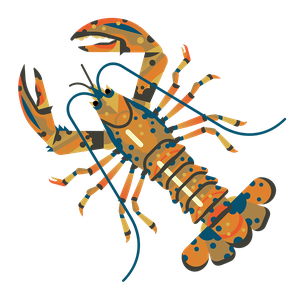
European lobster
Homarus gammarus
What to check for
Location
Scotland (Orkney)
Technical location
Atlantic, Northeast, North Sea (North)
Caught by
Pot, trap or creel
Rating summary
This stock is data limited. There is concern for the biomass due to a lack of biomass data, and no concern for fishing pressure due to recent landings being low, and F being below FMSY for females. There is a minimum size in place for this fishery however, there is no limit on creel numbers, no spatial controls and no total allowable catch in place. Management would benefit from effort controls that are responsive to the state of the stock. Potting, or creeling, for European lobster has minimal impact on the surrounding environment.Rating last updated June 2023.
Technical consultation summary
This stock is data limited. There is concern for the biomass due to a lack of biomass data, and no concern for fishing pressure due to recent landings being low, and F being below FMSY for females. There is a minimum size in place for this fishery however, there is no limit on creel numbers, no spatial controls and no total allowable catch in place. Management would benefit from effort controls that are responsive to the state of the stock. Potting, or creeling, for European lobster has minimal impact on the surrounding environment but may result in the entanglement of whales in this area. Entanglement rates in the Orkney creel fisheries are lower than on the west coast, however, there has been an estimated 66 minke whale and 17 humpback whale entanglements from 2009-2019.
How we worked out this Rating
This stock is data limited, there is concern for the biomass due to a lack of biomass data, and no concern for fishing pressure due to recent landings being low, and F being below FMSY for females.Landings of European lobster in Orkney have fluctuated and declined to as low as 98 tonnes in 2018. Estimates of fishing pressure (F) for female stocks were generally lower than males, slowing a decrease in relation to previous assessments in Orkney. The latest available stock assessment (2019) showed that while males are fished above FMSY, females are fished below FMSY. As landings have been low in recent years, and females are fished below FMSY, there is no concern for fishing pressure.There is no data available to indicate biomass. Therefore, there is concern for the biomass.
Management requires considerable improvement and effort controls are needed to improve the stock.There are some management measures in place for this stock, but there are no catch limits in place to prevent overexploitation. There is no limit on creel numbers, no spatial controls and no total allowable catch (TAC) for either the fishery as a whole, or individual vessels. There are also no tools available to implement a harvest control rule to provide a quick management response to adverse trends in stock indicators.In Orkney, the minimum conservation reference size is 90mm carapace length, and there is a maximum landing size of 155mm for females. It is also prohibited to fish for or land a lobster that bears a v-notch, or that has been mutilated to obscure a v notch. The maximum landing size is designed to protect larger breeding females, and since May 2025, it is now illegal to land a berried (egg-bearing) brown crab in Scotland, in line with the rest of the UK. In Scotland, vessels fishing commercially for brown, velvet, spider, or green crab, lobster or crawfish must have a license with shellfish entitlement. Owners of vessels that are 10m and under with a shellfish entitlement are required to complete the FISH1 form for all landings of crabs and lobsters and submit it on a weekly basis to the Fishery Office at which the vessel is administered. For vessels that are over 10m in length, data on fishing activity by trip must be recorded in an EU logbook and submitted to the Fishery Office within 48 hours of landing. Licensed fishing vessels that do not hold a shellfish entitlement can land a maximum of 5 lobsters and 25 crabs per day. Regulations effective from April 2017, restrict the numbers of certain shellfish species that can be taken by unlicensed fishing boats. The restrictions are set daily per vessel as 1 lobster and 5 crabs (of any species). There is currently a restrictive licensing system, whereby no new licenses and entitlements are being granted.The UK Fisheries Act came into force in January 2021 and requires the development of Fisheries Management Plans (FMPs). There are no details yet on how and when these will be developed. FMPs have the potential to be very important tools for managing UK fisheries, although data limitations may delay them for some stocks. MCS is keen to see FMPs for all commercially exploited stocks, especially where stocks are depleted, that include:Targets for fishing pressure and biomass, and additional management when those targets are not being metTimeframes for stock recoveryTechnologies such as Remote Electronic Monitoring (REM) to support data collection and improve transparency and accountabilityConsideration of wider environmental impacts of the fishery
Potting, or creeling, for European lobster, has minimal impact on the surrounding environment but may result in the entanglement of whales in this area.Brown crab and European lobster are fished together in a mixed fishery with seasonal and regional variation in target species taking place. The key fishing season for European lobster in the UK takes place from May to December. Lobsters are caught in pots, also known as creels, and can be fished individually or as part of a fleet of up to 100 pots, depending on the size of the boat and crew. Pots are portable traps made of wood or steel wire and plastic. The lobster is baited into the initial part (the chamber) and moves into the secondary part (the parlour) where it becomes trapped.In European lobster fisheries, there is no legislation or regulation to standardise the type of pot used. They tend to be highly selective as undersized animals can be returned to the sea alive and survival rates for non-target organisms are thought to be high. More than half of the bycatch caught are predicted to survive, although there is little available research to prove this. Measures to further reduce bycatch include the use of escape panels to allow undersize animals and bycatch to escape pots. North Sea cod may be caught as bycatch in this fishery, and they will generally be undersized. There is a legal obligation to release undersized cod.In creel fisheries, there is potential for entanglement of endangered, threatened or protected (ETP) species from the ropes attached to the pots. A report in 2010 estimated that around 7.5km of creel lines would be in Scottish waters throughout most of the year. These creels are targeting crab, lobster and Norway lobster. Whales become entangled in groundline because the rope used is buoyant and floats in loops between pots, rather than lying on the seabed.The main species at risk are minke and humpback whales. A 2022 study has estimated that in Orkney, 66 minke whales and 17 humpback whales have been entangled from 2009-2019 (out of a total of 302 minke whales and 64 humpback whales in Scotland overall). Minke whales entanglements are likely to be acutely fatal, with 84% of entangled minke whales found by fishers being already dead.Marine mammal bycatch reporting requirements were only introduced in the UK in November 2021, so monitoring to date has been poor. From 2021, new conditions introduced for fishing licenses require all bycatch of marine mammals to be reported within 48 hours of the end of the fishing trip. However, whale entanglements will still be underreported if whales break free or animals are caught in abandoned, lost or otherwise discarded fishing gear.Habitat impacts from potting are low but can occur during deployment, soak time or hauling of the pot, impacting the benthic habitat and associated species through contact with the pot or end weight, or by scouring from ropes. Research that has taken place suggests that while some damage does occur, it is unlikely to be significant unless potting intensity is high (defined as approximately 30 pots per 500 square metres). Most damage occurs where traps are set in rocky habitats that are home to corals, sponges, sea whips and other large emergent species. These habitats and species provide nursery areas, refuges from predators and habitat for the settlement of invertebrate spat.In some circumstances, there can be instances of ghost fishing, when lost fishing gear continues to fish and can entangle a variety of species, but this can be minimised by using appropriate gear and release devices.
References
Leaper, R., 2021. An evaluation of cetacean bycatch in UK fisheries: problems and solutions. A report to WDC and HIS. Available at https://uk.whales.org/wp-content/uploads/sites/6/2021/02/cetacean-bycatch-uk-fisheries-problems-solutions.pdf [Accessed on 20.06.2023].Leaper, R., MacLennan, E. et al. 2022. Estimates of humpback and minke whale entanglements in the Scottish static pot (creel) fishery. Endangered Species Research. 49(217-232). Available at https://www.int-res.com/articles/esr2022/49/n049p217.pdf [Accessed on 20.06.2023].MacLennan, E., Hartny-Mills, L., Read, F.L., Dolman, S.J., Philp, A., Dearing, K.E., Jarvis, D. and Brownlow, A.C. 2021. Scottish Entanglement Alliance (SEA) - understanding the scale and impacts of marine animal entanglement in the Scottish creel fishery. NatureScot Research Report 1268. Available at https://www.nature.scot/doc/naturescot-research-report-1268-scottish-entanglement-alliance-sea-understanding-scale-and-impacts#Spatial+maps+%E2%80%93+where+do+entanglements+occur? [Accessed on 20.06.2023].Marine Scotland. 2018. Landing controls for crab & lobster fisheries in Scotland. Available at https://www.ssmo.co.uk/site/assets/files/1407/landing_controls.pdf [Accessed on 20.06.2023].Mesquita, C., Miethe, T., Dobby, H. and McLay, A. 2017. Crab and Lobster Fisheries in Scotland: Results of Stock Assessments 2013-2015. Scottish Marine and Freshwater Science Vol 8 No 14. Available at https://data.marine.gov.scot/dataset/crab-and-lobster-fisheries-scotland-results-stock-assessments-2013-2015/resource/80511417 [Accessed on 20.06.2023].Mesquita, C., Ellis, A., Miethe, T. and Dobby, H. 2023. Crab and Lobster Fisheries in Scotland: Results of Stock Assessments 2016-2019. Scottish Marine and Freshwater Science Vol 14 No 05. Available at https://doi.org/10.7489/12451-1 [Accessed on 20.06.2023].Moffat, C., Baxter, J., Berx, B., Bosley, K., Boulcott, P., Cox, M., Cruickshank, L., Gillham, K., Haynes, V., Roberts, A., Vaughan, D., & Webster, L. (Eds.), 2020. Scotland's Marine Assessment 2020. Scottish Government. Available at https://marine.gov.scot/sma/ [Accessed on 20.06.2023].Northridge, S., Cargill, A., Coram, A., Mandleberg, L., Calderan S. and Reid, B., 2010. Entanglement of minke whales in Scottish waters; an investigation into occurrence, causes and mitigation. Contract Report CR/2007/49 to Scottish Government by the Sea Mammal Research Unit. Available at http://www.smru.st-andrews.ac.uk/files/2016/08/Entaglement-of-minke-whales-in-Scottish-waters-an-investigation-into-occurrence-causes-and-mitigation.pdf [Accessed on 20.06.2023].Ryan, C., Leaper, R., Evans, P.G.H., Dyke, K., Robinson, K.P., Haskins, G.N., Calderan, S., van Geel, N., Harries, O., Froud, K., Brownlow, A. and Jack, A. (2016). Entanglement: an emerging threat to humpback whales in Scottish waters. Report to the Scientific Committee of the International Whaling Commission, SC/66b/HIM/01, 1-12. Available at https://www.seawatchfoundation.org.uk/wp-content/uploads/2016/12/Ryan_et-al_IWC.pdf [Accessed on 20.06.2023].SEA, 2018. Scottish Entanglement Alliance (SEA): Is marine animal entanglement in Scottish waters really a problem? Available at https://www.scottishentanglement.org/is-marine-animal-entanglement-in-scottish-waters-really-a-problem/ [Accessed on 20.06.2023].Scottish Government. 2025. Crab and lobster landing controls. Available at: Crab and lobster landing controls: poster - gov.scot [Accessed on 18.11.2025]Scottish Marine Animal Stranding Scheme. Map of Strandings. Available at https://strandings.org/map/ [Accessed on 20.06.2023].Sustainable Fisheries Partnership (SFP). Edible crab Orkney. FishSource profile. In: FishSource [online]. Updated 11 January 2021. Available at https://www.fishsource.org/stock_page/1481 [Accessed on 20.06.2023].

Sustainable swaps
Learn more about how we calculate our sustainability ratings.
How our ratings work