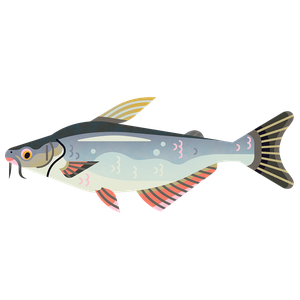
Grey gurnard
Eutrigla gurnardus
What to check for
Location
North Sea, Eastern English Channel and Skagerrak and Kattegat
Technical location
Atlantic, Northeast, English Channel (East), North Sea, Skagerrak and Kattegat
Caught by
Bottom trawl (otter)
Rating summary
This stock is data limited and there are no reference points to indicate whether biomass is at a sustainable level. There is concern for the biomass due to a decline in the biomass index and no concern for fishing pressure. Gurnards are a non-quota species and are often discarded due to low market demand. There is no management plan in place for grey gurnard and management requires considerable improvement, and a better understanding of the stock. Otter trawlers are likely to cause some damage to the seabed. Bycatch in otter trawling is moderate and may include some vulnerable species.Rating last updated July 2022.
How we worked out this Rating
This stock is data limited and there are no reference points to indicate whether biomass is at a sustainable level. There is concern for the biomass and no concern for fishing pressure.In the North Sea and in the Skagerrak/Kattegat, grey gurnard is an abundant demersal species. It is less abundant in the Channel, the Celtic Sea and in the Bay of Biscay. The time series of mature biomass index shows an increasing pattern from the beginning of the 1990s. Since then it was fluctuating at a high level until 2017. Since then, a strong decline in the index was observed. Index A (2021, 2022) is 10.4kg/hour, whereas Index B (2018-2020) is 16.5kg/hour, an A/B ratio of 0.63. As the mature biomass index continues to decline, this is concern for the biomass.Historically, grey gurnard is taken as a bycatch species in mixed demersal fisheries for flatfish and roundfish. The largest part of the catch is discarded. Owing to the low commercial value of this species, landings data do not reflect the actual catches. Catch data in 2021 is 5541 tonnes, a large decrease from 2020 (10,211 tonnes). ICES does not provide reference point values for fishing pressure, however, as this species is mostly discarded and catches have declined, there is currently no concern for fishing pressure. Grey gurnard has a medium resilience to fishing pressure.ICES advises that when the precautionary approach is applied, catches in each of the years 2023 and 2024 should be no more than 5846 tonnes. If discard rates do not change from the average of the last three years (2019-2021), this implies landings of no more than 1120 tonnes in each of the years 2023 and 2024. This is a decrease in advice of 30% due to the low index ratio.
There is no management plan in place for grey gurnard and management requires considerable improvement.There is currently no management for any of the gurnard species in the EU, e.g. no minimum conservation reference size (MCRS), no regulation on effort, gear or closed seasons (e.g. for spawning). No Total Allowable Catch (TAC) has been set for grey gurnard in this area, and the EU Landings Obligation doesn't apply to this stock, as it is not subject to catch limits.Grey gurnard in the North Sea, Skagerrak and Kattegat and Eastern English Channel is not a targeted stock, but is mainly caught as bycatch by the industrial fisheries, although when landed it is for human consumption. It is also caught in demersal fisheries for species such as cod and haddock. MCS would like to see bycatch species monitored and taken into account once fisheries management plans are implemented.Reporting at a species level has improved since 2012, allowing estimations of landings, but some are still reported as 'mixed gurnards' (e.g. Germany and England). Species misidentification continues to be a major problem in estimating the landings of all gurnards, including grey gurnard.Both the EU and UK have fishery management measures in place, which can include catch limits, targets for population sizes and fishing mortality, and controls on what fishing gear can be used and where. In the EU, compliance with regulations has been variable, and there are ongoing challenges with implementing some of them. There was a target for fishing to be at Maximum Sustainable Yield by 2020, but this was not achieved. The Landing Obligation (LO), an EU law that the UK has kept after Brexit, requires all quota fish to be landed, even if they are unwanted (over-quota or below minimum size). It aims to promote more selective fishing methods, reduce bycatch, and improve recording of everything that is caught, not just what is wanted. Compliance with the LO is generally poor and actual levels of discards are difficult to quantify using the current fisheries observer programme. UK administrations are in the process of replacing the landing obligation with country-specific Catching Policies. In the UK, it is too early to tell how effective management is, as the Fisheries Act only came into force in January 2021. The Act requires the development of Fisheries Management Plans (FMPs) (replacing EU Multi-Annual Plans). FMPs are currently in development, but the scope of them remains unclear. They have the potential to be very important tools for managing UK fisheries, although data limitations may delay them for some stocks. MCS is keen to see publicly available FMPs for all commercially exploited stocks, especially where stocks are depleted, that include: Targets for fishing pressure and biomass, and additional management when those targets are not being met, based on the best available scientific evidence Timeframes for stock recovery Improved data collection, transparency and accountability, supported by technologies such as Remote Electronic Monitoring (REM) Consideration of wider environmental impacts of the fishery
Otter trawlers are likely to cause some damage to the seabed. Bycatch in otter trawling is moderate and may include some vulnerable species.Grey gurnard is mainly discarded in the bottom trawl fishery for roundfish and flatfish and taken as bycatch in the industrial fishery for sandeel and sprat. In 2021, out of a total catch of 5541 tonnes, 4442 tonnes (80%) is discarded. Most landings are by Denmark, the Netherlands, the UK, Germany, and Norway. Most catches are from the North Sea, with a small amount from Skagerrak and Kattegat and a very small amount from the eastern English Channel.Grey gurnard is an important predator of cod, and the increase in abundance of grey gurnard led to an increase in mortality of North Sea cod (age-0) and whiting (age-0 and age-1) in recent years. It is estimated that grey gurnard can cause up to 50% of the predation mortality on 0-group cod and whiting.Demersal otter trawls have the potential to take relatively high quantities of bycatch. In the North East Atlantic there are reported catches of demersal elasmobranchs and endangered, threatened and protected (ETP) species, such as sharks, rays and marine mammals. Bycatch data is limited in many UK and EU fisheries as they are generally not well monitored.Demersal trawls have contact with the seabed, resulting in penetration and abrasion of habitat features. The impact of trawling on the seabed depends on the location and scale in which trawling occurs. For example, areas that are used to natural disturbance through tides and waves, are less sensitive to habitat impacts. Areas not used to mobile towed gears are typically more sensitive to trawling. Trawl gears are known to have some of the greatest impacts on Vulnerable Marine Ecosystems (VMEs).There are Marine Protected Areas (MPAs) in this area, some of which are designated to protect seabed features from damaging activities. This fishery overlaps with parts of these MPAs, but the proportion of the catch coming from these areas is expected to be relatively low in relation to the unit of assessment (i.e. less than 20% of the catch or effort), and so these impacts have not been assessed within the scale of this rating. Given the important role that MPAs have in recovering the health and function of our seas, MCS encourages the supply chain to identify if their specific sources are being caught from within MPAs. If sources are suspected of coming from within designated and managed MPAs, MCS advises businesses to establish if the fishing activity is operating legally inside a designated and managed MPA, and request evidence from the fishery or managing authority to demonstrate that the activity is not damaging to protected features or a threat to the conservation objectives of the site(s).To improve monitoring and reporting of fishing activity, MCS would like to see remote electronic monitoring (REM) with cameras implemented, used and enforced. To reduce the impacts of fishing on the marine environment we would like to see a just transition to the complete removal of bottom towed gear from offshore Marine Protected Areas designated to protect the seabed. We also want to see reduction and mitigation of environmental impacts including emissions and blue carbon habitat damage.
References
Eigaard, O. R. et al., 2016. Estimating seabed pressure from demersal trawls, seines, and dredges based on gear design and dimensions. ICES J Mar Sci;73(suppl_1):i2, s.l.: s.n.Froese R. and Pauly D. (Editors), 2022. Eutrigla gurnardus. Grey gurnard. Available at https://www.fishbase.de/Summary/SpeciesSummary.php?ID=68&AT=grey+gurnard [Accessed on 01.07.2022].Hiddink, J. et al., 2017. Global analysis of depletion and recovery of seabed biota after bottom trawling disturbance. Proc Natl Acad Sci. 114(31):8301–6.ICES. 2022. Grey gurnard (Eutrigla gurnardus) in Subarea 4 and divisions 7.d and 3.a (North Sea, eastern English Channel, Skagerrak and Kattegat). In Report of the ICES Advisory Committee, 2022. ICES Advice 2022, gug.27.3a47d. Available at https://doi.org/10.17895/ices.advice.19447934 [Accessed on 01.07.2022].Kennelly, S. J. & Broadhurst, M. K., 2021. A review of bycatch reduction in demersal fish trawls. Rev Fish Biol Fisheries 31, 289–318.Kynoch, R., Fryer, R. & Neat, F., 2015. A simple technical measure to reduce bycatch and discard of skates and sharks in mixed-species bottom-trawl fisheries. ICES J Mar Sci,72(6):1861.McCarthy, I. D., Cant, J. and Marriott, A. L.2018. Population biology of grey gurnard (Eutrigla gurnardus (L.); Triglidae) in the coastal waters of Northwest Wales. Journal of Applied Ichthyology. 34(4). pp.896-905Pinnegar, J. 2017. Fisheries and aquaculture climate science: Potential impacts, adaptation and mitigation - overview of current scientific knowledge and cutting-edge developments. Presented to the Seafish Common Language Group, June 2017, London, UK. Available at: https://www.seafish.org/media/1698860/clg_june2017_fish_aquaclimatescience_cefas2.pdf [Accessed on 30.06.2022].Silva, F., Ellis, J. & Catchpole, T., 2012. Species composition of skates (Rajidae) in commercial fisheries around the British Isles and their discarding patterns. J Fish Biol., 80:1678–1703.van Denderen, P. et al., 2015. Similar effects of bottom trawling and natural disturbance on composition and function of benthic communities across habitats. Mar Ecol Prog Ser. 2015;541:31–43.

Sustainable swaps
Learn more about how we calculate our sustainability ratings.
How our ratings work