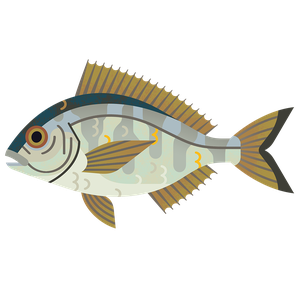
Grey mullet
Chelon labrosus
What to check for
Location
North Sea, English Channel
Technical location
Atlantic, Northeast, English Channel (East), English Channel (West), North Sea
Caught by
Net (gill or fixed)
Rating summary
There is limited data on the thick-lipped grey mullet population in this region. There is some evidence that populations have been in recent decline due to over-fishing. There is a lack of management. Gillnets in this area can encounter bycatch of non-target fish, mammals and birds.Rating last updated August 2023.
Technical consultation summary
There is limited data on the thick-lipped grey mullet population (or stock) in this region. There is some evidence that populations have been in recent decline due to over-fishing. Route 2 scoring has been applied to this rating owing to the lack of reference points for fishing pressure and biomass. Thick-lipped grey mullet has a medium resilience to fishing pressure. There is a lack of general management for grey mullet, which can be fished without limit. Minimum legal-size limits are absent or below size-of-maturity (I.e., Cornwall, and North western IFCAs), except in the Southern IFCA district, offering limited protection to juveniles. Grey mullet tend not to be a major commercial species but when fished commercially, they are a target or bycatch species which are mostly caught with gill nets, set close to the shore. Gillnets in this area can encounter bycatch of non-target fish, mammals and birds, harbour porpoises (vulnerable in Europe) are at serious risk.
How we worked out this Rating
There is limited data on the thick-lipped grey mullet population (or stock) in this region. There is some evidence that populations have been in recent decline due to over-fishing.Route 2 scoring has been applied to this rating owing to the lack of reference points for fishing pressure and biomass. Thick-lipped grey mullet has a medium resilience to fishing pressure.There is no formal stock assessment of grey mullet stocks and the status of the stock is unknown relative to reference points. There is little information available on mullet abundance in UK waters as there is a lack of data collection on the species. A slow growth rate, late maturity, biannual spawning and high site fidelity makes them highly vulnerable to over-exploitation. In 2018, the National Mullet Club suggested that mullet stocks have declined in recent years and commercial landings of grey mullet have been in decline since 2010, alongside the average weight of fish captured, which has been shown to be an indicator of over-exploitation. Therefore, there is concern for stock biomass and fishing pressure.Grey mullet are likely experiencing increased commercial pressure as a result of the limitations imposed on the bass fishery following their population crash.There are three species of grey mullet in UK waters; thick-lipped grey mullet, thin-lipped grey mullet and golden-grey mullet.
There is a lack of general management for grey mullet, which can be fished without limit and caught before having had the chance to reproduce. There is no specific management plan for this stock, and it is not covered by the EU Multi Annual Management Plans, which focus on demersal and deep sea fisheries. Grey mullet is not subject to Total Allowable Catch (TAC) and quotas. The Marine Management Organisation (MMO) has no minimum conservation reference sizes (MCRS) for any species of grey mullet, but in England the Inshore Fisheries and Conservation Authorities (IFCAs) may set MCRS for fish caught within their six nautical mile limit. Currently this is set at 42 cm in Southern IFCA, and 20 cm in Cornwall and North Western IFCAs. No other IFCAs have set a MCRS. This provides some protection to immature fish, however, length at fist maturity is documented at 29.5 cm for thick-lip grey mullet. Fish caught below this length would likely not have had the chance to reproduce. There are measures in place for bass which may inadvertently protect grey mullet but there is also a lack of monitoring, and catch reporting for the species, which limits the efficacy of management. Management of grey mullet is generally associated with managing the nursey areas, rather than the stock. For example, in Eastern IFCA, most of the estuaries, and a high proportion of the shallow near shore areas, are covered by some form of Marine Protected Area designation. However, these designations do not necessarily account for the food habits of the species, particularly in its juvenile phase. There can be management including catch limits, closed areas and seasons, however these are not necessarily effective as catches appear to be poorly recorded and adequate catch levels are unknown. In the EU, compliance with regulations has been variable, and there are ongoing challenges with implementing some of them. In the UK, the Fisheries Act only came into force in January 2021. The Act requires the development of Fisheries Management Plans (FMPs) (replacing EU Multi-Annual Plans). FMPs have the potential to be very important tools for managing UK fisheries. They will set out the policies to secure the long-term sustainability of our fish stocks for current and future generations and can include (data allowing): Targets for fishing pressure and biomass, with effective management to meet them; Timeframes for stock recovery; Use of technologies such as Remote Electronic Monitoring (REM) to support data collection, improve transparency and accountability; Consideration of wider environmental impacts of the fishery.
Gillnets in this area can encounter bycatch of non-target fish, mammals and birds. This includes the harbour porpoise which is vulnerable in Europe.Thick-lipped grey mullet is a coastal benthic fish found mostly on sandy bottoms.Fixed gillnets consist of a single vertical netting wall hanging between a float line and a weighted ground line which have little to no impact on the habitat, and very low levels of disturbance to the seabed. They are, however, recognised as the highest risk type of fishery for cetaceans globally, especially for small cetaceans in coastal areas. In the UK, the species most affected is the harbour porpoise, but a number of other species have been reported, and it should be assumed that most cetaceans are vulnerable to gill net bycatch. Gillnets pose serious risk to harbour porpoise wherever they are used around the UK and other cetaceans where their distribution overlaps with gill net use.Harbour porpoises are listed as Vulnerable in Europe by IUCN. They are on OSPAR’s List of Threatened and/or Declining Species and Habitats for the Greater North Sea and Celtic Seas, owing to evidence of a decline in populations, their sensitivity and the threat of incidental capture and drowning in fishing nets. They are also a priority species in UK and EU law (under which there are explicit bycatch requirements). Consequently, the UK designated seven Special Areas for Conservation for harbour porpoises, but these areas are not yet managed.The UK Dolphin and Porpoise Conservation Strategy lists harbour porpoise as having medium vulnerability to gillnetting for the UK as a whole. This is based on the species having a high sensitivity to gillnetting and medium exposure. The area of most concern is in the Celtic Seas, southwest of the UK, where most of the seabass gillnetting activity takes place. Exposure to gillnetting is high. A review of activities in the Bristol Channel Approaches Harbour Porpoise SAC lists commercial fisheries with bycatch (predominantly static nets) as a high risk, and a strandings report by Cornwall Wildlife Trust also shows that common dolphin bycatch is very high in this area. There is also bycatch of elasmobranch species which may be threatened or endangered. Porbeagle sharks are being caught as bycatch in gillnets but as they are a prohibited species, there is no official data on the numbers being caught and discarded. Spurdog bycatch is also thought to be of concern. The National Evaluation of Populations of Threatened and Uncertain Elasmobranchs (NEPTUNE) highlighted continued problems of spurdog bycatch and despite a supposed real time avoidance programme being implemented, 50 tonnes were still landed in Cornish ports in 2019.Acoustic deterrent devices (ADDs), such as ‘pingers’, have been shown to be effective at reducing harbour porpoise bycatch in gillnets, but the reduction achieved so far has been small (<15% of the total number of cetaceans killed in UK fisheries), they may cause unwanted disturbance or displacement, and they may not be effective for other species.Larger mesh sizes used (100mm, south Wales) and the banning of fishing in inshore bass nursery areas in England and Wales, will reduce bycatch of small species and undersized seabass.Increasing evidence over the last decade has shown that seabirds are suffering mortality from bycatch, particularly in gillnets. Bycatch of seabirds in gillnet fisheries is estimated to kill ~400,000 birds globally, each year. Diving seabirds are generally more vulnerable than surface feeding seabirds. Most of the UK’s gillnetting takes place in southwest UK and therefore there is concern for seabird populations here (i.e., razorbill (Near Threatened, Europe: IUCN), puffin (Endangered, Europe: IUCN) and the herring gull, arctic skua and roseate tern (Red - Birds of Conservation Concern 4: the Red List for Birds (UK)).If lost, gillnets can continue to fish for several weeks before becoming tangled and bundled up, a phenomenon known as ghost fishing. Fishing gears represent an investment by fishermen, thus there are incentives to avoid losing or damaging gear.UK regulations to reduce the impacts of fishing on marine habitats and wider species are under development, in the meantime most EU regulation have been adopted. Under EU legislation, bycatch species should be managed within scientifically defined or, where data isn’t available, suitability precautionary sustainable exploration limits. If stocks fall below a certain threshold, measures can be brought in such as gear limitations (e.g., mesh size or depth of use), time and/or areas closures, and Minimum Conservation Reference Sizes (MCRS).
References
Bradbury, G., Shackshaft, M., Scott-Hayward, L., Rexstad, E., Miller, D., and Edwards, D., 2017. Risk assessment of seabird bycatch in UK waters. Produced by Wildfowl & Wetlands Trust (Consulting) Ltd for Defra project MB0126. Available at: http://sciencesearch.defra.gov.uk/Document.aspx?Document=14620_MB0126RiskassessmentofseabirdbycatchinUKwaters_updated21Oct2019.pdf [Accessed on 04.10.2021].Butterworth, A. and Burt, A. 2018. Vulnerability and Over-Exploitation of Grey Mullet in UK Waters v2. National Mullet Club. Available at https://www.thenationalmulletclub.org/Vulnerability_and_Over-Exploitation_of_Grey_Mullet_in_UK_Waters_v2.pdf [Accessed 13.09.2023]Calderan, S. and Leaper, R., 2019. Review of harbour porpoise bycatch in UK waters and recommendations for management. January 2019, WWF. Available at https://www.wwf.org.uk/sites/default/files/2019-04/Review_of_harbour_porpoise_in_UK_waters_2019.pdf [Accessed on 06.07.2021].Chadwick, H., Clear, N., Crosby, A., Hawtrey-Collier, A. and Williams, R. Marine Strandings in Cornwall and the Isles of Scilly: 2019 Annual Report. Report by Cornwall Wildlife Trust and Marine Strandings Network. Available at https://www.cornwallwildlifetrust.org.uk/sites/default/files/2020-12/2019%20Summary%20Report%20-%20Marine%20Strandings%20in%20Cornwall%20and%20the%20Isles%20of%20Scilly.pdf [Accessed on 06.07.2021].Cook, R. and Heath, M. 2018. Population trends of bycatch species reflect improving status of target species. DOI: 10.1111/faf.12265. Fish and Fisheries. 19: 455-470. Available at https://onlinelibrary.wiley.com/doi/epdf/10.1111/faf.12265 [Accessed on 13.09.2023]Cornwall IFCA (2023). Cornwall IFCA byelaws, other regulations and codes of practise: Specified fish sizes (as amended). Available at https://www.cornwall-ifca.gov.uk/Byelaws_Regulations [Accessed 24.07.23]Ellis, J. R., Bendall, V. A., Hetherington, S. J., Silva, J. F. and McCully Phillips, S. R. 2016. National Evaluation of Populations of Threatened and Uncertain Elasmobranchs (NEPTUNE). Project Report (Cefas) V1.4. Available at: http://randd.defra.gov.uk/Document.aspx?Document=13513_MB5201NEPTUNEFinalReportv1.4.pdf [Accessed on 04.10.2021]Froese R. and Pauly D. (Editors), 2016. Chelon labrosus, Thicklip grey mullet. Available at: https://www.fishbase.se/summary/Chelon-labrosus.html [Accessed on 04.09.2023]Glemarec, G., Kindt-Larse, L., Scherffenberg Lundgaard, L. and Larsen, F. 2020. Assessing seabird bycatch in gillnet fisheries using electronic monitoring. Biological Conservation. 243. 108461. Available at https://doi.org/10.1016/j.biocon.2020.108461 [Accessed on 30.09.2021]ICES, 2018. ICES Advice: Bycatch of small cetaceans and other marine animals - review of national reports under Council Regulation (EC) No. 812/2004 and other information. Published 11 September 2018. Available at https://www.ices.dk/sites/pub/Publication%20Reports/Advice/2018/2018/byc.eu.pdf [Accessed on 06.07.2021]ICES. 2022a. Greater North Sea ecoregion – fisheries overview. ICES Advice: Fisheries Overviews. Report. https://doi.org/10.17895/ices.advice.21641360.v1 [Accessed 03.07.2023]ICES. 2022b. Greater North Sea ecoregion – Ecosystem Overview. ICES Advice: Ecosystem Overviews. Report. https://doi.org/10.17895/ices.advice.21731912.v1 [Accessed 03.07.2023]JNCC. 2022. Harbour porpoise (Phocoena phocoena) Special Area of Conservation: Bristol Channel Approaches / Dynesfeydd Môr Hafren. Conservation Objectives and Advice on Operations. Available at https://sac.jncc.gov.uk/species/S1351/ [Accessed on 22.7.2022].Leaper, R. 2021. An evaluation of cetacean bycatch in UK fisheries: problems and solutions. Available at https://uk.whales.org/wp-content/uploads/sites/6/2021/02/cetacean-bycatch-uk-fisheries-problems-solutions.pdf [Accessed 17.07.2023]Leeney, R. H., Amies, R., Broderick, A.C., Witt, M. J., Loveridge, J., Doyle, J. and Godley, B. J. 2008. Spatio-temporal analysis of cetacean strandings and bycatch in a UK fisheries hotspot. Biodiversity and Conservation. 17, 2323. Available at https://link.springer.com/article/10.1007/s10531-008-9377-5#citeas [Accessed on 06.07.2021].Leeney, R. H., Witt, M. J., Broderick, A. C., Buchanan, J., Jarvis, D. S., Richardson, P. B. and Godley, B. J. 2011. Marine megavertebrates of Cornwall and the Isles of Scilly: relative abundance and distribution. Journal of the Marine Biological Association of the United Kingdom, 92(8), 1823-1833. Available at https://www.cambridge.org/core/journals/journal-of-the-marine-biological-association-of-the-united-kingdom/article/marine-megavertebrates-of-cornwall-and-the-isles-of-scilly-relative-abundance-and-distribution/7981AA197C2320B6A9E2C01BD7A1F7B7 [Accessed on 06.07.2021].MCS. 2023. MPA Reality Check. Available at https://mpa-reality-check.org/ [Accessed 03.07.2023]Moan, A., Skern-Mauritzen, M., Vølstad, J. H., Bjørge, A. 2020. Assessing the impact of fisheries-related mortality of harbour porpoise (Phocoena phocoena) caused by incidental bycatch in the dynamic Norwegian gillnet fisheries, ICES Journal of Marine Science, Volume 77, Issue 7-8, Pages 3039–3049. Available at https://doi.org/10.1093/icesjms/fsaa186 [Accessed on 06.07.2021]North Western IFCA (2023). Minimum sizes. Available at https://www.nw-ifca.gov.uk/minimum-sizes/ [Accessed 24.07.23]Omeyer, L.C.M., Doherty, P.D., Dolman, S., Enever, R., Reese, A., Tregenza, N., Williams, R. and Godley, B.J. 2020. Assessing the Effects of Banana Pingers as a Bycatch Mitigation Device for Harbour Porpoises (Phocoena phocoena). Frontiers in Marine Science. Front. Mar. Sci. https://doi.org/10.3389/fmars.2020.00285.OSPAR, 2017. Intermediate Assessment 2017: Harbour Porpoise Bycatch. Available at https://oap.ospar.org/en/ospar-assessments/intermediate-assessment-2017/biodiversity-status/marine-mammals/harbour-porpoise-bycatch/ [Accessed 18.07.2023]Peltier, H., Authier, M., Deaville, R., Dabin, W., Jepson, P. D., van Canneyt, O., Daniel, P. and Ridoux, V. (2016). Small cetacean bycatch as estimated from stranding schemes: The common dolphin case in the northeast Atlantic. Environmental Science and Policy, 63: 7-18. doi: 10.1016/j.envsci.2016.05.004. Available at https://www.sciencedirect.com/science/article/abs/pii/S1462901116301514 [Accessed 23.07.2020]Scottish Government, 2021. UK Dolphin and Porpoise Conservation Strategy: Technical Report. Published 22 March 2021. ISBN: 9781800048522. Available at https://www.gov.scot/publications/uk-dolphin-porpoise-conservation-strategy-technical-report/documents/ [Accessed on 26.07.2021]. Seafish, 2022. Gill Nets. Available at: https://www.seafish.org/responsible-sourcing/fishing-gear-database/gear/gill-nets/ [Accessed on 12.8.22]Seafish (2023). Gill nets. Available at https://www.seafish.org/responsible-sourcing/fishing-gear-database/gear/gill-nets/ [Accessed 27.07.2023]Southern IFCA (2023). Minimum sizes. Available at https://www.southern-ifca.gov.uk/da/164147 [Accessed 24.07.23]Species account by IUCN SSC Cetacean Specialist Group; regional assessment by European Mammal Assessment team. 2007. Phocoena phocoena. The IUCN Red List of Threatened Species 2007: e.T17027A6734714. Available at https://www.iucnredlist.org/species/17027/6734714 [Accessed on 04.10.2021]

Sustainable swaps
Learn more about how we calculate our sustainability ratings.
How our ratings work