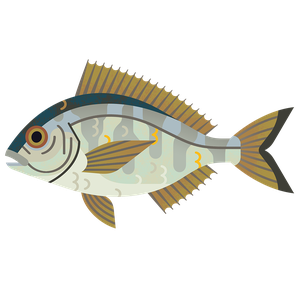
Haddock
Melanogrammus aeglefinus
What to check for
Location
Faroes grounds
Technical location
Atlantic, Northeast, Faroes Grounds
Caught by
Hook & line (longline)
Certification
Marine Stewardship Council (MSC)
Rating summary
The Faroes Grounds haddock stock is above target levels and not subject to overfishing. Catches have been within recommended limits in recent years. A new management plan was introduced in 2021. Historically, management measures have been unsuitable for controlling the fishery. Most Faroe haddock is caught by longlining, which can have a bycatch of vulnerable species. Better data is needed to fully understand these impacts.Rating last updated December 2025.
Technical consultation summary
The Faroes Grounds haddock stock is above target levels and not subject to overfishing. In 2025, SSB was 59,250t, well above MSY BTrigger, 23,030t The stock is therefore not in an overfished state. In 2020, F was 0.78, which was above Flim, meaning there is increased risk to the stock. It has since declined to 0.130 in 2025, which is below FMSY (0.27). Catches have been below recommended limits in recent years. Historically, management measures have been unsuitable for controlling the fishery. A new management plan was introduced in 2021.The certified fleet is responsible for around 87% of haddock catches. Certification is conditional on getting a peer review of the management plan, and FISF are currently behind target on addressing this. Management is based on a days-at-sea system and does not include catch limits. ICES suggests that the number of allocated fishing days does not necessarily relate to catch, because there are fluctuations in the catchability of each species. The previous management approach, which was also based on days-at-sea, failed to adequately control the fishery. Most Faroe haddock is caught by longlining. This method has a bycatch of northern fulmars, and more data is needed to fully understand the impact on the population.
How we worked out this Rating
The Faroes Grounds haddock stock is above target levels, and is not subject to overfishing.Stock assessments are carried out by the International Council for the Exploration of the Sea (ICES). The most recent assessment was published in 2025 using data up to that year. The next assessment is expected in 2026.The stock assessment defines reference points for fishing pressure (F) and biomass (B). For fishing pressure, there is a target to keep F at or below Maximum Sustainable Yield (MSY). For biomass, there is no target. However, there is a trigger point (MSY BTrigger). Below this level, F should be reduced to allow the stock to increase. Because BMSY is not defined, the Good Fish Guide (GFG) applies its own definition of 1.4 x MSY BTrigger.The biomass of the spawning-stock (SSB) of Faroe Grounds haddock was around 50,000 tonnes for most of the 1960s-1980s. After this, biomass fluctuated widely, peaking at 80,000t in 2003 and falling to just 9,000t in 2011. It was below Blim (16,458t), the point of reproductive impairment, from 2009-2017. It has since recovered and is now above the level at which additional management measures would be triggered (MSY BTrigger, 23,030t). In 2025, SSB was 59,250t. The stock is therefore not in an overfished state.Fishing mortality (F) has generally been above levels associated with Maximum Sustainable Yield (MSY) since records began in the 1950s. In 2020, F was 0.78, which was above Flim, meaning there is increased risk to the stock. It has since declined to 0.130 in 2025, which is below FMSY (0.27). Therefore, the fishery is not subject to overfishing.ICES advises that when the MSY approach is applied, catches in 2026 should be no more than 19,653 tonnes. This is a 61% increase on the previous year's advice because of an increasing stock size as a result of very high recent recruitment and recent low fishing mortality.
Catches have been within recommended limits in recent years. Historically, management measures have been unsuitable for controlling the fishery. A new management plan was introduced in 2021.FISF, the Faroe Islands Sustainable Fisheries company, achieved MSC-certification for their cod and haddock fisheries in 2021 following the introduction of a management plan. The certified fleet is responsible for around 87% of haddock catches. Certification is conditional on getting a peer review of the management plan, and FISF are currently behind target on addressing this. The cod certification has since been suspended owing to the poor stock status.Faroe Grounds haddock is primarily caught by Faroese fleets, accounting for over 89% of total catches in recent years. The UK (10%) and Norway (1%) also catch a small amount. The Faroe Islands have a number of agreements to cover international fisheries arrangements. In 2025, it was agreed that the UK could catch up to 880t of Faroe cod and haddock (combined). Of which no more than 264 tonnes may consist of cod, and as bycatch only. No directed fisheries for cod are permitted under this quota.A management plan for Faroe Plateau cod, haddock, and saithe was implemented in 2021. Like previous measures, it uses a days-at-sea system rather than catch limits and aims to keep stocks above the point of reproductive impairment (Blim) with 95% probability. The number of allocated days at sea varies by gear type and vessel size, and the plan accounts for predicted cod and haddock bycatch in the saithe fishery. Longliners and small trawlers are regulated according to cod and haddock stock status, while large single trawlers and pair trawlers are regulated by saithe stock status. The harvest strategy allows annual adjustments of fishing days by ±5%, depending on whether biomass or fishing pressure exceed target reference points. A conversion factor is used to translate fishing days into predicted fishing mortality and catches. However, ICES notes that allocated fishing days do not necessarily correspond to actual catches due to fluctuations in species catchability.In November 2023, Faroese authorities began reviewing this plan, resulting in the inclusion of a recovery plan for the 2024 fishing year to address the critical status of Faroe Plateau cod. The recovery plan imposed stricter measures than usual, including a 20% reduction in fishing days for all longliners and small trawlers (compared to the standard 5% decrease). Larger trawlers, initially set for a 5% increase, were instead given a 10% reduction due to cod bycatch concerns. Additionally, spawning closures were extended by 14 days on both ends of the traditional period. The revised plan will be evaluated again in 2024 and has not yet been submitted to ICES for review, leaving its effectiveness uncertain.Faroe haddock landings peaked at 27,000 t in 2003, declined to a low of 2,800 t in 2017, then rose to 9,334 t in 2019 and 7,310 t in 2023. Historically, most catches came from the Faroe Plateau, but since 2022 a significant share has been from the Faroe Bank (Subdivision 5.b.2), which was closed to most fisheries from 2008-2021. The Faroe Bank reopened in 2022 due to improved cod stock status, yielding 2,292 t that year and 660 t in 2023. In 2023, fishing days at the Bank were mainly allocated to small boats and jiggers, unlike 2022 when larger longliners (>110 GRT) dominated.In 2021, ICES catch advice was a 65% reduction for cod, 24% reduction for haddock, and a 37% increase for saithe compared to the previous year. The management plan was implemented accordingly: the 2022 allocation of fishing days for fleets 3-5 was 5% lower than in 2021, and the allocation for fleet 2 was increased by 5%. Haddock catch has been below advice since 2020, averaging 67% of advice from 2020 to 2024. Therefore, management is currently following advice.The previous management approach, which was also based on days-at-sea, failed to adequately control the fishery. Faroe Grounds haddock catches were 24% higher than the advice in 2018 and 2019. Zero catch was recommended from 2009-2016 but catches of around 3,500t continued.Other management measures include:A minimum permitted size of 40 cm for cod, 37 cm for haddock, and 45 cm for saithe.Consideration of real-time closures of an area if the proportion of juvenile fish in catches exceeds 30% of a haul (cod less than 50cm, saithe less than 55cm and haddock less than 45cm).Restrictions on where vessels can fish. In general, large vessels cannot access the 0-12nm zone. Around 60% of the Faroe Plateau shallower than 200m is closed to trawling for most of the year. Most of the Faroe Bank is permanently closed to trawling.There is a discard ban, and compliance with this appears to be high.The Faroe Islands are also a member of the North East Atlantic Fisheries Commission (NEAFC). Vessels listed on the NEAFC Illegal, Unreported and Unregulated list (blacklist) are not permitted to call at ports, receive services and supplies or change crew members in any port of the member countries of NEAFC.

Most Faroe haddock is caught by longlining. This method has a bycatch of northern fulmars, and more data is needed to fully understand the impact on the population.In 2024, longlining accounted for most Faroe haddock catch (around 73%). Trawling accounted for 27% of catches.Longlining for demersal species, such as cod and haddock, has a lower risk of habitat impacts than towed gear such as bottom trawling. The accidental bycatch of species such as seabirds and marine mammals is of greater concern. In the Faroe Islands, monitoring of bycatch is poor and better data is needed. Independent observer coverage is low and most data is self-reported by the fishing industry.According to the North Atlantic Marine Mammal Commission, whale and seal bycatch in Faroese trawl and longline fisheries is thought to be low. Reported incidents of marine mammal bycatch have mainly been in the pelagic fisheries for blue whiting, herring and mackerel. However, data is not shared with ICES for international analysis and reporting. Therefore, marine mammal bycatch in this fishery is not thought to be of concern, but better data is needed.Seabird bycatch is thought to be common in the longline fishery, mainly of northern fulmars. A project in 2021 to estimate annual bycatch indicated between 2,000 and 10,000 fulmars are caught annually. Northern fulmars are not considered to be threatened or in decline in the Faroe Islands, and therefore the fishery does not seem to be having population-level effects. The population is estimated to be around 600,000 breeding pairs. Data on other species is less clear. Some mitigation measures are used, primarily bird scarers (tori lines) and night-setting. Recommended best practice by ACAP (the Agreement on the Conservation of Albatrosses and Petrels) recommends the simultaneous use of 3 measures: weighted hooks, bird scaring lines and night setting. Alternatively, hook-shielding or underwater bait setting devices could be used. Better monitoring and mitigation could therefore be employed to reduce bycatch.Part of the Faroese longline fishery is Marine Stewardship Council-certified. As part of the certification, the use of bait in longline fisheries was analysed. Approximately 75kg is used to catch 1.5 tonnes of fish (5%). Longlining caught around 4,600t of haddock in 2024, suggesting that 230 tonnes of bait were used. Bait mainly comprises Atlanto-Scandian herring, North East Atlantic mackerel, Patagonian squid and Pacific saury. Mackerel and herring populations are currently at sustainable levels. There appears to be little data about squid and saury, but the quantity of bait used is unlikely to have a population-level impact.Certification reports indicate that longlining also catches cod, ling, tusk, Greenland halibut, saithe and monkfish. Small quantities of golden redfish, blue ling, wolffish, whiting, lemon sole and plaice are also taken. Faroese cod is at very low levels, below the point of reproductive impairment. It is unclear whether the haddock fishery poses a risk to the cod population.ICES notes that cod and haddock appear to be more drawn to longline bait when sandeel abundance is low. Therefore, years of low prey abundance could result in increased fishing pressure on these species.Shark bycatch and entanglement is a risk in longline fisheries. There is no information about whether this is a particular concern in this fishery. If caught alive, elasmobranchs are likely to be released, so there appears to be little data on interactions.
References
ACAP, 2024. ACAP Review of mitigation measures and Best Practice Advice for Reducing the Impact of Pelagic Longline Fisheries on Seabirds. Reviewed at the Fourteenth Meeting of the Advisory Committee. Lima, Peru, 12 -16 August 2024. Available at https://acap.aq/resources/bycatch-mitigation/mitigation-advice/4840-acap-2024-pelagic-longlines-mitigation-review-bpa/file [Accessed on 03.12.2025].BirdLife International, 2025. Species factsheet: Fulmarus glacialis. Available at http://datazone.birdlife.org/species/factsheet/22697866 [Accessed on 03.12.2025].Faroese Seafood, 2022. Fisheries in the Marine Ecosystem. Available at https://www.faroeseseafood.com/fishery-aquaculture/fisheries-in-the-marine-ecosystem/ [Accessed on 03.12.2025].Faroese Seafood, 2022. Fisheries Management in the Faroe Islands and the new Act on Marine Resources. Available at https://www.faroeseseafood.com/fishery-aquaculture/fishery-legislation-and-management/ [Accessed on 03.12.2025].Havstovan, 2022. Tilmæli um fiskiskap eftir tosk, hýsu og upsa í 2022. Available at http://www.hav.fo/PDF/Radgeving/2022/Tilmaeli_2022.pdf [Accessed on 21.11.2022].ICES, 2023. Faroese ecoregion – Ecosystem overview. In Report of the ICES Advisory Committee, 2023. ICES Advice 2023, Section 7.1, Available at: https://doi.org/10.17895/ices.advice.24711000 [Accessed on 03.12.2025].ICES, 2024. Faroes ecoregion – Fisheries overview. In Report of the ICES Advisory Committee, 2024. ICES Advice 2024, section 8.2, Available at: https://doi.org/10.17895/ices.advice.27879915 [Accessed on 03.12.2025].ICES, 2024. Northwestern Working Group (NWWG). ICES Scientific Reports. 6:39. 958 pp. Available at: https://doi.org/https://doi.org/10.17895/ices.pub.25605738 [Accessed on 03.12.2025].ICES, 2025. Haddock (Melanogrammus aeglefinus) in Division 5.b (Faroes grounds). In Report of the ICES Advisory Committee, 2025. ICES Advice 2025, had.27.5b. Available at: https://doi.org/10.17895/ices.advice.30738524 [Accessed on 03.12.2025].Kiseleva, A., Lassen, H. and Revenga, L., 2021. Marine Stewardship Council (MSC) Public Certification Report: FISF Faroe Islands ling and tusk, scope extension with cod and haddock fisheries. Prepared by DNV Business Assurance on behalf of FISF. Published on 01.09.2021. Available at https://fisheries.msc.org/en/fisheries/fisf-faroe-islands-cod-haddock-tusk-and-ling/@@assessments [Accessed on 21.11.2022].Kühn, S., 2016. Loss of longline-bait to northern fulmars. Economic balance between damage from bait-loss and costs of measures to reduce seabird bycatch on the Faroe Islands. Master's thesis, University of Akureyri, Iceland. Available at https://skemman.is/bitstream/1946/25479/1/K%c3%bchn_2016_masterThesis_final.pdf.NAMMCO, 2020. Report of the North Atlantic Marine Mammal Commission Scientific Committee Working Group on By-Catch. Tromsø, Norway. May 2020. Available at https://nammco.no/topics/byc_reports/.Revenga, L., Lassen, H., Honneland, G., 2024. Marine Stewardship Council (MSC) Public Certification Report: FISF Faroe Islands Demersal - Reassessment. Prepared by DNV Business Assurance on behalf of FISF. Published 27th November 2024. Available at: https://fisheries.msc.org/en/fisheries/fisf-faroe-islands-demersal/@@assessments [Accessed on 03.12.2025].UK Government, 2025. Agreed record of fisheries consultations between the United Kingdom and the Faroe Islands for 2025. Updated 14 March 2025. Available at: https://www.gov.uk/government/publications/fisheries-bilateral-agreement-with-the-faroe-islands-for-2025 [Accessed on 03.12.2025].


Sustainable swaps
Learn more about how we calculate our sustainability ratings.
How our ratings work