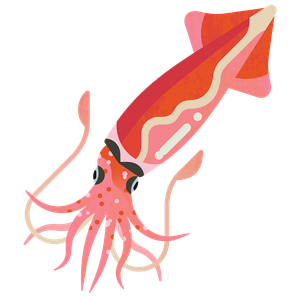
Japanese flying squid
Todarodes pacificus
What to check for
Location
Japan Sea and Pacific Coast
Technical location
Pacific, Northwest, All areas
Caught by
Hook & line (jig)
Rating summary
Japanese flying squid is a resilient species, but there is concern for fishing pressure and biomass. In Japan, there are some management measures to control fishing for Japanese flying squid. However, recent catch limits have been higher than recommendations. Most catches are by jigging. This is a low impact fishing method with no habitat impacts and low levels of bycatch.Rating last updated: December 2021.
How we worked out this Rating
Japanese flying squid is a resilient species, but there is concern for fishing pressure and biomass. Route 2 scoring has been applied to this rating owing to the lack of a stock assessment for the stock as a whole. Japanese flying squid (JFS) is considered to have high resilience to fishing pressure.There are three JFS stocks or cohorts, based on their spawning seasons: summer, autumn (fall) and winter. Autumn and winter are the largest and most important stocks. They are found in the Japan Sea, the Pacific coast of Japan, the East China Sea, and the Yellow Sea of China. The Fisheries Research and Education Agency of Japan (FRA) conducts annual assessments for stocks in Japanese waters but there is shortage of information in Chinese and Korean waters. A 2020 study has estimated the stock status for the species as a whole. A combination of this study and the Japanese assessments have been used to apply stock scoring.In Japanese waters, the spawning biomass (SB) of the winter stock appears to have increased significantly from 40,000 tons in the 1980s to 400,000t in 2010. It has since decreased and in 2020 was estimated to be 56,000 tons. This is well below target levels (SBMSY, 234,000t). The spawning biomass of the autumn stock increased from 70,000t in the 1980s to around 900,000t in the late 1990s, and has since fluctuated widely. In 2020 it was 225,000t, which is also below target levels (SBMSY, 329,000t). A 2020 study indicates that the population of the species is below sustainable levels. Therefore, there is concern for the biomass.Catches of JFS have increased since the 1980s. For the winter stock, they peaked in 1996 at around 250,000t and started to decrease in 2016. Catch in 2019 was around 64,000t. In Japanese waters, fishing mortality (F) has been higher than levels associated with Maximum Sustainable Yield (FMSY) since 2014 (except in 2017). For the autumn stock, catches peaked in 2005-2006 at nearly 400,000t, and have been declining since. The catch in 2019 in was an estimated 198,000 tons. Fishing mortality has fluctuated but is currently above FMSY. Therefore, there is concern for the fishing pressure.
In Japan, there are some management measures to control fishing for Japanese flying squid. However, recent catch limits have been higher than recommendations and the stock is overfished. Japanese flying squid (JFS) is caught in the northwest Pacific, Sea of Japan, Yellow Sea, and East China Sea by Japan, North Korea, South Korea, China, Taiwan, and Russia. There is limited information about Chinese catches and so the impact of the different fleets and management measures on the stock as a whole is difficult to determine. There is no joint management plan that covers all areas and all fleets. Stock assessments are carried out for JFS in Japanese waters, but not elsewhere.Japan’s fisheries management is structured around a fishing rights system for coastal fisheries, and a licencing system for offshore and distant waters. Management measures include input control (restriction of fishing effort), output control (restriction of catches) and technical control (restriction of fishing gear and areas), as well as voluntary regulations.The Japanese flying squid is mainly regulated through a catch limit (Total Allowable Catch, TAC). The annual TAC is set by the government through a process that weighs a combination of socioeconomic factors and the ABC (Acceptable Biological Catch) recommended by researchers. Pre-season scientific surveys are conducted by the Japanese Research Agency to assess the distribution of the stocks, the number of recruits and specific biological parameters. The TAC is shared among the major fleets. In 2018, the FRA started to adopt Maximum Sustainable Yield as an explicit fishery target for efficient management of the stocks. However, TACs are often set higher than recommendations. The two squid cohorts (autumn and winter) are overfished and subject to overfishing. According to the FRA, they will not recover to target biomass until 2025-2030, and only if fishing pressure is reduced. Therefore, management is not currently protecting the stock from overexploitation.The Fisheries Agency and the Coast Guard of Japan closely cooperate to conduct monitoring and surveillance of fishing activities in Japan. The Fisheries Agency also conducts on-board inspections of foreign fishing boats operating in Japan’s EEZ based on bilateral agreements to make sure they comply with license terms. Since 2012 Japan's designated vessels which operate in offshore and distant waters are requested to use the Vessel Monitoring System (VMS) in order to ensure monitoring and management measures. This monitoring and enforcement system seem to be effective.In 2019, the North Pacific Fisheries Commission (NPFC) adopted a conservation and management measure for the Japanese flying squid fishery. However, it is unclear how this resolution is being applied. It includes a requirement to freeze the number of vessels fishing for JFS, use Vessel Monitoring Systems, and support work to develop stock assessments.
Jigging is a low impact fishing method with no habitat impacts and low levels of bycatch. The Japanese flying squid (JFS) is fished using several fishing methods but jigging represents the bulk of the catches, although it varies by region.As jigs are set near the surface (0-50m deep), there is no impact on the seabed. Jig fisheries tend to be a highly selective fishing method, with a discard rate of 0.1% for the squid fisheries.Reports indicate that squid fishing both with and without lights is highly selective gear type and there is virtually no bycatch of fish, seabirds, or marine mammals. Specific information is scarce. During an observer program on Chinese and Japanese squid vessels in New Zealand in 1999, no seabirds or marine mammals were seen by observers to be injured or killed as a result of fishing operations.Predators of JFS are numerous, including many species of marine mammal such as the short-finned pilot whale, other toothed whales, baleen whales, northern fur seal, rays, dolphin fish, chub mackerel, jack mackerel, and skipjack tuna. The fishery has the potential to impact on populations of those species that depend on the JFS for prey, but there is no information to quantify the level of impact.
References
AFMA, 2016. Australian fisheries management authority. Australian government. Squid jig. Available at: http://www.afma.gov.au/portfolio-item/squid-jig [Accessed on 02.12.2021].Arkhipkin, A.I., Rodhouse, P.G.K., Pierce, G.J., Warwick Sauer, Mitsuo Sakai, Louise Allcock, Juan Arguelles, John R. Bower, Gladis Castillo, Luca Ceriola, Chih-Shin Chen, Xinjun Chen, Mariana Diaz-Santana, Nicola Downey, Angel F. González, Jasmin Granados Amores, Corey P. Green, Angel Guerra, Lisa C. Hendrickson, Christian Ibáñez, Kingo Ito, Patrizia Jereb, Yoshiki Kato, Oleg N. Katugin, Mitsuhisa Kawano, Hideaki Kidokoro, Vladimir V. Kulik, Vladimir V. Laptikhovsky, Marek R. Lipinski, Bilin Liu, Luis Mariátegui, Wilbert Marin, Ana Medina, Katsuhiro Miki, Kazutaka Miyahara, Natalie Moltschaniwskyj, Hassan Moustahfid, Jaruwat Nabhitabhata, Nobuaki Nanjo, Chingis M. Nigmatullin, Tetsuya Ohtani, Gretta Pecl, J. Angel A. Perez, Uwe Piatkowski, Pirochana Saikliang, Cesar A. Salinas-Zavala, Michael Steer, Yongjun Tian, Yukio Ueta, Dharmamony Vijai, Toshie Wakabayashi, Tadanori Yamaguchi, Carmen Yamashiro, Norio Yamashita & Louis D. Zeidberg (2015) World Squid Fisheries, Reviews in Fisheries Science & Aquaculture, 23:2, 92-252. https://www.tandfonline.com/doi/full/10.1080/23308249.2015.1026226Burgess, J. and Blezard, R.H., 1999. Observer reports from squid-jigging vessels off the New Zealand coast 1999. Conservation Advisory Science Notes No. 255, Department of Conservation, Wellington. Available at https://www.doc.govt.nz/Documents/science-and-technical/casn255.pdf [Accessed on 02.12.2021].FisheryProgress, 2021. East China Sea and Yellow Sea Japanese flying squid – trawl. Available at https://fisheryprogress.org/fip-profile/east-china-sea-and-yellow-sea-japanese-flying-squid-trawl-0 [Accessed on 01.12.2021].FRA, 2021a. Japanese flying squid (winter outbreak system group). Available at: http://abchan.fra.go.jp/digests2020/simple/2020_18.pdf [Accessed on 01.12.2021].FRA, 2021b. Japanese flying squid (autumn outbreak system group). Available at: http://abchan.fra.go.jp/digests2020/simple/2020_19.pdf [Accessed on 01.12.2021].Kelleher, K. 2005. Discards in the world’s marine fisheries. An update. FAO Fisheries Technical Paper. No. 470. Rome, FAO. 2005. 131p. Available at https://www.fao.org/3/y5936e/y5936e00.htm [Accessed on 02.12.2021].Jereb, P. & Roper, C.F.E. (2010). Cephalopods of the world: An annotated and illustrated catalogue of cephalopod species known to date. Volume 2. Myopsid and Oegopsid Squids. FAO 2010. 649 pp. Available at https://www.fao.org/3/i1920e/i1920e.pdf [Accessed on 02.12.2021].Martí, C., Vallerani, M. & Ojamaa, P. (2017). Research for PECH Committee – Fisheries in Japan, European Parliament, Policy Department for Structural and Cohesion Policies, Brussels. Available at https://www.europarl.europa.eu/RegData/etudes/STUD/2017/601995/IPOL_STU(2017)601995_EN.pdf [Accessed on 01.12.2021].NPFC 2019: North Pacific fisheries Commission. CONSERVATION AND MANAGEMENT MEASURE FOR JAPANESE SARDINE AND JAPANESE FLYING SQUID. CMM 2019-11 (Entered into force 29 November 2019). Available at: https://www.npfc.int/system/files/2019-11/CMM%202019-11%20FOR%20JAPANESE%20SARDINE%20AND%20JAPANESE%20FLYING%20SQUID.pdf [Accessed on 01.12.2021].SeaLife Base (2021). Japanese flying squid (Todarodes pacificus). Available at https://www.sealifebase.se/summary/Todarodes-pacificus.html [Accessed 09.03.2021].Sustainable Fisheries Partnership, 2018. Japanese flying squid: East China Sea and Japan Sea. FishSource profile. In: FishSource [online]. Updated 16th October 2018. Available at https://www.fishsource.org/stock_page/1183 [Accessed 09.03.2021].Wang, Y., Liang, C., Wang, Y., Xian, W. and Palomares, M., 2020. Stock Status Assessments for 12 Exploited Fishery Species in the Tsushima Warm Current Region, Southwest Japan and East China, Using the CMSY and BSM Methods. Frontiers in Marine Science. https://doi.org/10.3389/fmars.2020.00640.

Sustainable swaps
Learn more about how we calculate our sustainability ratings.
How our ratings work